|
Young people from all
over the world are finding ways to combine international
travel with practical farming experience.
|
|
Amy Sisti had been working with cheese
for six years in some of New York City's finest restaurants
and retail shops when she decided she "wanted to get
back to the roots of it all."
"I always loved learning about the stories behind different
types of foods," Sisti recalls. "One of the things
I liked about cheese is that it has great stories—but
I felt like I needed to be more directly acquainted with those
stories."
Through a group called Women Chefs & Restaurateurs, Sisti
learned about an internship program at the Tenuta di Spannocchia,
an educational center, organic farm and guest house in Tuscany,
Italy. Spannocchia offers three-month internships to young
people interested in getting hands-on experience in organic
farming and in what might be called sustainable agritourism
management. Sisti applied, was accepted and set off on what
turned out to be one of the best experiences of her life.
Working and traveling in Italy not only gave her the connection
to the land she was looking for, she says, it also deepened
her understanding of cheesemaking and strengthened her contacts
within the world of farmstead cheese production.
"The Spannocchia program is really well designed,"
she says enthusiastically. "We worked hard, but we also
had a lot of free time," she adds, explaining that Spannocchia
interns attend Italian classes twice a week and take regular
field trips to other organic farms in the region. Ten interns
are accepted each session: two to work in guest services,
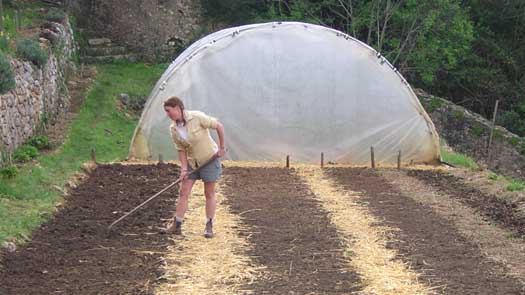
two in the vegetable gardens, one as a shepherd, two with
the other animals, one in the wood lot, one in the vineyard
and one as an all-rounder.
The Spannocchia internship is becoming increasingly competitive,
says Carrie Curtis Sacco, the organization's education director—and
not just because people have romantic images of life under
the Tuscan sun. Sisti and her fellow interns are representative
of a growing group of young people from all over the world
who are keen to enrich their knowledge of sustainable food
and farming systems by combining international travel with
practical farm work. Fortunately, the range of opportunities
for international sustainable ag training—formal and
informal, practical and theoretical, short-, long- and medium-term—is
increasing as well.
The WWOOF model
In the early years of the organic movement, one of the few
ways to gain international organic farming experience was
through WWOOFing—short-term work in exchange for room-and-board
arrangements made through a membership network originally
known as Working Weekends on Organic Farms. Founded in 1971
by Sue Coppard, a London secretary looking for inexpensive,
rewarding short breaks in the countryside, the WWOOF name
was later broadened to Willing Workers on Organic Farms (to
reflect farmstays longer than a weekend) and more recently
to (to soothe the concerns
of some countries' immigration authorities).
|
The WWOOFing movement has spread to some 60
countries, with hundreds if not thousands of
farms and volunteers participating each year.
These days "the sun probably never sets
on WWOOF."
|
|
|
From those modest beginnings, the movement has spread to
some 60 countries, with hundreds if not thousands of farms
and volunteers participating each year. At least 17 countries
now have their own national WWOOF organizations, while another
40 or so are grouped as "WWOOF Independents." While
some of the latter have just a single participating farm (Cameroon,
Estonia, Singapore), others, like France and Spain, have well
over a hundred farms on their lists. As the WWOOF UK website
puts it, these days "the sun probably never sets on WWOOF."
The popularity of WWOOFing seems to have been expanding faster
in the past decade or so, keeping pace with the extraordinary
growth of the organic sector generally. WWOOF Italia, for
example, has grown from 23 host farms in 1999 to 230 in 2005,
according to its coordinator, Bridget Matthews. (The Tenuta
di Spannocchia is one of them.) Fran Whittle of WWOOF UK,
which also administers the WWOOF Independents, reports that
the first international WWOOF conference, held in 2000, attracted
participants from 15 countries. New WWOOF groups have recently
been formed in Turkey, Mexico, Slovenia and the Czech Republic.
(Past issues of The New Farm have featured columns by WWOOFers
traveling in Costa Rica, India, and beyond. "Jason
and Derek reflect on their travels" , for example,
includes an informative summary of the ups and downs of WWOOFing.)
Aspiring organic farmer Hope Temple, a native of Virginia
who went WWOOFing for the first time in New Zealand in February
and March of 2005, says her primary goal was to learn more
about medium- to large-scale, grass-based sheep and cattle
production—sectors in which New Zealand excels. She'd
also heard "phenomenal things about the land itself—mountainous,
undeveloped, rural, and beautiful." She wasn't disappointed.
She worked on four farms, ranging in size from 150 acres to
70,000 acres, for a total of six weeks—three weeks on
one and a week each on three others. "My experiences
included mustering 3,000 sheep from a 900-acre 'block' in
the early morning, shearing sheep using clippers, and driving
sheep through the working pens to sort lambs from mothers,
sick from healthy, young from old," she recalls.
Temple's advice to prospective WWOOFers is to "research
carefully and reach out, early, to a large number of farms.
I have a significant farming background, so this helped me
get selected for stays in some more competitive places."
As with any type of travel, she adds, you need to ask yourself
what you want to get out of it: "education, vacation,
a diversity of experiences, or a more grounded, in-depth experience.
Working on a large number of farms will give you less knowledge,
but you will see more examples of farming and probably, literally,
more of a country."
One complaint occasionally heard about WWOOFing is that at
least in some countries, the farms that accept WWOOFers—read,
put up with unpredictable and at times unreliable volunteer
labor—include a disproportionate number of "lifestyle"
farms run by ex-pats, as opposed to production-oriented family
farms more typical of the host country. But programs and participants
vary widely. In New Zealand, for instance, according to Temple,
WWOOF listings included everything from small yoga retreat
centers to vast sheep ranches, not all of them organic. WWOOFing
demands flexibility and open-mindedness on the part of both
host farmers and farm volunteers, WWOOFers say, and can lead
to many wonderful as well as occasional not-so-wonderful experiences.
Perhaps most importantly, WWOOF UK’s Whittle points
out, as a movement the organization has contributed thousands
of hours of labor and innumerable exchanges of insight and
good will to the collective force of organic stewardship.
MESA goes reciprocal
At the other end of the time-commitment spectrum, the Peace
Corps has long served as an introduction to international
sustainable agriculture work—and, anecdotally speaking,
has prompted many a former volunteer to pursue organic farming
upon their return home. A handful of other organizations,
such as the Foundation for Sustainable Development (),
sometimes described as the "alternative Peace Corps,"
organize similar service opportunities for Americans abroad.An
exciting recent development in the world of international
sustainable ag training is that the nonprofit Multinational
Exchange for Sustainable Agriculture (MESA) (),
which for the past decade has been helping young people from
developing countries find apprenticeships on organic farms
in the United States, has established a reciprocal program
for U.S. citizens interested in working on organic farms overseas.
Based in San Francisco, MESA is, according to executive director
Lauren Augusta, the only U.S. State Department-recognized
agricultural exchange program with an emphasis on sustainability.
(State Department recognition permits the group to arrange
one-year J-1 visas for participants coming to work on farms
in the United States.) Its stated mission is to "cultivat[e]
sustainable farming communities around the world through farmer-to-farmer
exchange."
This year the group is sponsoring its largest group of foreign
trainees "by far," Augusta says: 44 interns from
five different countries training on about 35 organic farms
and research centers across the United States. To select trainees,
MESA partners with local sustainable agriculture organizations
in countries like Ecuador, Peru, Thailand, and Mexico; over
the years, Augusta explains, those relationships naturally
led to the idea of arranging for trainee exchanges in the
other direction.

|
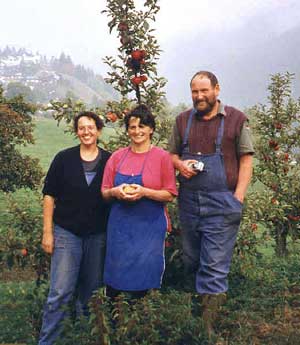
Frequently, MESA trainees form strong bonds
with other participants, partner organizations
and host farms.
|
|
MESA's first overseas sustainable agriculture program, beginning
in January 2006, will be an eight-week work-and-training experience
on organic farms in the Galápagos Islands of Ecuador.
The program is the result of a partnership with FUNDAR Galápagos
(the Fundación para el Desarrollo Alternativo Responsible
para Galápagos) and is being coordinated by a former
MESA volunteer who grew up in the islands, Byron Fonseca.
The Galápagos are a unique, exciting setting for an
opportunity of this kind, Augusta notes. Because of the fragility
of the island's biota, access to the islands is tightly regulated,
and most tourist expeditions only stay for three or four days.
"People don't think about there even being farms in
the Galápagos," Augusta comments. "But they
have a big impact on the environment there, and so some groups"—including
FUNDAR Galápagos—"are promoting sustainable
farming there. There's also a big emphasis on getting the
farms to be more productive, so they can import less from
the mainland," she continues.
The Galápagos program will cost participants around
$2,500, including everything but airfare, for eight weeks,
Augusta says. Academic credit is possible on an independent
study basis. In the future, MESA hopes to organize similar
opportunities in mainland Ecuador, Argentina, Thailand and
Kenya.
Potentially, MESA's reciprocal exchange and other programs
like it could fill a niche between long-term Peace Corps stints
and short-term WWOOFing experiences, Augusta suggests. "WWOOF
is very ad hoc—it has almost no central administration,
and offers no support in terms of visas or longer stays,"
she points out. On the other hand, the fact that a number
of reciprocal exchanges have already developed out of individual
MESA trainee experiences (and without formal MESA’s
assistance) suggests that the ad hoc approach may, in many
cases, be a perfectly satisfactory way to for these kinds
of interactions to develop.
"Frequently, MESA trainees form such strong bonds with
the participants and the partner organizations and the host
farms that setting something [additional] up, either formally
or informally, is definitely an option," Augusta concludes.
"[So] that's something I grapple with--how much does
MESA need to coordinate this?"
Junior (farm) year abroad
Another potential route for gaining international sustainable
ag training lies through university exchange programs, or
by applying directly to overseas academic institutions. A
number of undergraduate (conventional) agriculture programs
at U.S. universities do offer study-abroad opportunities,
and presumably, as the number of sustainable ag-oriented degree
and certificate programs increases, so too will the number
of study-sustainable-ag-abroad programs.
Study-abroad opportunities consistently rank high among the
program features sustainable ag students say they want, says
Albie Miles of the Center for Agroecology and Sustainable
Food Systems, which operates a six-month organic farming and
gardening apprenticeship at the University of California in
Santa Cruz and has taken a leadership role in coordinating
discussions about sustainable agriculture education in the
United States. (The Santa Cruz apprenticeship is open to international
applicants as well as to U.S. and Canadian citizens.)
The first National Sustainable Agriculture Education Conference
will be held in January 2006, in Pacific Grove, California,
just prior to the annual Eco-Farm Conference, Miles notes,
and although the conference is focused on U.S. sustainable
ag education, a few participants will be coming from overseas,
including representatives of the Nordic School of Agroecology/Ecological
Agriculture (AGROASIS), a joint project of universities in
Norway, Denmark, Sweden, Finland and Iceland.
A number of institutions of higher education across Europe—including
the University of Wales at Aberystwyth, the Scottish Agricultural
College, and the Institute of Organic Agriculture at the University
of Bonn, Germany--have established degree programs in sustainable
and organic agriculture. Many of these programs accept applications
from international students, although proficiency in the relevant
language will be a prerequisite. A partial list of undergraduate
and graduate (BSc and MSc) organic agriculture programs in
Europe can be found on the website of the (ENOAT).
A diploma in biodynamic farming
One of the most distinctive new international training courses
in organic agriculture is found at a small school called Emerson
College in East Sussex, England. Founded in 1962 by Francis
Edmonds, Emerson is dedicated to the teachings of Rudolf Steiner
and has been offering various levels of training in biodynamic
gardening and farming for decades. (Some of the oldest and
most successful biodynamic farms in the United States were
started by farmers originally trained at Emerson, and—small-world
fact—Sue Coppard's first WWOOFing weekend back in 1971
took place at the college.)
|
"Here you're totally immersed in organic
and biodynamic philosophy, and you're part of
a community. It's not like going to a regular
university."
|
|
|
In 2000, the college was approached by the Warmonderhof Training
Center at Groenhorst College in the Netherlands about creating
an English-language version of Warmonderhof's vocational training
course in biodynamic agriculture, which dates back to 1947.
The Warmonderhof course is taught in Dutch and primarily serves
Dutch students in their late teens and early twenties. By
partnering with Emerson, explains course co-leader Juergen
Schumacher, the Dutch college sought to meet a growing demand
for formal, hands-on training in biodynamic and organic farming
among a much broader demographic.
Supported in part by a grant from the European Union's Leonardo
da Vinci II program for vocational training, the collaboration
between the two schools resulted in the creation of a three-year
course in biodynamic agriculture leading to what's known as
a Level 4 diploma, a vocational qualification recognized throughout
the EU. (The college is looking into obtaining BSc accreditation
as well.)
"We're the only English-language training course of
this kind," says Ian Lawton, marketing and short-course
manager for the college, which also offers Waldorf teacher-training
and has up to 200 students in residence at a given time. "Here
you're totally immersed in organic and biodynamic philosophy,
and you're part of a community. It's not like going to a regular
university."
An emphasis on internationalism
Students in Emerson's biodynamic agriculture course come
from all kinds of different backgrounds, Lawton and Schumacher
note. Most are in their late twenties and early thirties,
but some are as young as 18 or as old as 50. Some have farmed
all their lives; others may not even have extensive gardening
experience. Some arrive well-versed in the teachings of Rudolf
Steiner, having attended Waldorf schools or worked in a Camphill
community; others come with experience in organic farming
but with no real knowledge of biodynamics.
The first group of students, admitted in the fall of 2001,
included two Americans; other students have come from Brazil,
Israel, and Scandinavia, as well as Britain and elsewhere
in Europe.
Schumacher, who received formal training in both conventional
and biodynamic agriculture and managed his own biodynamic
farm in Germany for 20 years in addition to working as an
accountant and tax advisor before coming to Emerson, says
that he values the diversity of the student population enormously.
"It's not so easy sometimes at the beginning to get
everyone together," he admits, "but it works out
before long. I'm very, very happy to have this kind of variety,"
he continues, noting that frequently the less experienced
students ask fundamental, challenging questions that may not
occur to those who have been farming for years.
The course of study embraces everything from tractor operation
and maintenance to bookkeeping, personnel management, botany
and soil science. Tuition is £3,750 (about $6,800) each
for years one and two and £2,500 ($4,500) for year three;
room and board runs another £2,500 to £3,000 ($4,500
to $5,440) per year. Students spend six semesters at Emerson
and do a five-month placement between their first and second
years working on another biodynamic farm of their choice.
In their final year, students contact a local conventional
farm and do a comprehensive study of what it would take to
convert that farm to biodynamic management, from production
to marketing.
By training at the college, says Schumacher, students gain
a rigorous theoretical grounding in biodynamics as well as
a comprehensive set of practical farming skills. "Here
it is combined--half is practical and half is theoretical,"
he explains, noting that exclusively on-the-job training for
young farmers can sometimes lead to practical proficiency
without a full understanding of underlying agroecological
principles.
To foster that balance between classroom and field, Lawton
says, Emerson has constructed new facilities and established
a 5-acre biodynamic market garden at the college. Additional
training takes place at the 250-acre Tablehurst Community
Farm, a diversified biodynamic grain-and-livestock farm located
adjacent to the college, and at Bore Place, an organic dairy
farm 15 miles away. Field trips are also made to other organic
farms, including Warmonderhof.

|
Perhaps the best measure of the biodynamic
agriculture course's potential is the wealth
of job prospects open to its graduates.
|
|
Perhaps the best measure of the need for a course like this
is the wealth of job prospects open to its graduates, Schumacher
says. Whereas the number of conventional farm manager positions
has been declining for many years, openings in organic and
biodynamic farming are rising steeply. Every week, the college
receives job postings from throughout northern and western
Europe, the United States, Canada, and even as far away as
New Zealand.
"The world is short of qualified people—people
who really want to do the job; not consultants but practical
people," Schumacher emphasizes. "We have a huge
pin board [for posting job announcements] and it's full all
of the time--it never gets empty. All of our graduates have
a choice of what to do."
And although the Emerson program is small—to date it
has graduated two classes of about a dozen students each—before
long, it and other nascent training opportunities of its kind
will help shape the future of organic farming worldwide.
As Schumacher puts it—in an observation that could
apply to any of the programs described here--"If all
[our graduates] become good farm managers, that will have
an impact." 
| Spannocchia Foundation
Multinational Exchange for Sustainable
Agriculture (MESA)
European Network for Organic Agriculture
University Teachers (ENOAT)
|
Willing
Workers on Organic Farms (WWOOF)
Emerson College Biodynamic Training
AGROASIS
|
|
|
|