|
Posted September 16, 2005: The Manzanares'
connection with Tierra Wools starts at the beginning of April,
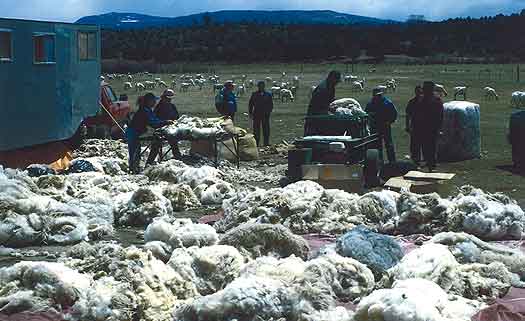
with shearing. Sophia Chavez comes out and makes selections
of the Manzanares' wool and that of other producers. About
70 percent of the wool she buys is from Churro sheep; 30 percent
from Rambouillet. In 2004 the Manzanares sold about 2,000
pounds of wool to Tierra Wools, amounting to well over 90
percent of the wool company's purchases. The remainder came
from the small flocks of a handful of other local producers.
On average, a ram fleece weighs 11-13 pounds, a ewe fleece
eight to nine pounds. Just under a pound of this weight is
lost when the fleeces are "skirted."
The fleeces are sorted according to the fineness of the wool--the
coarser wools are destined for rugs, the finer wools for blankets
and hand spinning. Rug-quality wool fetches $2.50/lb., blanket
wool, $3.50/lb., and the finest hand-spinning wool, $5.00/lb.
Premiums are paid for wool that holds together well or has
a unique color. Chavez says there is a shortage of colored
wools and feels this is a problem that should be worked on.
The going rate for Rambouillet wool on the commodity market
is just 15¢/lb. Antonio points out that this price has
not changed since his grandfather was selling wool 80 years
ago—and in real terms it has dropped substantially.
The price that Tierra Wools pays enables the small sheep producers
to earn a living wage managing their flocks. It also creates
an incentive for them to keep raising Churros.
The price paid by Tierra Wools has fluctuated over the years.
At first, thanks to a government incentive, wool producers
were receiving about $50 per Churro fleece, and the Churro
was increasing rapidly in the area. Around this time, Ganados
del Valle hired two agricultural specialists to help producers
improve their methods, from feeding to keeping the wool clean.
Ganados del Valle also ran a Sheep Share Program, through
which producers could receive 10 Churro ewes in exchange for
agreeing to breed them to a Churro ram and return a lamb (or
its dollar equivalent) to Ganados del Valle every year for
10 years.
When the government incentive ended and fleece prices fell,
these programs also came to an end and Churro numbers started
to decline. Sophia Chavez is now appealing to growers in Colorado
and the Navajo Nation to fulfill Tierra Wools' need for Churro
wool.
Processing the wool
After the fleeces are purchased, they are placed in storage
for up to a year. During this time, they are kept cool so
there is less chance of moth problems developing. They are
also separated from the processed wool so that if moth problems
do develop, the processed wool will not be damaged.
The first step in processing is to wash the skirted fleeces.
Originally the washing was done in tubs outside the Tierra
Wools store filled with boiling water, soap, and washing soda
to soften the fibers. This method was abandoned because it
was slow and ineffective. Later, Tierra Wools began sending
their unprocessed wool to Alamosa, Colorado, to be washed
in a machine called a Sargent Wool Scouring Train, which could
gently clean up to 400 lbs. of wool a day.
Eventually, Tierra Wools bought the scouring train and installed
it at the shop in Los Ojos, but unfortunately this arrangement
also fell short of expectations. To be profitable, the scouring
train needed to be used regularly, but the Los Ojos area was
suffering a prolonged drought and the machine put a strain
on the community's water reserves. Tierra Wools also found
they had neither enough labor to keep the machine in operation
nor enough drying racks to handle the volume of wool being
scoured.
For the past few years, the unprocessed fleeces have been
sent to a facility in Texas in burlap bags containing about
105 lbs. of wool each. There they are cleaned and washed using
natural detergents and a small amount of washing soda.
After washing, the wool goes to the Taos Valley Wool Mill
to be carded and spun. Carding is the combing and blending
process done in preparation for spinning, and it must be done
differently for different types of wools. With the shorter
Rambouilett fibers, a "woolen" process is used,
whereby the fibers are laid in a cross-thatched pattern before
spinning. For the longer-fibered Churro, a "worsted"
system is used, with the fibers laid horizontally.
About 80 percent of the Churro wool is spun into yarn at
the mill in Taos. The remaining Churro wool is hand spun by
Tracy Martinez at the Tierra Wools’ store.
Through the skirting, washing, carding and spinning process,
the wool loses about half of its original weight. Most of
this loss is due to the dirt, grease and other debris removed
during washing. A small amount is lost when short, excess
fibers are not taken up during the carding process.
The gentle processing that Tierra Wools uses for all its
wool is superior in a number of ways to the processing methods
used by most of the industry. Tierra Wools' processing uses
natural soaps and washing soda and air drying. Conventional
processing involves cleaning with chemicals such as sulfuric
acid and alkali and oven drying. Although conventional processing
is cheaper and faster, it can weaken the wool fibers and make
them brittle. It can also leave chemical residues in the wool
with potentially unhealthy effects, especially for sensitive
individuals.
Tierra Wools' transporting and processing costs are high
and can raise the price of the wool to four or five times
that of conventional. Chavez says for rug-quality yarn, the
carding and spinning alone costs from $4 to $6/lb. For thinner,
blanket-weight yarn, the price goes up to $8/lb. (thinner
yarns have more yards per pound). Hand-spun yarn costs even
more.
Dyeing the yarn
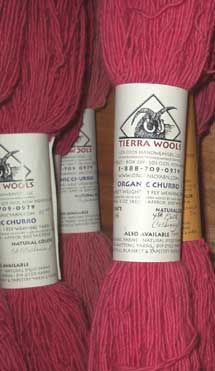
After the wool is made into yarn, it is ready to be dyed,
either with natural or commercial dyes. Natural dyeing takes
longer and produces a more expensive yarn--whereas the natural
process dyes 10 to15 lbs. of yarn a day, commercial dyeing
can color as much as 150 lbs/day.
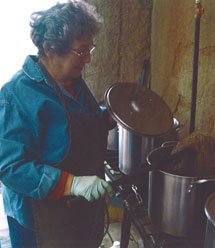
The natural dyeing is done by Lupe Valdez in a back room
of the store using locally collected wild plants and purchased
natural dyes. Before applying the dye, Valdez dips the yarn
in a hot mordant bath of alum and cream of tartar to help
the dyes take hold in the fibers. She then simmers the yarn
in a series of hot dye baths to obtain a variety of colors.
A local plant called cota is used for golds, another called
yerba de la negrita for yellows, walnut husks for browns.
Reds come from imported cochineal beetles, and are unusual
in that successive dye baths lighten rather than darkening
the reddish color. For indigo, Valdez places the skeins in
tubs to which sugar, bran, nitrogen and oatmeal are added
every couple of weeks to feed a bacterial culture that breaks
down the water-insoluble indigo powder, releasing its dyeing
action.
Valdez gathers most of the local dye materials herself.
“I like to get the chamisa when it first starts opening
and it looks green underneath," she explains. "I
have never gathered any when the plant turns brown. I figure
that it doesn’t have good color anymore.” To get
the dye color out of the plants she boils them for one hour.
She blends the dyes from different sources to produce intermediate
colors.
Using natural dyes means that each batch of color is unique.
“I don’t get the colors exact," Valdez says.
"I only get what the plants will give me. A lot depends
on the season, on the moisture and minerals in the water and
soil.” In addition to the variability within the dyes,
the yarn itself will vary in its dyeing characteristics. Valdez
says the Churro wool grabs dyes and accepts color better than
the Rambouillet.

The natural, seasonal variations in dye materials, wools
and the dyeing process mean that every skein of yarn and every
weaving produced at Tierra Wools is unique, a work of art
unto itself.
Dyeing with synthetic or commercial dyes begins with soaking
the yarn overnight in cold water. In the morning, the yarn
is transferred into tubs of boiling water, dye and mordant
heated over a fire of piñon and oak. When the yarn
has taken up all the dye, it is placed on a rack to cool,
rinsed in cold water and then hung to dry. The amount of dye
used and the depth of color achieved are determined by the
dyer.
The sales of different yarn colors are tracked closely in
the shop so that the dyers can adjust their output accordingly.
Sophia Chavez says that some colors, such as reds and greens,
always sell briskly. Even so, it is difficult to keep all
of the colors in stock at all times because the dyeing process
is slow. At other times Tierra Wools cannot keep up with the
dyeing because of a shortage of processed yarn. “This
year we ran out because we didn’t have a place to have
it spun,” explains sales manager Tina Ulibarri.
Weaving and marketing
In the early years of the business, the naturally dyed yarns
didn’t sell well, presumably because of their higher
price. As word of their quality and uniqueness spread, however,
sales picked up. Tierra Wools would like to produce more naturally
dyed yarn, but Chavez feels it is important to carry the more
affordable, commercially dyed wool as well, so "there
is something that everyone can afford."

Ulibarri says most people are interested in the Churro wool
for weaving and Rambouillet for knitting. They're also interested
in the wool colored with natural dyes—about 70 percent
of the wool products that Tierra Wools sells are colored with
natural dyes. The naturally dyed wool fetches $5 to $10 more
per skein, and also increases the value of the weavings made
from it, especially if it is Churro wool.
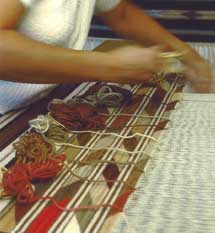
Over the years, Tierra Wools has developed the talents of
many weavers through its training and apprenticeship programs
and incentives. Behind the looms in the store hang ribbons
and awards from national and international competitions. "This
is a dream that has developed over the years," says Angie
Serrano, one of the original Tierra Wools weavers. "I
was a hobby weaver. When Tierra Wools opened its doors, I
refused to be left behind.”
Apprentice weavers begin with simple designs and progress
to a tapestry. Laura Monroe, a former school teacher, went
through the three-month training and has been honing her skills
for the past year and a half. Of her experience at Tierra
Wools, she says, “I have freedom and can work when I
want, on what I want, with no federal mandate.”
Tierra Wools currently has 12 weavers. Two, Teri Garcia and
Pauline Moya, have been with the company for about 10 years
and are now considered master weavers. Each weaver receives
a standard rate based on the quality of their work, with bonuses
available for unique design elements or color changes. "If
it is an exceptional piece" and it can be sold for a
higher price, Chavez explains—say $675 instead of $600—"some
of this increase is passed on to the weaver.”
The weavers are encouraged to do their work on the store
looms during showroom hours, especially on the weekends. The
group has learned that having the looms operating helps educate
customers and motivates them to make a purchase. “When
the customer comes in and sees the weavers, they get really
excited and want to buy something,” says Mary Velasquez,
the Tierra Wools bookkeeper.
Management and sales
Tierra Wools was spun off from Ganados del Valle in 1997,
with the wool producers and weavers forming a limited liability
company, Los Ojo Handweavers, LLC. Under the new structure,
the wool growers, spinners, dyers and weavers assumed control
of the business, sharing profits and losses 50/50 with a group
of outside investors. With the help of the non-profit Regional
Campaign for Human Development, an equity account has been
set up which matches funds for employees who invest in the
company. So far, more than a third have done so.
Tierra Wools also offers classes in natural dyeing, spinning
and weaving. The School of Rio Grande Weaving Traditions is
extremely popular and brings in funds both through the classes
themselves and through rentals of the “Casitas,"
where the students stay. Classes are limited to four students
per session due to limited space both at the Casitas and on
the looms. Tierra Wools hopes to expand the facilities in
the future and make the school a bigger part of their venture.

Sales at Tierra Wools follow the summer tourist season, with
98 percent of total sales made directly out of the showroom
between June and October. Although a growing number of off-season
visitors, many of them retirees, frequent the store in the
winter, business is very slow. The company's general strategy
is to build inventory through the winter and sell it off in
the summer, but cash-flow problems occasionally force them
to lay off weavers in the slow months, even when they have
enough wool to weave.
Anything that influences tourism--the Cerro Grande fire that
burned Los Alamos, the 2001 recession, the Iraq war, high
gas prices--affects business, and Tierra Wools recognizes
that their isolation is an ongoing challenge. Entering competitions
in the New Mexico State Fair and arranging temporary exhibits
in other towns are some of the ways they seek to attract new
potential customers.
Tierra Wools also sells skeins of yarn via the Internet.
Although still a small part of the business, Internet sales
seem to have potential. The current website is several years
old and has no online ordering facility, just a toll-free
phone number.
A final challenge—but also sign of success—is
that they need to make structural improvements. “When
we bought this building we had a gallery that had a hole in
the wall so that you could see the post office next door,"
recalls Angie Serrano. "Now the roof leaks. We. . . .
used [to use only] the front room for the business and a few
looms, and now we have outgrown the building.”
The members of Tierra Wools are determined to solve these
problems and make their business a success. “Tierra
Wools is a lot of fun but a lot of work," says Lupe Valdez.
"It has many dedicated people, and that is what you need
to make it work.” “We all have a sense of ownership
and take the business to heart," adds Sophia Chavez.
"We are all going through the same struggle and have
to stick together.”
From sheep producers to weavers, the members of Tierra Wools
will continue to move forward, working together to improve
a company that has become a central part of their lives. They
have brought back the Churro and the traditions associated
with it while at the same time forging a model for a vertically
integrated local enterprise using identity-retained marketing.
From organic lamb to high-quality yarn and weavings, these
farmers and craftspeople have closed the loop. As both producers
and marketers, they have restored a way of life. 
Part
I: How a community effort brought back the
Churro breed, and how one local rancher is now raising and
marketing organic Churro lamb
|