|
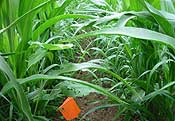
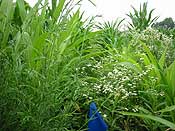
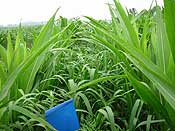
“Damn, that’s a lot of weeds!” is a common response when conventional farmers visit The Rodale Institute® for the first time. Before our farm manager, Jeff Moyer, throws an organic tomato our way, let us assure you that he and the rest of the farm crew do an excellent job with weed management. The point is that many conventional farmers are simply not used to seeing any weeds in their fields at all.
Most organic farmers, on the other hand, are very familiar with their non-crop vegetation. The next comment we usually get from our visitors is, “how do you get such good yields with all those weeds?” Our answer is that, based on our experience and experimentation, weeds in organic crops just don’t compete as strongly as they do with conventional crops.
Part of what we are seeing is that crop-weed interactions can be very different between these two cropping systems. Weed competition appears to be much less in the organic plots than in the conventional plots.
This season at The Rodale Institute we are studying the effects of weeds on corn and soybeans in our Farming Systems Trial, a long-term comparison of organic and conventional farming systems. Part of what we are seeing is that crop-weed interactions can be very different between these two cropping systems.
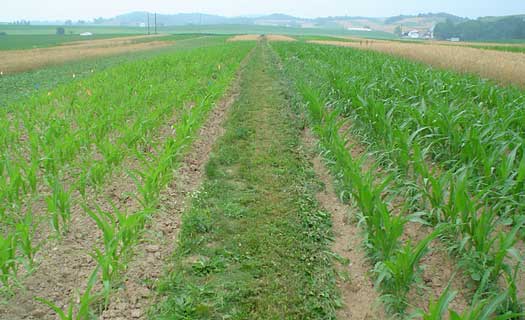
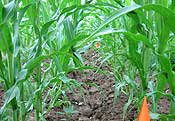
Weed competition appears to be much less in the organic plots than in the conventional plots. Although the organic corn was planted two weeks after the conventional corn, the organic corn is greener, taller, and shows no obvious nutrient deficiency. The conventional corn shows reduced growth, yellowing foliage, and necrosis of the lower canopy, indicating nitrogen deficiency. This pattern emerged following a very dry May and June.
The weed management dilemma
Weeds are a serious problem for farmers because they can reduce crop yields, decrease crop quality, foul equipment, and poison livestock. Costly chemical herbicides, potentially dangerous to both farmers and the environment, are normally used to combat weeds in conventional agricultural systems. Organic farmers generally rely on labor-intensive mechanical methods to remove weeds from their fields.
Farmers also fight weeds for aesthetic or cultural reasons. Many people regard weed control as an index of farming skill, regardless of crop yield or farm profitability. This attitude can lead to excessive weed control—weed control beyond what makes sense economically—which in turn can lead to increased water pollution and herbicide resistance development. Finding a balance between yield loss and excessive management is a challenge faced by farmers every year.
To find that balance we must start with an understanding of how the presence of weeds affects crop yield. Weeds compete with crop plants in three major ways. First, weeds may simply shade out crop plants, resulting in poor growth from decreased photosynthesis. Second, weeds may use up water that would otherwise be available to crop plants. This type of competition is especially important in arid regions and drought years. The third form of competition occurs when weeds use up nutrients that would otherwise be available for crop plants.
Although the organic corn was planted two weeks after the conventional corn, the organic corn is greener, taller, and shows no obvious nutrient deficiency.
The conventional corn shows reduced growth, yellowing foliage, and necrosis of the lower canopy, indicating nitrogen deficiency.
Crop-weed interference has been studied extensively over the past 50 years. Most of this research has examined the effect of a single weed species on specific crop plants under controlled conventional management systems, resulting in "typical yield reduction" indices for various weeds in different crops. Information about yield reduction potential, crop quality loss, and harvesting difficulties is used in combination with data on the costs of weed removal to produce "economic weed threshold" levels.
The economic weed threshold is defined as the weed density at which a control practice is economically justified. This approach acknowledges that at low weed density levels, crop plants are not negatively affected and therefore removal of additional weeds is more expensive than it's worth. Most economic weed threshold values are expressed as number of weeds per area. On a practical level, however, few farmers--conventional or organic--calculate weed thresholds when deciding how to manage weeds on their farms.
Possible explanations for an unexpected result
Okay, back to the tale of two competitions. At The Rodale Institute we occasionally have a field or two where weeds develop prolifically. This is usually a result of poor weather conditions that prevent normal mechanical weed management (rotary hoeings and cultivations). Interestingly, however, in most of these cases our corn crops still yield competitively.
According to the Penn State agronomy guide, these corn crops should suffer massive yield losses. The 2005 agronomy guide, for example, indicates that you can expect a 10 percent corn crop yield reduction when you have 150 pigweed plants per 100 feet of row. Additional 10 percent losses should be expected with 150 lambsquarter plants, 400 giant foxtail plants, or 50 velvetleaf plants. If you add these plant populations and losses up, than you should expect to have a 40 percent yield loss from these 750 weeds per 100 ft row. After many trials examining weed interference with crops, I can assure you that we do not see a 40 percent loss of yield when we have weed populations like that.
You should expect to have a 40 percent yield loss from these 750 weeds per 100 ft row . . . However, in most of these cases our corn crops still yield competitively.
Since most weed-induced yield reduction information and economic weed thresholds have been determined under conventional management practices, the question arises, do organic systems have different economic weed thresholds than conventional systems?
One fundamental difference between conventional and organic farm management that could be affecting crop-weed interactions relates to the understanding and treatment of soil resources. For many conventional farmers, soil is just a substrate to store synthetic fertilizer and hold crop plants in place. Most organic farmers, by contrast, view the soil as a biotic entity that needs to be fed and cared for like any other living organism.
Soil fertility and health are essential to understanding crop-weed competition. In organic production systems, plowed-down cover crops, manures and composts provide nutrients over a longer period of time than do the synthetic fertilizers used in conventional corn and soybean production systems. Research has shown that weeds normally take up synthetic fertilizer faster and in larger quantities than crop plants. Nutrients from organic matter sources that are available for a longer period of time can potentially provide a buffer against nutrient competition. Weeds do not have the opportunity to deplete organic nutritional sources within critical time-frames as they do with use of synthetic fertilizers.
Soils on organic farms also typically have increased organic matter, which allows more rainwater to penetrate and be retained than in soil with lower OM levels. Because organically managed soils hold more water and nutrients, it is likely that crop-weed competition will be reduced.
Another reason why weeds may reduce crop yields in conventional systems more than in organic systems is because organic farmers tend to plant later than conventional farmers. Conventional farmers can use seeds treated with fungicides, allowing them to plant into cool, moist soils in early spring without having the seed rot before it germinates. By the time organic corn is planted, the soil is warmer and the plants grow more quickly, making it more competitive against weeds than slow-growing conventional corn. The organic crop is likely to reach canopy earlier, reducing competition for sunlight.
A closer look
These are more than just hypotheses. After 25 seasons comparing organic and conventional corn and soybeans, we have found that there is no significant difference between organic and conventional crop yields. This occurs despite the significantly increased weed biomass typical of the organic systems compared to conventional systems. Long-term data from the Farming Systems Trial shows that excessive weed infestations do indeed cause reductions in corn yields, but only when the dry weight of the weeds exceeds 4,000 pounds per acre.

After 25 seasons . . . we have found that there is no significant difference between organic and conventional crop yields. This occurs despite the significantly increased weed biomass typical of the organic systems.
We are currently conducting more studies to investigate weed thresholds in organic and conventional corn and soybean fields. Within the Farming Systems Trial, we have set up an experiment with four treatments—weed-free, additional weeds added, normal weed management, and no weed management—in order to evaluate crop yield and quality under different levels of weed infestation. This study will be used to resolve this issue of differences in weed-crop competition, but will also be useful to determine effectiveness of normal weed management practices and to see if differences exist in the types of weeds present in organic and conventional fields.
Our weed management research is part of a larger collaboration between The Rodale Institute, Dr. John Teasdale from the USDA-ARS Sustainable Agricultural Systems Laboratory and Dr. Dave Mortensen from the Penn State Weed Ecology Laboratory (click here for more on the collaboration). Additional trials are seeking to evaluate the relative weed tolerance of different corn and soybean varieties. These trials are now in their third season and we hope to soon have the ability to make recommendations on commercial varieties that are notably weed tolerant. So stay tuned.
|