|
|
Just
a beginning…
Palestinian stories needed
Editor’s Note: Yigal Deutscher set out
to profile the best examples of agrarian, ecological,
community-based and place-centered agriculture
in Israel that he could find. Thanks to family,
the organic community network and a willingness
to follow even mysterious leads, he turned in
a robust handful of compelling stories. This is
the fourth story in a six-part series.
Yigal (who is Jewish) and I agreed from the get-go
that he would avoid the fractious and murderous
politics of Israel-Palestine as much as possible.
He’s done that, but he’s also been
true to the lives of the people he’s talked
to. As this week’s story shows once again,
contention over the land permeates life in the
region on many levels. He took a risk to do this
story, and was rewarded with just a glimpse into
the lives of non-Jewish farmers in one area.
Palestinian farmers continue to suffer loss of
their critical olive trees, ancient fields and
homes from Israeli military activity, carried
out in the name of security for Israel. They have
suffered loss of water rights that cripples production
in many areas. The tall concrete security wall
designed to protect Israelis from terrorist attacks
is still being expanded, increasing the difficulty
and resentment of Palestinian farmers separated
from access to their land and/or markets.
Yigal’s stories are a beginning to document
the personal lives and struggles of farmers in
the region. These agriculturists live within their
political and religious context as do farmers
everywhere: some farmers fully engaged in the
strife around them, some affected despite their
wishes not to be, some determined to rise above
partisanship through courage to build community
through sharing land, food and hope.
We welcome a similar series on Palestinian or
Arab farmers in Palestine/Israel, done with equal
determination to focus on farming first, but also
reflecting the reality of being on the land in
the midst of conflict.
Maybe…maybe the fragile steps of early
February 2005 will create openings for farmers
on both sides to farm more and worry less. –
Greg Bowman, online editor
|
|
|
Where we are:
NORTHERN
Arrasid micro-farms, Sachnin

This NGO started by Laithi is located in the
Palestinian village of Sachnin in the El-Batuf
valley of Northern Israel.
Editor's Note:
Yigal Deutscher had already spent the summer
of 2003 training in sustainable agricultural
and Jewish spirituality when he came to our website
and noticed our standing challenge to:
Help
us find farmers from many nations willing to tell
their stories in small doses over time, as their
lives unfold and their farms develop.
He set high goals, and he delivered
in finding and profiling farmers who are making
a difference. In this contested land with its
millennia of occupations, ravages and civilizations,
farming with ecological foundations faces harshness
from the climate, political tension and a conventionally
oriented food economy.
The journey begins in the southern
deserts, leads us north through the West Bank
and continues all the way up until we near the
Lebanon/Syria borders. (Click
here for complete series line-up.)
Where we have been:
SOUTHERN
Elaine
Solowey at Kibbutz Ketura is a California
native. Elaine Solowey is a scientist with a mission,
evaluating plants from around the world in the
harsh Arava desert. She wants to discover "small
steps towards abundance" (her book title)
for the coming years of harsher climates around
the world.
"The well-being
of the world depends on agricultural stability
and health. No one seems to understand this."
Kibbutz
Neot Smadar –
About 20 years ago, a group of unacquainted
urbanites formed to explore issues of community:
what is means and how is it formed. The place
is an experiment to live out what they’ve
agreed upon -- a healthy community based on self-sufficiency
that includes organic orchards and farms, natural
building, a flock of goats, and much more.
“[The organic
farmer] made it all seem like a puzzle to us,
the connections he was trying to make between
plant and earth, plant and plant, human and earth.
This was his lifework, a never ending one."
WEST
BANK
Moshav
Itamar: Alon and Rachel Zimmerman at
This West Bank farming couple coaxes an agricultural
existence from a no-man’s land between Arab-controlled
Nablus (Shechem). and an Israeli army firing zone.
Conflict forced changes in crops and marketing
that led Alon to devise highly integrated, self-sufficient
system of crops, fish, microclimates and livestock.
His fingers wrap around
a silver goblet, full with dry red wine, reflecting
the eyes of those peering in. A drop escapes and
trickles over the side. Prayer sanctifies the
wine, which sanctifies the moment.
Where we are going:
NORTHERN
Beit Elisha at Kibbutz Harduf …is
Israel's only Biodynamic farm, but one so large
that it is also the country's largest supplier
of organic produce, from veggies to cheeses. It
is also a working agricultural kibbutz -- one
of the last in Israel -- whose wholistic environment
provides a healing medium for members with developmental
disabilities.
"Everything needed
to sustain and allow the continuation of creation
is already here, given to us with the first light.
All we have to do is harness it, gather a small,
potent dose and apply." Gadi, farmer.
|
|
|
 |
"Everything
is politics in this land. When you eat, you eat politics.
When you drink, you drink politics. You can't even breathe
the air without suffocating on politics,"
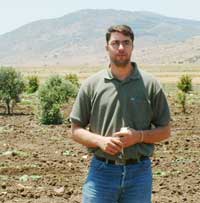
Laithi bluntly tells me when we first meet. And I am already
dreading to hear his words. But instead we watch silently.
In the distance, the air is oily, as if the ground underneath
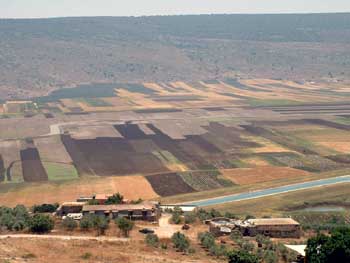
was made of burning coals. The El-Batuf valley spreads out
like an old patchwork quilt, with different shades of rectangular
greens, grays, and browns stitched together.
The national water carrier snakes through the valley. The
cement-lined channel is sparkling blue, filled with the clean
waters of the nearby Lake Kineret, on its way to the more
arid southern reaches of the country. Parallel to this is
the valley's rainwater catchment canal. It is a sprawling
grey, muddy mess. Every winter, the valley is flooded with
rainwater, destroying the fields. The canal was dug to harness
such potential, to turn it from destructive to creative. The
waters still flood the valley. The water in the canal is polluted
with pesticides and chemical fertilizers, animal wastes, sometimes
even animal carcasses.
"If we try to use the water of the national carrier
we will be arrested. The Ministry of Agriculture has offered
to irrigate the fields with treated wastewater but that would
put us in competition with saline conditions. We are like
a thirsty camel in the desert, unable to drink the waters
we are carrying."
And he begins to tell me of the past, a past he never experienced
but one that nevertheless fills his head. It is the history
of Sachnin, his home community in northern Israel. Just like
the patchwork fields, it is a story of many different people,
finding a voice in his own. Continuously, he begins sentences
with “we”, invoking his participation in a collective
memory not bound by time.
"We used to live in homes built of stone and clay. Grandparents,
uncles and aunts and children would live together, an extended
unit, alongside the chickens and goats. There were no proper
bathrooms. Olive, fig, and almond trees would crowd the space
outside.
From May to September, during the harvest season, we would
live in the valley, on our fields, in tents covered by animal
hair. At other times, the men would leave on donkeys early
in the morning, guided by moonlight. There was no proper irrigation;
wells were dug and buckets were filled. Everyone farmed for
the community, a few crops to his or her liking.
The harvest would be shared through a trade and barter system.
There were no moneys in the community. No one would be in
need; everything was common to the communal public, even to
those that had nothing to trade."
"I would walk to school barefoot until I was 14,"
Laithi's uncle tells me over a cup of black coffee. He points
to his shoes, as dark as the liquid. "Now I have many
pairs of shoes but not such friendly neighbors." The
streets are paved, or at least were at one point. They are
filled with potholes and cracks. Shops and restaurants line
the streets. The fruit trees are gone, the earth is hidden,
and apartment buildings compete for space. Many of the buildings
have never been finished, left blanketed by a grey cement
exterior. "The owners are waiting to save enough money
so they can cover their homes with a stone finishing,"
Laithi tells me. But isn't that what they used in the first
place, before there were shoes, bathrooms, and money?
|
"This needs to work for everyone's
sake, for a return to dignity. This is our fight for independence
and it begins with food security." |
|
Farming has been altered dramatically, alongside everything
else. At one point, the communal lands numbered over 25,000
acres. Now, it has been reduced to almost 2,500 acres. In the
early 1900's, land was practically worthless. Two goats would
get you a quarter of an acre. Handshake agreements and the cultivation
of an ownerless wild were relied upon to establish borers between
family plots. The mapping of the land, the shift to official
written and signed documents, began with the Turks and became
the norm when the State of Israel was established. Registration
of ownership meant being available to the army and responsible
for taxes, payments that none of the members of the community
could afford. The land was lost to them and slowly awarded to
others.
There was a fascination with these others, the people of the western worlds
that were settling all around. "They seemed possessors
of wisdom and knowledge; we began to see ourselves as primitive
and foolish," Laithi says. The English began to build
roads, teasing the Arabs forward with their syringes of modernity,
with offerings of jobs in oil refineries and construction
projects. The Kibbutz
and Moshav
communities were, on the same dimensions of land, producing
more than the Arab farmers, living a more comfortable life.
They had machinery, irrigation and chemicals. "And we
craved the entire package," Laithi remembers.
Farming as a lifestyle swiftly evolved into commercial agriculture.
Once the market economy rooted itself in the region, the valley
was crowded with tomatoes, sugar beets, and tobacco, all grown
for Israeli food distributors. Traditional methods were replaced
by chemicals, animals replaced by machine. “With a cow,
we could cultivate maybe a half an acre a day. After the tractor
came, we were able to work up to 25 acres,” Laithi’s
uncle, one of the supporter’s of Sachnin’s agricultural
machines and chemicals, justifies. Production rose. Labor
was not so overwhelming anymore; people left to cities for
proper low-wage jobs in construction.
Farming became the grace of the foolish
peasant.
The valley looks different now. Tractors make their way through
the grid formations like electrons in a computer chip. Rusty
water tanks stand on each field like forgotten war relics.
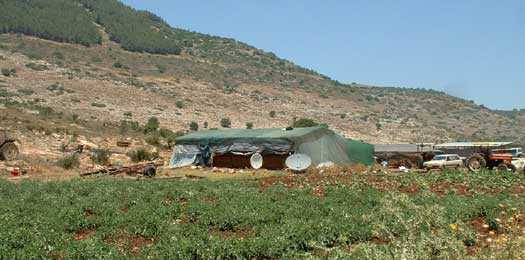
The harvest season tents are still there but are made of vinyl,
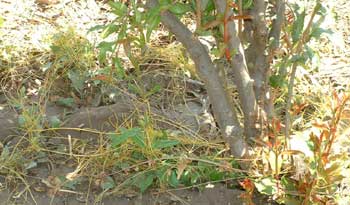
with satellite dishes set up outside. Patches of long, yellow
holoparasitic plants stretch themselves from the soil and
wrap around the bases of fruit trees and vegetables. The ground
has been saturated with chemicals. Empty plastic pesticide
bottles litter the roads.
Out of 23,000 residents in Sachnin, only 2% are still farmers.
Over 70% of the town lives below the poverty line. "Organic
farming is a luxury," they tell Laithi, full of misconceptions.
"The farmer's job," they continue, "is to extract
the maximum from minimum land and labor. To get the same amount
of produce, of the same quality, you need more of both. These
are things they don't have."
At weddings, guests bring bags and bags of figs and olives
to share. "These are from the wild," Laithi hears
them say, natural foods for a celebratory occasion. Their
awareness ends there, however. They cannot afford organic
produce, neither do they demand it. "I just have to make
it seem sexy to them,” Laithi says. “There is
no such thing as new agriculture; it is all just new words,
a modern wrapping of the traditional."
Urgently seeking farming wisdom
He tells me he is devoted to collecting the past from its source,
and I imagine him running franticly grabbing at fireflies. He
approaches the old farmers, the individuals that might remember
different times, when farming was about a relationship between
land and human, without other artificial inputs and pressures.
"I am documenting their words, sorting through a collection
that will finally reveal itself as Palestinian Agriculture."
He began with his Grandfather. "I would sit at his feet,
teased by words of a primitive wisdom. The man lived to 100
years; there were over 1,000 people at his funeral. They called
him misaad, the lucky one. He married the prettiest woman
in the town and had wealth. He even had blue eyes. One simple
question from me would trigger an outpouring of stories that
would fill my head."
He shares with me what he has found, snapshots of a different
era. Of course, the animal wastes were used as fertilizer,
medicinal plants bordered the beds. But there are more interesting
nuggets of information.
- Early in the morning, when the air was humid and dew
was still sitting on the leaves, the farmers would sprinkle
ground dust on the plants. They noticed that while many
plants were attacked by insects, the ones by the road, covered
in dust, would never be harmed…
- The beehives were molded from mud so the animals would
not have to exert so much energy in temperature control…
- After the winter flooding of the valley, holes were dug
close to the water-logged fields and would be filled by
the workings of the tide. The water was pumped to smaller,
simpler catchments by each farmer's plots and used throughout
the season…
- Lentil and tobacco leaves would be burned,
smoked next to plants that were attacked by insects…
- Diseased pumpkins would be treated with garlic. The vines
would be carefully sliced, a clove of garlic inserted, and
the wound bound in cloth…
- Salt mounds would be left outside the farmer's door,
one for each of the winter months. When the farmer found
a month’s mound melted by humidity, he would know
the rains were soon to come and the planting season would
begin.
Carrying forward
The NGO begun by Laithi is called Arrasid,
or Bearing Witness. Farmers in the region donated 10 acres,
some of the land in the valley, some in the mountains. The
goal is to establish proper microfarms on each plot, where
the old methods of farming will be fully incorporated. It
will be a place for devout followers of modernity to come
and breathe in a time that no longer is, to touch and feel
as their curiosity or doubts demand.
 |
A seed bank has been started. Many plots in the valley are
less than one acre and have not been farmed in years. The
owners rationalize such a small spot as useless. The seed
bank will give these families incentive to grow for themselves
using free, readily available organic seed. The other possibility
is to work for the NGO, growing seed for a salary. The Sachnin
Municipality has also given Arrasid access to almost 3 acres
of fields to grow crops and seeds. The site connected to one
of the local secondary schools has been used for agricultural
programming in the past and will now continue to do so, although
now in an organic way. Laithi estimates, through past school
years, that over 1500 students will participate in the program.
|
"We need to start small. People
will be watching us closely, expecting an embarrassing
failure." |
|
For the most part though, educational capabilities aside, the
actual farmers will be making the impact. What Arrasid offers
them is community support and knowledge. It will be designed
as a co-op, where the NGO provides advice and seeds, a guaranteed
buyer and market, in exchange for an agreement to grow following
certain regulations.
In addition, 1% of all profits must be returned to the local
Arab community in need.
Laithi already has 50 farmers committed to working with him.
A few months ago, he took them on a tour of the Arava desert,
to see the sustainable farming practices used by Kibbutz Ketura
and Neot Smadar. Seeds were exchanged, as well as advice.
For the traveling farmers, it was a portal into their grandparents'
farming techniques. The group was amazed that the knowledge
of their families rests with children of Westerners, that
these farmers are able to blend this past with the modern
present, to choose irrigation and certain machines while ignoring
the chemicals and fertilizers. "Why did we ever neglect
ourselves like this?" the younger Arab farmers began
asking, convinced.
“We need to start small,” Laithi says. “People
will be watching us closely, expecting an embarrassing failure.
This is not personal, no need to claim a victory. But this
needs to work for everyone's sake, for a return to dignity.
This is our fight for independence and it begins with food
security. Our blood and flesh is mixed with the soil. Even
if we have our land, if we have evolved into creatures that
don't interact with it, we have lost ourselves.”
“This valley will be the micro-region for an organic
renaissance in the Arab communities…It’s just
a matter of time,” Laithi adds after a moment of contemplation,
almost as a prayer. But there is no self-pity in his voice.
He speaks as if the future is now, as if his words have actually
willed it into existence.
|