|
|
Amazement
at Canaan’s bounty
replaced by demands on the land
Alon's Now aspires to the past. All through their
years of wandering through the desert, divine
nourishment was obvious to the Hebrew people,
flowing down from the sky in the form of Manna.
Immediately upon arrival in this land (the Biblical
Canaan), the miracle was concealed in the form
of plant growth. This was finally an interface
with God, a chance for the people to bring forth
and create blessing rather than continue to effortlessly
receive.
"This amazement in food must have been so
real, so electric for the ancient Hebrews,"
Alon imagines. They were farmers, living a healthy,
simple life, belonging to extended families united
in work. Classifications such as organic and sustainable
did not exist; there was no need when all interactions
with the natural were healthy ones. All activities
came out of this shared knowledge of the people,
a powerful, common wisdom grounded in a deep-rooted
awareness of the spiritual within the physical.
You cannot force the past on to the present, though.
Modern Israel has turned those images into relics.
Arable land is being lost under highways and sprawl.
"No one cares for land anymore; we have lost
our roots in the place where we were first blessed
with them. Israelis have separated themselves
from holy work; put themselves in the position
of taking and receiving. The privilege of working
this land was given to us by God and we happily
handed it to others."
Cheap Arab labor was taken advantage of for years.
Since the Intafada, it has become the Thais. A
group of them are found on almost every farm in
the country. “The timeless influence that
is in the air, in the soil, in all the natural
elements of the country is free to all, if only
Israelis would open themselves to it. Instead,
it is the western industrial agriculture that
is heavily relied on, a new science replacing
an ancient wisdom.”
|
|
|
Where we are:
NORTHERN
Neot Smader Kibbutz

The Zimmerman family farm is located between
Arab-controlled Nablus (Shechem). and an Israeli
army firing zone.
Editor's Note:
Yigal Deutscher had already spent the summer
of 2003 training in sustainable agricultural
and Jewish spirituality when he came to our website
and noticed our standing challenge to:
Help
us find farmers from many nations willing to tell
their stories in small doses over time, as their
lives unfold and their farms develop.
He set high goals, and he delivered
in finding and profiling farmers who are making
a difference. In this contested land of with its
millennia of occupations, ravages and civilizations,
farming with ecological foundations faces harshness
from the climate, political tension and a conventionally
oriented food economy.
The journey begins in the southern
deserts, leads us north through the West Bank
and continues all the way up until we near the
Lebanon/Syria borders.
Where we have been:
SOUTHERN
Elaine
Solowey at Kibbutz Ketura is a California
native. Elaine Solowey is a scientist with a mission,
evaluating plants from around the world in the
harsh Arava desert. She wants to discover "small
steps towards abundance" (her book title)
for the coming years of harsher climates around
the world.
"The well-being
of the world depends on agricultural stability
and health. No one seems to understand this."
Kibbutz
Neot Smadar –
About 20 years ago, a group of unacquainted
urbanites formed to explore issues of community:
what is means and how is it formed. The place
is an experiment to live out what they’ve
agreed upon -- a healthy community based on self-sufficiency
that includes organic orchards and farms, natural
building, a flock of goats, and much more.
“[The organic
farmer] made it all seem like a puzzle to us,
the connections he was trying to make between
plant and earth, plant and plant, human and earth.
This was his lifework, a never ending one."
Where we are going:
NORTHERN
Beit Elisha at Kibbutz Harduf …is
Israel's only Biodynamic farm, but one so large
that it is also the country's largest supplier
of organic produce, from veggies to cheeses. It
is also a working agricultural kibbutz -- one
of the last in Israel -- whose wholistic environment
provides a healing medium for members with developmental
disabilities.
"Everything needed
to sustain and allow the continuation of creation
is already here, given to us with the first light.
All we have to do is harness it, gather a small,
potent dose and apply." Gadi, farmer.
|
|
|
 |
Alon's
hands wear his emotions.
The dirt behind his fingernails, filling the lines and cracks
of his skin, are stains of devotion.
His fingers wrap around a silver goblet, full with dry red wine,
reflecting the eyes of those peering in. A drop escapes and
trickles over the side. Prayer sanctifies the wine, which sanctifies
the moment.
Alon Zimmerman and Rachel, his wife, sit with their eight
children sharing food and song. This day, fields will not
be watered, seeds will not be sown, weeds will not be pulled,
compost will not be spread, nor a harvest reaped. The work
of the week is dignified by abstaining from it. Creation again
returns to the Creator. This is the meditation of Shabbat,
from sundown Friday until the same time Saturday.
|
"Just as Joseph blessed his brothers
with food during a time of drought, this region has been
blessed with abundant fertility." |
|
After a fine sleep, morning prayers, and a festive lunch, Alon
and I walk through the Samarian hills surrounding Itamar, his
community. Slowly, they lift themselves from the ground, like
a cluster of old men rising from bed.
"When the Hebrew people entered Israel, that is where
they buried the bones of Joseph," Alon tells me, pointing
at present-day Shechem. "Just as Joseph blessed his brothers
with food during a time of drought, this region has been blessed
with abundant fertility."
Abundance, devastation, erosion
The land was divided and settled, a portion to each of the
12 tribes of Israel. Terraces were cut into the hills and
cisterns were dug. The land's history is full with wars and
devastation. The Romans cleared the predatory wildlife for
their games. The Turks cut the trees and overgrazed their
animals. The rich, dark soil is now all on the valley floor.
We are standing on exposed rock and thorny bushes. We continue
walking, exploring limited space.
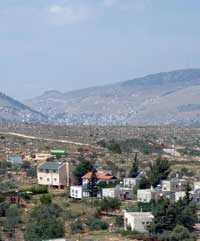
Itamar spreads out over one of the hilltops, enclosed by
protective metal fencing and barbed wire. Alon does not cross
the valley to visit the burial site of Joseph these days.
We are in the middle of the West Bank and Shechem is Arab-controlled.
Israelis and Palestinians neighbor one another and the only
relation between them is competing death tolls. There is an
isolation that penetrates the air.
A five-minute walk from Itamar begins an Israeli army firing
zone. Alon adopted the no-man’s land between. He has
been farming it for the last 20 years. Truckloads of soil
were brought from the valley below and set on the hill, giving
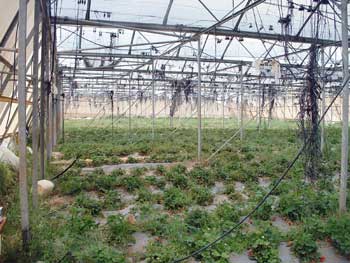
him more than 20 inches of topsoil. He erected a hoop house
above the improved area, covering almost 2 acres of land.
Spun horticultural fabric, shade cloth, or no covering at
all fit each crop respectfully. Strawberries are harvested
from November to August, an extended season that produces
4 tons per quarter acre. During the winter, the porous coverings
allow snow and rain to bring in nitrogen. Onion and garlic
grow open to the elements. Cucumbers, peppers, and tomatoes
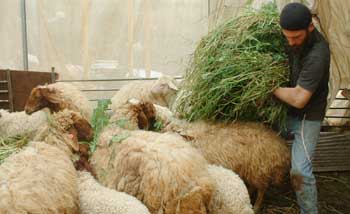
are the summer crops. Livestock lives undercover, as well.
Beyond the structure, grape vineyards as well as orchards
of apples, apricots, and figs have been planted on the ancient
terraces that mark his land.
"The government doesn't invest in us; the banks won't
bother with us," he says. Relocation is a constant threat.
Supported farms get a packinghouse, trucking. Any available
land is offered to them, and then advisors arrive to share
advice and knowledge.
In retrospect, Alon is grateful that this special treatment
did not come to him -- advisors would have only arrived with
a menu of poisons. Instead, he received a forced education
in self-sufficiency, a blessing in itself.
Surviving through flexibility
Alon's personal survival is due to flexibility, a willingness
to adapt to the volatile reality around him. The Zimmermans
were the first in Israel to work with organic strawberries,
exporting them to England. The competition was fierce. Conventional
farmers in Europe were flooding the market with organic produce,
switching to chemical-free production just because the prices
were higher.
Pulling themselves from the international market, they began
growing a variety of vegetables for an organic distributor
in Israel. Once the Palestinian Intifada began, though,
there were new problems to face. Trucks were no longer sent
into the disputed region, leaving the Zimmermans without a
way to channel their produce to the rest of the country.
Alon's first reaction was to get his vegetables to the distributor
on his own. This meant driving through what was just about
a full-on war zone. "No one knew who I was. My role became
the common enemy. Arabs were throwing rocks at my car. So
were Israelis. Soldiers from both sides were shooting at one
another."
By the time he reached his destination, the produce was ruined
and he had no buyer.
|
"No one knew who I was. My role
became the common enemy. Arabs were throwing rocks at
my car. So were Israelis. Soldiers from both sides were
shooting at one another." |
|
Selling fresh vegetables was no longer a viable option for them.
So he completely rearranged and organized his fields with
new intention. The family’s business is now in jams,
fruit leathers, pickles, spices, granola, and soup mixes.
Growing, processing, and packaging have all become part of
the home operation. When the market price is exceptionally
high, the vegetables are sold fresh. Otherwise, the produce
is brought directly to their home and dealt with.
While Israeli vegetable prices have remained the same over
the years, taxes, water, and farming materials continually
rise. The extended shelf life and value-added products of
processing is what keeps them financially alive.
Seeing blessings, finding synergy
|
|
Ancient
Jewish agricultural rules reveal ecological, biological
principles
The past Alon dreams of – when Israelis
intentionally cherished God’s land -- can
be tapped into through ancient agricultural mitzvot,
religious laws. These are the remnants of one
of the first extensive sustainable farming systems
in history, based on spiritual elements as much
as the physical. The laws are all recorded in
the Bible, applied long before the appearance
of chemical farming.
More>
|
|
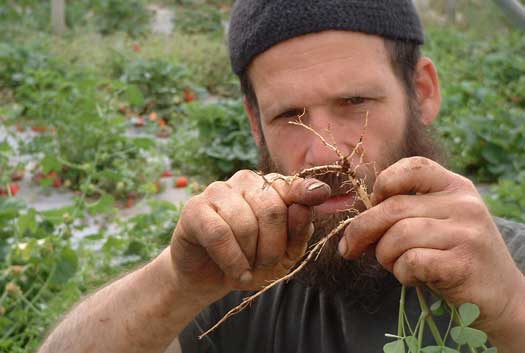
Alon works the land in a kipa and tzizit,
traditional Jewish garments that remind him of a divine presence.
A thick beard covers half his face. The wisdom of processing
fresh crops into more stable forms is explained in religious
terms. "Everything exists as a blessing. Our job is to
make arrangements and opportunities to connect one blessing
to the next."
The market calls only for the best-looking strawberries,
uniformin shape, color, and texture. When he was harvesting
fresh for the market, 30 percent of the plant yield would
remain on the crop, useless to him, rotting in place. “This
is a bracha levatala, a refusal of divine
sustenance," he explains.
With processing, Alon has found a way to utilize whatever
the plant may offer. Every healthy strawberry is harvested.
Once the green tops are sliced off, all the berries are equally
valuable for the pot. The same goes with all other crops grown.
The revelations that came while he was adapting to processing
motivated him to alter his growing system, striving towards
a synergy among the farm components. Loops within loops, each
whole system feeding another. The new goal is to create a
closed unit where all needs can be generated on-site, without
further inputs.
The crop plots are rotated every year, with one section devoted
to the growing of a green manure, usually a legume. These
highly nutritious plants – some of which go to seed
to become the next year's weeds -- are fed to his chickens
and sheep. The animal pen is rotated along with the crop plots,
de-weeding and manuring the land for the next growing season.
Under each plant is a microclimate housing a variety of natural
predators, including spider mites, parasitic wasps, ladybugs,
even the praying mantis.
Mimicking the ancient cisterns dug into the hill, the heavy
rains of winter collected by the roof structures of the hot
houses are sent to a reservoir where carp are grown. A biological
filter cleans the water; dried algae and fish wastes are incorporated
into the living soil.
The closed-loop biological unit Alon is striving for is one
that involves a communal effort. He does not have the time
or energy to create a sufficient home garden to meet all the
needs of his family. A grassroots support network exists among
the Israeli farmers of the region. "We sell to each other
at low prices; we help each other with transportation needs,
with spreading nylon over the hoop houses." Every morning,
a bottle of goat's milk is found by Alon's doorstep; a year's
supply of milk traded for a share in the strawberry harvest.
Boiling berries into profit
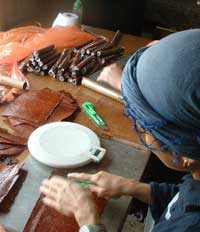
The home is their factory. On the kitchen table, fruit leathers
are rolled and packaged. Industrial sized bags of organic sugar
and oats line the walls, like sandbags against a flood. Boxes
of freshly picked strawberries are stacked in the corner, awaiting
use. In the basement, various end products line the shelves.
Jams are boiling on the stove. Fruit leathers are in the driers.
The action is constant. Each day brings new volunteers. The
work ends after midnight and begins again early in the morning.
While Alon works the fields, Rachel processes the raw materials.
"For the first year, it was all trial and error,”
Rachel says. “We threw away more than we made. The recipes
in the books were useless. Once we had consistency in taste,
I went selling from door to door. In those days, I just wouldn't
sleep.”
Now, word of mouth spares her. Customers call in their orders
and pick them up. When delivering becomes necessary, they
rely on a neighbor’s goodwill. Alon and Rachel have
neither car nor driver’s license.
Rachel and Alon make the perfect yin-yang couple. They are
even two separate companies, divided for tax benefits. Alon
sits at the table with configurations and formulas. His plans
include methane converters, solar- and wind-generated power,
even hydroponics. He laughs to himself, absorbed in his dreams.
Rachel silently and sternly runs from the boiling jam to
the ringing phones, taking orders from customers. "We
keep it simple. Don't grow more than you can use. Don't sell
to stores or distributors. Don't take orders you can't keep.
Don't ever, ever get into debt. And I can still hardly contain
any of this. There is no time for anything else, no money
for extra help."
The sweets are their best selling products. "Do you
have any idea how jam is made?" Rachel asks me. "The
fruits are boiled, killing all nutritional value. Then sugar
is added. This is what everyone wants so this is what I make."
Her first profession was a nutritionist, specializing in macrobiotic
diets. She is disturbed by her own creations.
These marital and vocational partners are slowly making sense
of their tightly integrated enterprises, even as they imagine
expansion and more complexity. Alon is busy with plans for
a proper small-scale factory, fueled by alternative energy.
Rachel is thinking of new products, those with ingredients
high in protein. Both are looking eagerly at their oldest
children, soon to be finished with high school.
Yet there is no permanence for all their sacrifice and investment.
Nothing is certain with such unstable political surroundings.
Only the intention strives for the eternal. "The only
claim I have to the land is a religious one,” he says.
“It has nothing to do with the U.N." and its efforts
to bring stability to the region. Alon's identity belongs
to the land which, he believes, is an extension of the Bible.
|
"Land is not a prostitute. It
is not something to be traded back and forth, to be picked
and hacked at like a piece of inanimate property. The
land is a living force which belongs to God." |
|
"Land is not a prostitute. It is not something to be traded
back and forth, to be picked and hacked at like a piece of inanimate
property. The land is a living force which belongs to God."
The politics of land belong to the human ego. The politics of
land stem from desires of control and ownership. As the land
surrounding him is consumed by such politics, Alon approaches
the soil, water, and sun in prayer. He does not farm for financial
reward, nor does he farm to claim ownership.
He farms so God will know that there are still those that
rejoice in the role of caretaker. The map is not the territory
and the territory is irrelevant. To some it may be the West
Bank, to others Samaria.
To Alon, the land is simply home.
|