|

Posted March 21, 2003: In Thai, “Hin
Pha Fan Nam,” is translated literally as “Stone,
Cliff, Sky, Water,” and signifies “abundance.”
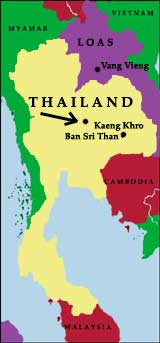
This is the apt name of a 12-acre self-reliant Buddhist community
located 20 kilometers outside of Kaeng Khro in central Thailand.
 |
"We have enemies," notes
Darbboon Deeratana, a 25-year member of an Asok. "Monks
from other temples, and fertilizer companies." |
|
Here a stream trickles down out of the western mountains,
turning into marshes of wild, edible lotus flowers, bordering
gardens of cabbage, pumpkin, morning glory, banana, papaya,
and rose apple. The stream eventually feeds into a swimming
pond where nearby children mill homegrown rice by hand, meticulously
removing the husks with woven bamboo baskets and nimble fingers.
Down a dirt path lined with landscaped boulders, others stuff
a fine mixture of sawdust and fungi spores into plastic bags
that will eventually yield edible mushrooms. Past piles of
earthy compost, two children grind soybeans into milk, which
they will take to the kitchen to make tofu.
Early to rise and 5 rules for happy days
|
 |
|
Sharing
their widsom: The Asok movement hosts 40
seminars a year. |
|
This community, with roughly 20 permanent members and 20
boarding students, is part of the larger “Asok”
movement that has become the pioneer and leader of regenerative
agriculture in Thailand. Meaning “no sorrow” or
“happiness” in Thai, the movement was begun in
1975 by Bodhiraksa, a Thai celebrity-turned-monk, as a reaction
to what he saw as corruption in Thai Buddhism. The Asok movement
now includes thousands of members living throughout the country
and hundreds living in 18 self-sustaining communities.
People living in Hin Pha Fa Nam, like all Asok members, rigorously
follow Buddhist teachings, as they interpret them. Everyone
must strictly observe Buddha’s five precepts, which
include no killing, lying, sexual misconduct, stealing, or
taking of intoxicants. The day begins at 3:30 am and, after
two hours of meditation, members spend most of the day working.
Adult members eat only one meal a day.
Additionally, while several mainstream Thai monks are millionaires,
Asok monks are not allowed to own any property and lay members
living inside the community make no money. But everyone receives
free food, lodging, and medical care, and students receive
free education.
“We want to show that we can live without money,”
said Rakboon Asoktrakool, a woman who has been supporting
Asok for 18 years and moved to Hin Pha Fa Nam two years ago.
“You can earn your living by growing plants, not just
by taking money.”
The sun sets on a Western philosohpy
Asok calls this system “boonism.” “Boon”
means “merit” in Thai, and the “ism”
is added to show that a system based on cooperation and morality
can be at least as viable as Western economic systems such
as capitalism.
|
 |
|
Team
Spirit : In this Buddhist community everything
is shared including the smiles. |
|
From the beginning, self-reliance has been a central goal,
and most communities produce almost all the food and products
they need to sustain themselves. Fifteen years ago, members,
who had already been strict vegetarians, began growing and
consuming only organic products, partly for health reasons.
“We recognize the dangers of chemicals,” said
Asoktrakool. “We feel sympathy for people who use them
and want to prove that (organic) is best for Thais.”
Additionally, members, already prohibited from slapping even
mosquitoes, wanted to more accurately follow the first precept
of not killing.
“When the farmers used a lot of chemicals it killed
a lot of insects,” said Darbboon Deeratana, 25-year
member of the “Santi Asok” community outside Bangkok.
“We don’t want to kill animals – we don’t
want them to suffer. If you go to Sisaket province you see
a lot of paddy fields but no animals live there.”
Deeratana noted that there are practical reasons for not
using pesticides as well. “We don’t use chemicals
because it goes against the first precept of no killing. But
also if you kill animals you break the ecological chain –
the animals help reduce the population of pests. Using a lot
of spray is the wrong thing to do.”
|
"Six years ago,
communities began hosting seminars on organic agriculture
and self-reliance. Eventually, these were even funded
by the Thai government, in an effort to relieve the debt
of poor farmers who had invested too heavily in chemi-cals
and agricul-tural equipment. Ironic, because it was the
govern-ment which promoted modern farming practices in
the first place. " |
|
Members now grow all crops organically and several communities
have recently opened up organic produce stores and restaurants.
Those living on farms outside of communities can sell their
produce here, as long as Asok inspectors have approved them.
Asok members also use less technology, as can be seen by
the wooden, hand-operated rice mills, and the scarcity of
large agricultural equipment such as tractors. Besides decreasing
reliance on money, Asoktrakool feels this furthers a sense
of community.
“Brother and sister, father and mother – everyone
can talk while they’re working,” she said. “It
causes good relationships and is a lot of fun. There are many
jokes and a harmony of spirit. When you use the machine mills
you just pay money and don’t form relationships.”
Asoktrakool stressed that many Asok practices stem from
traditional Thai ways of farming, rather than having been
introduced by the West, the way chemicals were. “We
got many of our ideas from old Thai wisdom. Not from America,”
she said. “We don’t use chemicals from America
– your country gave us the chemicals!”
Bright days are born from growing
knowledge
Like many organic farmers, Asok members experiment continually
to find better methods. Several years ago, for instance, they
discovered an alternative to the previously company-owned
fermentation mixture that serves both as fertilizer and pest
deterrent. This mixture includes soil, burned husks, plants
from the legume family, fresh leaves, a byproduct of milled
rice, and manure. The mixture is then fermented with sugar,
doused with water, covered for 7 days, and turned.
“We adopt and improve and then spread to other communities,”
said Asoktrakool.
Because compassion and selflessness are central components
of their religion, Asok members devote much of their time
to sharing their knowledge. After a large economic collapse
in Thailand six years ago, communities began hosting seminars
on organic agriculture and self-reliance. Eventually, these
were even funded by the government, in an effort to relieve
the debt of poor farmers who had invested too heavily in chemicals
and agricultural equipment. This is often felt to be a bit
ironic, because it was the government, lobbied by companies,
which promoted modern farming practices in the first place.
Today the Asok movement hosts roughly 40 seminars a year,
each including 50 – 100 farmers, and lasting about a
week. Farmers learn everything from the secret of the fermentation
mixture to soap making.
Asoktrakool noted that these seminars are usually highly
successful. “Most tell us it is the best for them when
they come back, that they gain more production than before,”
she said.
Quietly waking to a new tomorrow
But Asok practices and ideas have not gone without criticism.
“We have enemies,” Deeratana noted, “monks
from other temples, and fertilizer companies.”
From the beginning the movement has been frowned upon by
mainstream Thai Buddhism, which went so far as to sue Asok
for incorrect practice several years ago. Chemical companies,
with much to lose from organic agriculture, have also posed
problems. Besides being suspected of “buying out the
bureaucrats,” as Deeratana puts it, in an effort to
make money off of cash crop agriculture, they have been accused
of even more direct trouble making.
A year ago, an Asok produce store was set on fire and, although
the community didn’t press charges, many felt the culprit
was obvious. “People in the village know it was someone
from the fertilizer company,” said Deeratana.
He explained that the company had lost a lot of profit due
to organic seminars held at the nearby Asok community. Indeed,
the village there had turned almost completely organic, as
people saw that they could produce more without using chemicals.
While no one knows for sure who was responsible for the arson,
hostility from the fertilizer company is common knowledge.
But there are also many who support Asok practices and admire
their courage. Luke Cannon, an American who has stayed and
worked on four different communities, is one of these. “They’re
embracing a lot of difficult things most people are afraid
to face – in the face of politics and tradition,”
he said.
Small time farmer and natural builder Jon Jandai agrees,
and has collaborated with members to build several adobe structures
in Asok communities. He emphasized how much the movement has
accomplished. “They are the best model for self-reliance
in Thailand, “ he said. “They don’t have
an academic thing -- not writing, talking – they just
do it. I think that is the best way.”
And despite external opposition and strict rules, members
themselves continue to wake up at 3:30 am, to eat organic,
homemade tofu, and to sit together seperating rice husks by
hand.
“Living here I feel peace and high confidence –
to be alive in a good life,” said Asoktrakool.
For those like her, “hin pha fa nam” is enough
for happiness.
Coming next: Jason and Derek are on their
way to India. But that’s all we'll know until our fearless
travelers make contact again from the land that brought us
algebra, geometry and calculus—maybe there is a reason
we haven’t heard anything yet… 
|