|
March 31, 2005: Many farmers who grow
fruits and vegetables arrange to have honeybee hives situated
near their fields and orchards in order to ensure adequate
pollination. But new evidence suggests they should take
steps to protect and encourage native pollinators as well.
Dr. Claire Kremen, assistant professor of ecology and
evolutionary biology at Princeton University, led a
study of the role of native bees in pollination of watermelons,
cherry tomatoes, and hybrid sunflowers in the Central
Valley of California. Her research team found that native
bees provide significant pollination services for these
crops—in some cases enough to make honeybees unnecessary.
They also found that the proximity of natural areas
was a significant factor in native pollinator populations
on farms and that organic farms tended to have more
vigorous native pollinator populations than conventional
farms.
There are some 4,000 native bee species in North America,
says Kremen, and as many as 50 to 60 species may be
found in a given agroecosystem. Ongoing threats to the
European domesticated honey bee, including parasitic
mites and hybridization with aggressive African bee
strains, have caused a 50 percent decline in U.S. honey
bee colonies since 1950 and a 70 percent decline in
feral honey bees, according to Kremen. These factors
are making commercial pollination services more expensive—and
thus the protection of native pollinators more important.
Watermelons
Like all cucurbits, watermelons have separate male
and female flowers and are dependent on insects for
pollination. Individual female flowers open for a single
day and must receive 500 to 1000 pollen grains to produce
a marketable melon. Kremen's team found that native
bees were more effective than honey bees in pollinating
watermelons, in part because they forage earlier in
the day and transfer more pollen per visit.
The researchers found 23 native bee species visiting
watermelon plants in Yolo County. The five most important
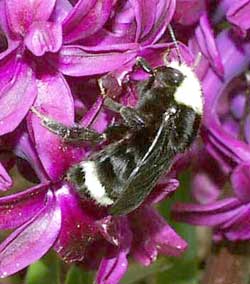
were the yellow-faced bumble bee (Bombus vosnesenskii),
the California bumble bee (Bombus californicus), the
squash bee (Peponapis pruinosa), long-horned
bees (Melissodes species) and sweat bees (Halictus
species).
Cherry tomatoes
Tomato plants are self-fertile, but the flowers must
be vibrated for their pollen to be released. Usually,
the wind is enough to vibrate tomato plants, but insect
visits can help significantly. Honey bees don’t
normally visit tomato flowers because the flowers have
no nectar and honey bees are unable to vibrate the tomato
flower to release the pollen. Most tomato pollinating
is performed by bumble bees and other native species.
Kremen's team demonstrated that cherry tomatoes visited
by native bees produced larger and more numerous fruits
than those pollinated by wind alone. Five native bee
species were found visiting cherry tomatoes on organic
farms in Yolo County, the most important being the yellow-faced
bumble bee (Bombus vosnesenskii), the California
bumble bee (Bombus californicus) and the mud
bee (Anthophora urbana).
Hybrid sunflowers
Bee pollination is essential to the production of hybrid
sunflower seeds. While growers typically use honey bees
for this purpose, Kremen's group found that native bees
are also important pollinators. At least 29 native bee
species were found to visit sunflowers in Yolo County.
The most important were long-horned bees (Melissodes
spp.), sunflower bees (Diadasia and Svastra
spp.), the yellow-faced bumble bee (Bombus vosnesenskii)
and the sweat bee (Halictus ligatus).
Most interestingly, the researchers demonstrated that
interacting populations of honey bees and native bees
resulted in the best pollination rates, evidently because
the different types of bees skirmish with one another,
causing more movement between the interspersed rows
of male-sterile and male-fertile plants.
Organic makes
a difference
Monitoring native bee populations on organic farms
close to wild habitat, organic farms distant from wild
habitat, and conventional farms distant from wild habitat
(conventional farms tend not to located with close proximity
to wild habitat), Kremen's research group found that
80 percent of organic farms close to wild habitat could
rely entirely on native pollinators for pollination
services. By contrast, just 50 percent of organic farms
located distant from wild habitat could rely on native
pollinators alone, and none of the conventional farms
had sufficient native pollinators for pollination needs.
Overall, native bees provided 28 percent of pollination
on conventional farms and 60 percent on organic farms.
Enhancing pollinator
habitat
Farmers can improve native pollinator populations on
their farms by supporting natural area protection and
restoration efforts in their communities; leaving field
and road borders untilled to provide habitat for ground-nesting
bees; eliminating or reducing insecticide use; and planting
or preserving native flowering plants in pastures, hedgerows,
and other areas on their farms.
Kremen has collaborated with the Xerces Society for
Invertebrate Conservation, a non-profit group based
in Portland, Ore., to produce three fact sheets summarizing
her findings and suggesting ways for farmers to encourage
native pollinator populations. The fact sheets can be
downloaded free of charge from the Xerces Society website
at .
The Xerces Society has also published a 34-page booklet,
and 145-page book, the .
Laura Sayre is senior writer for NewFarm.org.
|