|

September 28, 2004: The first time I drank
pulque (pronounced pool-kay) back in the mid-1970s,
I knew there was something special about it because it gave
me power over the alleyway dogs that always hounded me on
my walk home from the pulquería on the outskirts
of Cuernavaca. Plus, it didn’t give me a hangover.
Pulque is a thick, white-colored drink of 3-4% alcohol
made by a brief fermentation of the sap of the maguey plant,
an Agave species. It is different from tequila and
mescal in that it is not distilled.
Traditionally, pulque forms an important part of
the diet of the native peoples of the central highlands of
Mexico, and the maguey plant an important part of their life
here. Pulque has been considered a poor person’s
drink, and many a campesino has substantially bolstered his
diet of tortillas and beans with the drink. It has been shown
to be an important part of poor pregnant and nursing women’s
diets, and that women who drink pulque are less at
risk for anemia.
 |
"The Aztecs attached such importance
to the maguey, having to do with fertility, that one of
their supernatural beings, Mayahuel, was pictured seated
within a maguey plant, nursing a baby." |
|
Pulque has been left out of the “modern”
diet promoted by government and market forces in Mexico. In
its place have come beer and spirits, neither of which have
anything close to the nutrition that pulque has. Beer
is much more expensive. Cheap cane spirits, the preferred alcohol
of the poor now, will rot one’s gut much faster than pulque
ever will.
In a country where 25-40% of rural people are malnourished,
advocating the replacement of a nutritious beverage like pulque
with nutritionless beverages like beer and spirits seems wrong.
Analysis of pulque has shown that it is a nutritious
drink, providing thiamine, riboflavin, niacin, pantothenic
acid, as well as a beneficial microbial community for the
human digestive system.
Most middle class Mexicans turn up their noses at the mention
of pulque. It is considered a crude, peasant drink,
and not nearly as desirable as beer and spirits. Part of pulque’s
bad reputation comes from years of abuse by alcoholic campesinos,
who would drink gallons of it daily, starting in the morning
and going all day.
The maguey plant has traditionally been much more than just
a source of drink. The Spanish explorer Francisco Hernández
wrote in 1577 about the maguey in the central highlands of
Mexico:
“As a whole (maguey) can be used as fuel or to
fence fields. Its shoots can be used as wood and its leave
as roofing materials, as plates or platters, to make paper,
to make cord with which they make shoes, cloth, and all
kinds of clothes…. From the sap…they make wines,
honey, vinegar, and sugar…From the root, they also
make very strong ropes which are useful for many things.
The thicker part of the leaves as well as the trunk, cooked
underground…are good to eat…There is nothing
which gives a higher return.
The Aztecs attached such importance to the maguey, having
to do with fertility, that one of their supernatural beings,
Mayahuel, was pictured seated within a maguey plant, nursing
a baby.
The people who still drink pulque, mostly campesinos,
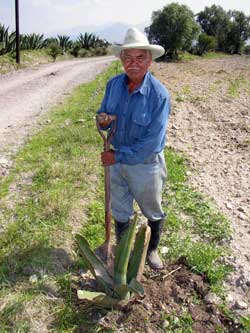
swear by its health properties. One farmer, Guadalupe Hernandez
Garcia, in his 70s and still actively farming, recalls when
he was sick with some kind of kidney ailment. “I went
to the doctor and was given expensive medicines. After a month,
I was still sick. I ran into an old guy who told me to drink
a liter of pulque everyday. After a couple of weeks
I was completely better,” said Guadalupe. He balled
his fists and showed his muscles, “And look at me now!”
The magueys that are used for pulque can be from
several species of Agave, the most common being Agave
atrovirens, which can grow to ten feet tall (non-flowering
stage) and 12-14 feet across. The maguey has much thicker
leaves and is much larger than the Agaves traditionally
used for making tequila and mescal.
Maguey plants are traditionally grown around the edges of
crop fields, on non-crop land, and along paths and roadways.
The state of Hidalgo, about 100 miles north of Mexico City,
is considered to be Mexico’s pulque center,
where the best pulque is still produced. The town
of Tepotzotlan, where this article is being written, is on
the southern edge of Hidalgo.
Making pulque
Unlike tequila and mescal production, where the plant heart
is extracted and cooked, in pulque production the
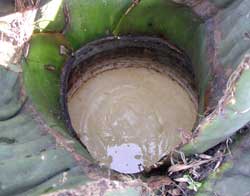
maguey heart is tapped while the plant is still alive. This
gives many times the volume of sweet sap, called aguamiel
(honey water), than if the heart was simply cut out, cooked
and crushed. Aguamiel flow lasts for up to six months
and can yield 1000 liters over that time.
The process of selecting a maguey plant and preparing it
for aguamiel production is quite involved, the whole
process taking nearly a year. When a plant is about to send
up its enormous flowering stalk at the end of its 7-15 year
lifetime, it is selected for agualmiel tapping. It is at this
stage that the plant has conserved large amounts of nutritious
sap in order to send its flowering stalk 20 feet in the air.
First the protective sheath of leaves around the flower bud
are removed. The floral embryo is then killed by puncturing
it with a sharp object. This is left for several months, during
which time the bud around the dead embryo swells but can’t
grow vertically. After this period it is ready to be hollowed
out, and the bud is repeatedly punctured again so that its
center rots out. After a week the rotted material is cleaned
out of the center of the plant, leaving a cavity for the aguamiel
to collect.
Plant sap fills up the cavity rapidly and must be harvested
twice a day. Each time the aguamiel is extracted,
the sides of the cavity are scraped clean of scar tissue,
and the shavings saved for feeding to animals.
The extraction of the aguamiel is done using a long
calabash gourd called an acocote. The harvester uses
his mouth, placed on a hole at the top of the acocote,
to provide suction for the aguamiel to flow up into
the gourd, which is then emptied into a bucket.
Aguamiel contains about 10% sugar. The fermentation
process is started by seeding the aguamiel with “mother
of pulque”, a culture containing the right
microorganisms.
A couple of days of fermentation later a drink of about 3-4%
alcohol is obtained. The fermentation process is biochemically
a different one than beer or wine. In beer and wine production,
the yeast organism Saccharomyces ferments sugars
into alcohol. In the pulque fermentation it is another
organism, of the genus Zymomonas, which produces
alcohol from sugar. Zymomonas is resident on the
surfaces of the maguey plant and naturally colonizes the aguamiel.
Zymomonas uses an entirely different biochemical
pathway for the production of alcohol, called the Entner-Deuderoff
pathway, than Saccharomyces.
Other unique microbial processes are part of the pulque
fermentation. A bacterium of the genus Leuconostoc
is partly responsible for pulque’s famous viscosity
(Mexicans who do not like pulque joke most about
its viscosity). Leuconostoc produces dextrans from
sugars, which makes for the viscosity. Lactobacilli,
well known for promoting gastrointestinal health, are also
active in the fermentation.
During the fermentation the vitamin content (milligrams of
vitamins per 100g of product) of pulque increases
from 5 to 29 for thiamine, 54 to 515 for niacin and 18 to
33 for riboflavin, according to one analysis.
Pulque must be drunk within a day after its 36-48
hour fermentation, or refrigerated, and is famous for its
awful smell when allowed to putrify. Pulque contains
albumins, which when allowed to putrify, cause a terrible
stench. A Spanish traveler wrote in 1552 “There are
no dead dogs, nor a bomb, that can clear a path as well as
the smell of…. (putrified pulque).
Pulque is sold in casual backyard type businesses
called pulquerías. Usually just a few tables
and chairs, sometimes pigs, chickens, or dogs kick around
at one’s feet. The pulque is traditionally
served in calabash gourds, but by the 1970s, plastic buckets
were commonly being used.
In the old days pulque haciendas, farms which specialized
in growing maguey and making pulque, were the centers
of pulque production. Very few, if any, of these
exist anymore.
Pulque should only be bought at reputable pulquerías,
as contamination can be a problem if not made and stored properly.
Many a case of the skitters has been caused by poorly made
pulque.
Vidal Aguillon, proprietor for 40 years of what is now the
last pulquería in Tepotzotlan, Pulquería
El Mirador, reflected on the demise of pulque. “The
days of the old pulque haciendas are over and there
aren’t any left around here. Maybe one or two in the
state of Hidalgo. The magueys are being used up or allowed
to flower and aren’t being replanted. People aren’t
interested in pulque anymore.” 
|