In
1977, I was involved with a project in which we introduced
grain amaranth to a dozen highland Mayan farmers in San Juan
Comalapa, Guatemala. Twenty-eight years later—on a recent
trip back to Guatemala to visit the Catu family, with whom
I lived back then—there was no sign of the amaranth.
There was, however, another “food” new to my host
family—Pepsi. Everything else for the special “guest”
meal—the tortillas, beans, greens, a little beef—was
the same as before. I’ve been told that Pepsi carried
out a massive advertising campaign in rural areas. Why Pepsi
and not Coke? “We’re a Pepsi family,” they
proclaimed in testament to the effectiveness and pervasiveness
of the ad campaign.
The good news is that the soda pop ritual only happens about
twice a month; on special occasions, they buy two liters for
24 people. I can give them that. I just wish we had the type
of promotional power and funding for foods like amaranth that
the soda pop and beer companies have.
I had known since the 1970s that amaranth grain was considered
an excellent food because of its complement of amino acids.
But upon reexamining amaranth’s nutritional data (some
of it recently published), plus having just finished off a
bag of atole de amaranto, a good-tasting, amaranth-based
powder for making the hot drink atole, I’m
newly astonished—both by amaranth’s super-nutritional
qualities and its continued obscurity. Amaranth is a truly
remarkable food. As one U.S. food industry person (admittedly
from a company that develops and markets amaranth) put it:
"Amaranth is positioned in today’s marketplace
like soybeans were 50 years ago." I now realize why.
Amaranth enjoys a protein content of a remarkable 16 percent
and is two to three times higher in lysine than most other
grains. In fact, this important amino acid is low in most
other grains and is perennially deficient in the diets of
the rural poor in countries such as Guatemala. Amaranth is
also 4 to 8 times higher in calcium and 3 to 5 times higher
in iron—both critical elements for nutrition—than
other common grains such as corn, wheat, and rice. In fact,
when rated by nutritionists for general nutritional quality,
amaranth scores significantly higher than other common foods
such as milk, soy, wheat and corn. Amaranth’s digestibility
score is an impressive 90 percent, much higher than problematic
foods such as soy, milk and wheat.
|
|
 |
Amaranth
seeds contain 5 percent to 9 percent high-quality oil, again,
much higher than the common grains. Found in the amaranth
oil are tocotrienols—a relatively rare and very beneficial
form of vitamin E—and squalene, another rare compound
reported to have anti-cancer properties.
Amaranth is not a new crop here, or more accurately it can
be said to be both old and new. Cultivated extensively by
the ancient Mayas and Aztecs, amaranth was so important to
the latter culture that they used it as a medium for subjugated
tribes to pay tribute. It is estimated that some 20,000 tons
per year of amaranth were brought to the ancient Mexican city
Tenochtitlan from the 17 surrounding provinces, where it was
used as a food associated with religious days. It was this
association with the Aztec and Mayan religions that prompted
the Spanish rulers to banish the crop from its Mesoamerican
empire. Since then it has mostly disappeared from Central
America.
In Mexico, grain amaranth production has hung on until today,
but as a relatively minor non-staple; it is the basis of a
sweet cookie-like condiment called alegria, in which
popped amaranth is mixed with sugar syrup and honey.
Other countries such as India, Nepal, China, and the U.S.
have done work on grain amaranth. In the U.S., The Rodale
Institute (publisher of New Farm) has done the most work on
amaranth, mostly in the 1970s. Several varieties that have
been used in the U.S. were released by The Rodale Institute
(TRI). TRI’s work on the crop was discontinued in the
1980s.
In
countries such as Guatemala, where more than 50 percent of the
population lives in poverty (World Bank, 2004), malnutrition
is rampant, and infant mortality is still high, amaranth, as
the primary ingredient in a formula, can replace the “modern”
nutritional formulas developed over the years in attempt to
bolster rural people’s nutrition. An article in the Journal
of Food Science concluded that amaranth grain could be the basis
of infant formula because of its combination of high digestibility
and nutritional quality.
Combine these nutritional pluses with the fact that amaranth
is a hardy, drought-resistant plant, and you have a crop with
great potential for incorporation into developing (as well
as developed) country diets.
My trip to visit a smallholder farm where amaranth is being
reintroduced as a potential grain crop took me into the hinterlands
of a region of Guatemala that is considered to be “food
insecure” (food security is the going word these days
in agricultural development circles). Totonicapán,
a Mayan Quechua speaking area, is one of the poorest regions
in Central America, with more than 50 percent of the population
categorized by the World Bank as “extremely poor.”
(There are three main categories: non-poor, poor [as mentioned
above, this category characterizes 50 percent of Guatemalan
population], and extremely poor. The extremely poor have serious
malnutrition, health, and infant mortality problems.)
I was struck by the percentage of land that is badly eroded,
to the point that bedrock shows and no crops can be grown
(except perhaps vetiver grass, another remarkable plant. Vetiver
will not only grow on these sites, it will regenerate the
topsoil by stopping runoff in its tracks.) An even higher
percentage of the cropland was down to gravel and sand, and
a mid-season drought had turned the corn crop on these soils
into shriveled, yellow, stunted plants that would yield little
or nothing. About half the land had good soil, and the crops
looked alright.
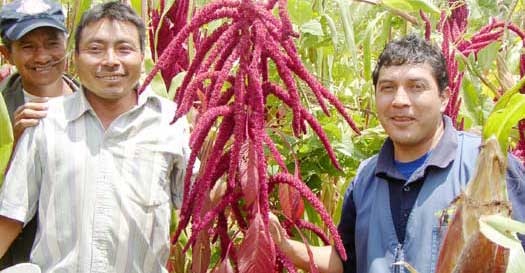
It was in one of these eroded, gravel-strewn parcels of cropland
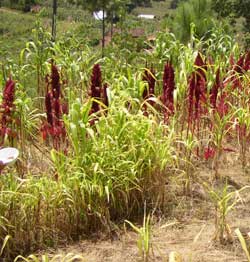
where the corn had completely failed that we found a thriving
crop of amaranth. Though the number of amaranth plants that
had been cultivated was small, the health of the crop—with
its robust, red inflorescences—was impressive. Amaranth’s
reputation for drought resistance, while not well documented
(though some data exists) seems to be well-founded.
Amaranth is one of the few dicotyledonous plants that has
what is known as the C4 metabolism, a much more efficient
form of photosynthesis than the more-common C3 and linked
to proficient production and drought resistance. Most of the
world’s C4 crops—corn, sorghum, sugar cane, millet—are
from the grass family.
The Spanish NGO (non-governmental organization) Intervida
is currently the main entity promoting amaranth for small
farm production in Guatemala. Intervida’s headquarters
just outside Quetzaltenango resemble a college campus. There,
two fulltime Guatemalan extension agents who work on amaranth;
Roberto Miranda focuses on amaranth agronomy and the dissemination
of seed, and Gladys Castillo works on the equally important
aspect of the domestic processing and preparation of amaranth,
an area often left out of food-crop development projects.
The farmer-collaborator, Santos Modesto, is a smallholder
farmer near the village of Xecajá. Santos had sown
amaranth in his milpa, a traditional corn-bean-squash
polyculture. In the plot that still had good soil, the corn
plants (a local variety) were about 2 meters tall; shorter
than usual because of the mid-season drought, but nevertheless
yielding adequately. Modesto had cultivated amaranth plants,
from seed provided by Roberto, at a ratio of approximately
two or three corn plants to one amaranth. This type of mix
is the way in which many farmers here do things. Roberto said
that there were other collaborators who had sown the amaranth
in small monoculture plots.
Grain amaranth is an ideal crop for small farmers. Since
it is small seeded (about a millimeter in diameter—slightly
larger than poppy seed— and off-white colored), farmers
can spread the seed liberally and then harvest them young
for pot herbs when they are 20cm to 30cm high, leaving adequately
spaced plants for grain production. The grain amaranth plants
commonly reach two meters in height.
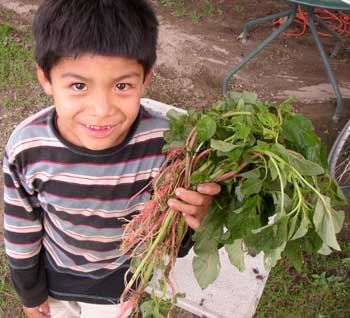
In traditional markets all over Mexico and Central America,
bundles of baby weed amaranth known as bledo (which
grows liberally in farmers’ fields) are sold as pot
herbs. The same weed, known as pigweed, grows all over North
America where soils are disturbed in the spring (i.e., virtually
all gardens and farm fields). Vegetable amaranth has been
rated as equal or superior to spinach in taste and has substantially
more calcium, iron and phosphorus. The baby forms of grain
amaranth are equally as good as pot herbs.

Most
of the amaranth grain varieties are Amaranthus hypochondriacus,
with some varieties coming from A. cruentus and A.
caudatus. Vegetable amaranth varieties were developed
in the 1970s from A. tricolor, A. lividus,
and A. creuntus. Amaranths are some of the worst
weeds in the world. All are black seeded, the most common
being A. retroflexus.
Harvesting grain amaranth requires more labor than harvesting
corn but no more than harvesting beans. After seed filling,
the amaranth inflorescence is cut from the plant, taken to
the home compound, and dried over a plastic tarp, which catches
the seeds.
According to Roberto Miranda, the grain amaranths they have
tested have yielded the equivalent of 3,600 kg/ha. This is
consistent with trials in the U.S., where amaranth yields
have ranged from 1,500 to 6,000 kg/ha.
Intervida packages a product, called Amarantole—made
from the flour of toasted amaranth, corn and rice, with added
cinnamon—for making atole, the porridge-like,
sweetened beverage that is a favorite hot drink here. The
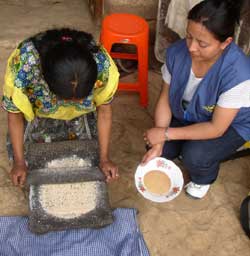
agency also has extension workers in the field teaching women
how to prepare the amaranth by gently toasting it, grinding
it on their stone grinders, and blending it into tortillas
or into their traditional atole recipes.
Progress is, of course, slow in trying to get people to put
something new into their food routines, even when it tastes
good and can significantly improve their nutritional status;
that is, unless they are subject to massive advertising campaigns—a
la Pepsi—or perceive it as being able to make them “modern.”
(These caveats don’t just apply to the people of developing
countries; American culture is rife with such examples.)
“We are in Guatemala for the long run,” says
Intervida’s Luis Nuñez.
I finished off the package of Amarantole that was given to
me by Intervida and want more. Today I searched the market
in vain for amaranth seed, semilla de bledo, in order
to make my own.
Don Lotter is a freelance agricultural researcher and
journalist based in Davis, California. He is a frequent contributor
to NewFarm.org.
|