|
Posted August 3, 2004: The two o’clock
lineup at the corner tortillería that I pass
daily is a cross section of Mexican society. Men and women in
business attire, school kids, maids, campesinos, laborers –
all wait in line for Mexico’s daily sustenance -hot, steaming
corn tortillas, fresh off the press. No matter what one’s
economic standing is, corn tortillas are the basis of at least
two meals a day.
Developed by the original Mesoamericans, the process of making
tortillas by boiling shucked corn with chunks of calcium hydroxide,
a process called nixtamal, liberates nutrients and
softens the seed coat. The boiled, nixtamal-ized
corn was traditionally ground to masa dough using
a stone hand grinder called a metate. This took women several
hours every morning, often starting a four AM.
In the 1940s and ‘50s, one of the first widespread
uses of small scale gas engines and electric motors was to
power wet grain grinders for making masa. A hand
press or hand patting were used to form the masa
into tortillas.
By the 1960s and ‘70s small scale tortilla-making machines
which could put out a hot, steaming tortilla every two seconds
were spreading throughout Mexico.
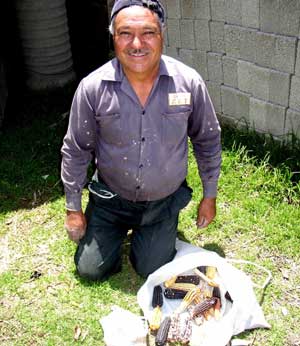
Mexico is the center of origin and diversity for corn. Nearly
a hundred major corn landraces, genetically distinct local
varieties, also known as criollo varieties, exist
in Mexico. Up until recent decades, these criollo
varieties of corn supplied local tortillerías.
| "Mexico is the center of origin
and diversity for corn. Nearly a hundred major corn landraces,
genetically distinct local varieties, also known as criollo
varieties, exist in Mexico." |
 |
|
Modern high-yielding varieties of corn have made inroads
into this diversity. Grown in states of Mexico like Sinaloa,
where the government has heavily subsidized the development
of capital intensive agriculture, high-yielding varieties
nowadays make up much, if not most, of the corn used in tortillerías
in Mexico. None of the commercial corn grown in Mexico is
genetically modified, as Mexico has a moratorium in place
on planting GM corn.
With the initiation in 1948 of the first of the “green
revolution” institutes, CIMMYT (International Center
for the Improvement of Maize and Wheat), outside of Mexico
City, Mexico was one of the first of the developing countries
to participate in the development of high-yielding, input-intensive
corn and wheat varieties.
Areas that were fertile and irrigable were where criollo
varieties probably first began to disappear, under the onslaught
of modern, large-scale agriculture. Ironically, it was these
landraces, allowed to disappear before comprehensive gene
bank collections were started, that would have been most valuable
to green revolution plant breeders, as they were selected
for growing on irrigated lowlands.
However, because only about a quarter of the 6.5 million
hectares of corn grown in Mexico are suitable for high-yield
production, the other three-quarters of corn land, nearly
all rain-fed, has mostly been planted with local criollo
varieties.
Corn in the central highlands of Mexico.

Imeldo Escalona Chavarria is one of the 253 farmers who make
up the Santiago Cuahutlalpan ejido (Click
here for more info on ejidos) near the town of
Tepotzotlán, in Mexico´s central highlands an
hour’s drive north of Mexico City. Imeldo farms 8 hectares,
about twice the average holding for 800 hectare ejido.
He grows mostly corn, as well as traditional beans and fava
beans.
It’s mid-May and the rains have come in full force
here. It’s the kind of rain that Californians like myself
don’t see enough of, picturesque afternoon thundershowers
that clear the air and then go away, leaving clear evening
skies.
Imeldo’s corn land is half criollo, planted
on rainfed land, and half hybrid commercial corn, sown on
irrigated land. Over the entire ejido the proportion
is 20% hybrid and 80% criollo, according to Imeldo’s
brother Rogelio, an ejido leader. Imeldo’s
improved corn varieties yield about 8 tons per hectare. Last
year however, the rains were so good that the rainfed criollo
corn yielded on par with the hybrid corn.
Hybrid corn, or any non-criollo corn, will pollinate
criollo corn when they are grown near each other,
if the tassling date of the hybrid corn corresponds with the
flowering (silking) of the criollo corn, giving seed
that has genes from the hybrid variety. I asked Imeldo how,
when selecting seed for the next year, the farmers here keep
the criollo corn separate from the hybrid varieties.
“We can see which grains come from the hybrid corn,”
says Imeldo, “they have a different shape and color.”
(A future article will deal with genetic “contamination”
and gene flow in criollo corn in more detail.)
The tillage regime that the Santiago Cuahutlalpan farmers
use is fairly unique. Only about one in fifty farmers owns
a tractor, so initial disking of fields by tractor is generally
hired out for 650 pesos ($65) per hectare. Row forming is
also sometimes done by tractor for 350 pesos ($35) per hectare.
After the initial disking, however, the farmers here use
horse-drawn plows, known as yuntas. Imeldo says that
most of the farmers in the ejido own a pair of horses
and a plow. Some of them do all of the operations, including
initial disking, using the yunta.
Soil fertility maintenance is mainly by NPK and urea fertilizers.
Out of ten years a farmer may grow a year of field beans and
a year of fava beans, according to Imeldo. Green manure crops
are not well-known here. Irrigated areas may get a couple
of years of alfalfa out of ten.
The use of herbicides varies throughout the ejido,
with some farmers, like Imeldo, using herbicide on both the
hybrid and criollo corn while others depend on the
yunta. In general, according to Rogelio Escalona,
herbicides are used on the hybrid corn, and the yunta,
plus azadon, a large hoe, are used on the criollo
varieties. Imeldo uses a herbicide called “Calibre”.
He also sprays an insecticide for a pest called the chapulin.
|
"For the price we get for corn,
it's not worth growing it for sale. Feeding it to animals
and then selling the animals pays better." |
|
About seventy percent of the corn grown by the Santiago farmers
goes to feeding animals, mostly cattle and horses, according
to Imeldo as well as his brother, Rogelio. The rest is for home
consumption. Since this area is near Mexico City, there is a
substantial demand for meat from city dwellers.
Meat consumption has been growing in Mexico at over 4% per
year, and in urban areas, where Mexico´s wealth is concentrated,
that growth is probably considerably more than the national
average.
Eighty to ninety percent of meat sales in Mexico are via
small butcher businesses, carnecerias. These small-scale
meat brokers comb the countryside, buying a beef cow here
or a sheep there, have it slaughtered at a licensed plant,
and sell it in their carneceria.
Mega-stores have been making inroads into the small-scale
food retailers. Sales of meats by large grocery chains (Walmart
is the largest grocery chain in Mexico), which import much
of their meat from the US, have been growing at a rate of
about 10% per year.
It is the small-scale meat industry that is driving much
of the corn production in areas like Santiago, areas that
are within a half day drive of a major city.
“For the price we get for corn, it’s not worth
growing it for sale. Feeding it to animals and then selling
the animals pays better,” says smallholder Baltazar
Gonzales, member of the Tepotzotlán ejido.
In other areas of Mexico, however, farther from affluent
urban areas, the market for farm-grown meat is not as strong,
and Mexican corn farmers have been suffering as a result.
Low corn prices driven by cheap,
subsidized corn from the US.
Imports of cheap, subsidized US corn have been killing the Mexican
small farmer, who has depended on the corn crop for sale as
well as domestic consumption for, well, millenia. Until the
early 1990s Mexico supported its corn farmers with subsidies.
This changed in the early 1990s when the Mexican government
bought – lock, stock, and barrel – into the “free”
market and globalization process being pushed by the US and
its “Washington Consensus” economists.
Actually, Mexico’s conversion to “liberalization”
of the corn market may have been as much a process of force-feeding
as salesmanship, according to a report from America’s
Policy (www.americaspolicy.org), a New Mexico-based think
tank. Mexico’s mid-1990s debt crisis and peso devaluation
was bandaged with a $100 billion bailout orchestrated by the
Clinton administration. Part of the deal was for Mexico to
buy a billion dollars worth of US corn. Furthermore, subsidized
US credit was given to Mexican companies to buy US corn, at
7% interest rates, as opposed to the going Mexican rates,
for buying Mexican corn, of 20-30%.
In just one year, corn imports by Mexico increased by 120%
from 1995 to 1996. Nearly all of the US corn goes for animal
feed.
| "In just one year, corn imports
by Mexico increased by 120%." |
|
|
Subsidies now account for 40% of US farm net income, most
of that going to very large operations. During the 1990s,
as part of the US-backed push to transform Mexican agriculture
to the “free” market, the percentage of Mexican
farmers’ income from the government fell from 33% to
13%.
It is now well established that US corn exports to Mexico
constitute “dumping”, at a “dumping margin”
of 25% under what the cost should be. Recent articles in Mexican
newspapers report that this is being addressed in bilateral
meetings. However, having lived in Canada, and heard the Canadian
trade experiences with the US, I can say without hesitation
that the entire “free trade” movement is a one-way
street, going the US way. US negotiators bald-facedly and
without any compunction whatsoever tell their counterparts
across the negotiating table that “this is the way it
is going to be” in negotiating agreements that are skewed
toward the US. So don’t hold your breath on the Mexican
corn issue.
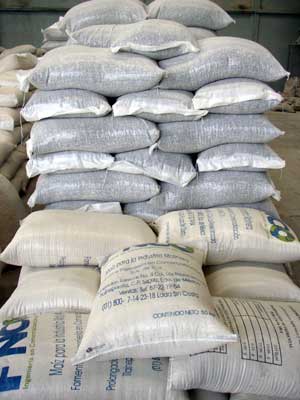
According to Ricardo Rentería, a manager at Servicios
de Almacenamiento, a grain warehouse and outlet near Tepotzotlán,
the food corn they buy comes from two main areas in Mexico
– the state of Sinaloa, and a region known as El Bajío,
a group of states around Guanajuato, in central Mexico. The
price for corn from these highly productive areas right now
is about 2.1 pesos per kg (US$0.21). According to Rentería,
criollo corn sells right now for about 2.5 pesos
per kg, if it´s available. “But these days corn
production in this area is decreasing. Farmers would rather
sell the land for building houses. They can make a lot more
money that way,” says Rentería.
Rentería alluded to the unfairness of the US corn
dumping and said that they buy very little US corn--and then,
only broken corn for animal feed. US corn is a mixture of
about 30% genetically modified varieties plus non-GMO corn.
Broken corn cannot be surreptitiously planted, a problem that
will be dealt with in a future article. My impression is that
there is widespread awareness in Mexico of the unfairness
of the US corn dumping policies.

I asked Sergio Robles, owner of Molina La Tradicion, a small
mill and store in the Tepotzotlán central market, about
whether criollo corn is available. “Local criollo
corn is not sold in large amounts anymore,” says Robles.
“Occasionally I get a farmer coming to me with criollo
corn, but generally the price he wants is too high –
3 or 31/2 pesos per kilo. We sell corn now for just a little
more than two pesos per kilo.”
I went to half a dozen tortillerías in Tepotzotlán
and asked where they got their corn. Only one, Tortillería
La Bougainvillea, said they consistently buy local criollo
corn. The others all get their corn from Sinaloa or the Bajío
states, capital intensive agriculture areas. Carmen Almazan,
whose great-grandparents started La Bougainvillea nearly fifty
years ago, said she prefers the local corn because it is usually
fresher and more tender than the commercial corn. She says
they pay just about the same price as commercial corn for
the criollo corn, maybe a little more.
A few of the tortillería proprietors said
that criollo corn tortillas tasted better, but most
said or implied that there isn’t much difference between
tortillas from criollo corn and those from commercial
corn. If there is any difference, the consumers don’t
appear to care much. Criollo corn tortillas and masa
are always available, made by hand press and sold by campesino
women in the local markets.
A standard practice, especially when corn supplies are short,
is for tortillerías to mix dry corn flour
(masa harina) into the fresh masa. 
COMING NEXT: In the next installment
of Pan-American Adventure, Don Lotter will take a closer look
at the corn situation in Mexico, and will profile another
farmer in the state of Oaxaca. He’ll also explore the
issue of transgenic contamination of native corn.
|