|

September 3, 2003: Nestled high in the Chimborazo
province, where the Andes stretch to their greatest altitude,
is Los Angeles de Colta, a farming village of 59 families. The
hamlet is home to an indigenous (pre-Incan Puruhua) community
moving swiftly into the future by following their past.
The people of Los Angeles, like most of those in the region,
farm the land of their ancestors. Unlike most of the farmers,
they are also growing the crops of their ancestors and tending
to them in the ancient ways. Quinoa is the crop and organic
is the way.
Quinoa (pronounced keen-wá), a seed grain, has been
cultivated in the Andean region for over 7,000 years and was
considered sacred by the Inca Empire. The crop was relegated
to status of animal feed by Spanish colonists, perhaps because
of its religious significance and, later, shouldered almost
completely out of production by cereals such as barley and
wheat and other crops such as potatoes and corn.
But farmers' fortunes were few growing these "new"
crops. The Andean highlands' cold, dry plateaus are perfect
for quinoa, but challenging for many of the non-native crops.
And a glut of product in the national market bottomed out
already low prices.
In response to the poor yield from non-native crops, US pesticide
and fertilizer manufacturers have led an aggressive campaign
in the region with the support of the government and governmental
agencies. Pesticide and fertilizer use in Ecuador has increased
dramatically over the years leading to depleted soil and a
rise in associated health problems. In fact, DDT, supplied
by a US company, is still being used on Ecuador's agricultural
land.
The Angels of Colta
Not long ago, the crops of Los Angeles were no different
than those of the rest of the Ecuadorian agricultural industry.
The famers' yields were low, their return was almost nonexistent,
and their children were suffering from malnutrition.
| "After just one year, those 12
farmers increased their incomes to roughly 50% more than
that of other area farmers. This year, 4025 families in
four provinces of Ecuador are planting over 2800 acres
to produce over 400 metric tons of organic heirloom quinoa
for exportation and they're thriving." |
 |
|
In 1998, 12 Los Angeles de Colta families (298 families across
Ecuador) agreed to cultivate quinoa in the traditional organic
way for a group called the Heirloom Quinoa Project. The Project
is the cooperative effort of four international organizations:
The People's Educational Radio of Ecuador (ERPE), a progressive
radio station dedicated to education and social service; Germany's
Bio Control System (BCS), a global organic certification organization;
the Canadian Development Fund, a fund for Ecuadorian development
based in Canada; and Chicago's Inca Organics, the distributor
and marketer of the finished product.
The goals of the project are to provide adequate income for
indigenous farmers, teach organic gardening and promote traditional
nutritional food products for both exportation and local consumption.
And the farmers of Los Angeles de Colta are some of the pioneers
in this bold effort.
After just one year, those 12 farmers increased their incomes
to roughly 50% more than that of other area farmers. The very
next year, 36 families agreed to raise heirloom quinoa and
by 2000, 51 families were participating in the project. This
year, 4025 families in four provinces of Ecuador are planting
over 2800 acres to produce over 400 metric tons of organic
heirloom quinoa for exportation and they're thriving.
Jose Balla, a Chimboarazan farmer remembers, "Before,
my father and his father had lost the knowledge of growing
quinoa and planted just a little for personal use. Today,
two-thirds of my farm (three hectare) is dedicated to producing
the grain for export."
Finding the "lost crop of the Incas"
It all begins in August and September of each year with organization
meetings held at various villages throughout the southern
sierra region of Ecuador. The farmers that attend receive
pricing information and organic training from IncaFood S.A.
(the Ecadorian export arm of Inca Organics) and ERPE.
The beginning of the wet season in October and November marks
the start of the growing season for the Los Angeles farmers.
No chemical fertilizers, herbicides or pesticides are allowed,
but the farmers do employ some familiar organic techniques
to boost yield, fertilize and fight weeds.
Compost is used, but only after it has passed through the
large worm farms they maintain and is reduced to "bono".
This version of castings is then applied as a very effective
fertilizer. Yield has increased with its use from approximately
1000 kilos per hectare to 1400 kilos per hectare.
The farmers rotate their quinoa crop with the Andean Lupin
bean. The Lupin, called ChoCho by the indigenous people, is
from the same family as the Italian Lupini bean and is used
to fix nitrogen the quinoa has depleted from the soil. The
beans provide a secondary income-generating crop and are also
harvested and sold or eaten locally as an excellent source
of protein. Also grown, sold abroad and eaten locally is an
Andean heirloom variety of black amaranth.
At over 9,000 feet, the village experiences temperatures
low enough for seven to nine months out of the year to make
cover crops unnecessary. Unfortunately, weeds don't mind the
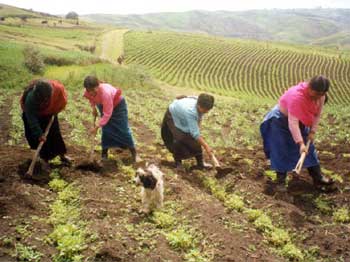
altitude. The families form community working groups, called
mingas, to weed and harvest crops more efficiently. The mingas
start weeding the fields about one month after the quinoa
has sprouted.
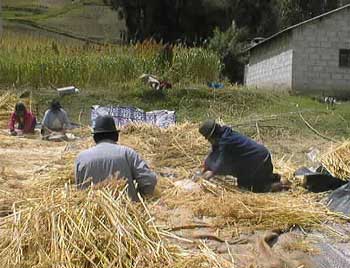
Harvesting quinoa follows the same pattern as field preparation
and weeding during the six to nine month growing season. Mingas
are formed to manually separate the grain onto white canvas.
The grain is then taken to a post-harvest facility for inspection
and cleaning.
Since all crops available for the international market are
grown organically, they must also be certified for export
as such. Technicians are recruited from within the villages
and trained by BCS for organic certification and by ERPE for
organic farming techniques. These technicians are then employed
by ERPE to give technical aid to the farmers, certify their
fields organic and inspect the quinoa before it goes onto
the post harvest facility for cleaning and packaging.
The post harvest facility, located at 10,000 feet, also employs
area villagers, adding more Ecuadorians, in addition to the
farmers, who can enjoy a secure job in a country that has
an unemployment rate of over 10%. The facility was built in
1998 as another international cooperative effort. The Canadian
Development Fund provided money for the creation of the building,
Inca Organics funded additional warehouse space and quality
control equipment and DED, a German development organization,
designed and built specialized cleaning equipment.
|
|
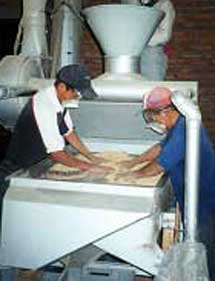
Most quinoa is mechanically polished rather than washed which
removes valuable nutrients in the process. Polished quinoa
also retains a powdery residue that must be rinsed off before
cooking. Heirloom Qunioa Project quinoa goes through a much
more simplified and straight-forward washing rather than polishing
to preserve the dietary fiber found in the germ layer. The
washing is more labor intensive, providing more jobs for local
families. And, no additional rinsing by the consumer is required.
The grain is divided into large, medium, and small sizes
by vibrating screens and dumped into separate washing tanks.
First, the quinoa is given a hot water wash to remove saponine,
a naturally-occurring, soapy-tasting coating. Then cold water
is pumped in, separating any foreign material from the grain.
The quinoa is centrifuged to remove most of the water from
the washing process and moved by conveyor belt to a final
drying bed. Hot air is blown through the grain to reduce the
moisture content to less than 3%. Finally, the quinoa is re-inspected,
packed and stored or loaded for shipment.
Growing more than just quinoa
A newfound spirit of cooperation and industry isn't the only
change seen in the village of Los Angeles de Colta. This year,
almost all the families are growing organic quinoa and the
villages reflect their success.
New homes of cement block are replacing the traditional chozas
(a windowless dwelling made of mud blocks with thatched roofs).
The average farmers' income has increased by an astonishing
50%--a rarity in Ecuador where dollarization of the economy
and high inflation are causing economic crisis. Juan Perex,
director of ERPE notes, "The typical farmers' income
has steadily increased from $230 per year in 1996, just before
the quinoa project started, to $450 per year today."
| "Whatever quinoa's global destiny,
this ancient seed has changed the way the world sees these
Ecuadorian farmers and the way they see themselves." |
|
|
Malnutrition is but a ghost in the Heirloom Quinoa villages.
While two-thirds of the quinoa is exported, one-third is used
by the villagers to improve their diets. The supergrain is
high in protein, low in carbohydrates, easy to digest, and
an excellent source of dietary fiber, phosphorus, iron, vitamins
B6 and E, magnesium and zinc. The families are now relearning
to prepare their traditional quinoa dishes and repair the
damage done by fast food.
"When we started out in 1997, one could hardly find
quinoa growing in the area. Now it's easily seen as you drive
through the provinces," said Marjorie Leventry, Vice
President of Inca Organics.
The premium quinoa produced by the Ecuadorian farmers in
the Heirloom Quinoa Project is recognized by world-renowned
chefs, such as Charlie Trotter, and international organizations,
such as the Slow Food Movement, for its superior flavor and
cleanliness. And the FAO (Food and Agriculture Organisation)
considers quinoa "one of the crops destined to offer
food security in the next century."
Whatever quinoa's global destiny, this ancient seed has changed
the way the world sees these Ecuadorian farmers and the way
they see themselves. The Heirloom Quinoa members discovered
most projects initially underestimated the abilities of the
farmers. They didn't need instructions on how to farm. What
they needed were markets for their products. Markets that
are fair trade and can sustain the production.
Ruben Vinoil, a farmer and village leader expressed it best,
"The life of the soil is also our life. We use organic
means to improve the life of the soil and it has certainly
improved our life." 
|