|
Posted April 12, 2007: Local food is the
rage these days. Everyone says they want it. Farmers’
markets are growing exponentially. Restaurants featuring it
are sexy. But many farmers and chefs still seem to struggle
to find each other and work together.
“To drive to Madison or Milwaukee, by the time you
get there, you only get to meet three or four chefs,”
said John Pavelski, who raises chickens at Sonday Farm in
Amherst Junction, Wisconsin. “Most chefs are only available
between 9 to 10:30 a.m., or 2 to 3:30 p.m. Otherwise, they
are busy.”
“I can make many phone calls and visit many farmers’
markets to meet farmers, but that takes a tremendous amount
of time,” said Charlie Durham, executive chef at Seattle’s
Sand Point Grill.
How can communities make it easier for them? One answer is
the “Farmer-Chef Connection” ()
conference-like approach.
These food-focused meet-ups are the brainchild of Debra Sohm-Lawson
and the Portland, Oregon chapter ()
of the Chefs Collaborative (),
a national coalition of food professionals committed to promoting
the sustainability aspects of food. “The idea for the
Farmer-Chef Connection germinated in the fall of 2000, when
JJ Haapala of Heron's Nest Farm in Junction City, Oregon,
gave a presentation to the Portland Chapter of the Chefs Collaborative,”
explained Sohm-Lawson.
“He mentioned that the farmers he worked with wanted
to sell to restaurants but did not know how. This planted
a question in my mind: ‘How could we facilitate and
strengthen links between farmers and chefs?’ The obvious
answer was, ‘Let's plan a conference.’”
In March 2001, the first Farmer-Chef Connection was held at
a vineyard in the fertile Willamette Valley of Oregon, just
outside Portland.
Farmer-Chef Connections bring together farmers, fishers,
ranchers and foragers with chefs, institutional food service
buyers and culinary school instructors for panel discussions,
networking and great food. The goal is simple: Connect the
producer and the buyer in a relaxed, fun setting, and let
them work together to figure out how to do business with each
other directly.
Dramatic results
The results have been impressive, as has been the growth
in the popularity of these events. One hundred producers and
buyers attended the first such event in 2001. In 2007, more
than 300 attended the Farmer-Chef Connection in Portland,
250 in Seattle, and hundreds more at similar events in Eugene
and Ashland, Oregon, and southeast Wisconsin, with another
event in the works for the San Francisco Bay area as this
story went to press.
“You need to get the chefs and farmers together in
one place,” said Jack Kaestner, executive chef of the
Oconomowoc Lake Club, in Oconomowoc, Wisconsin. “You
need to sit them together around a dinner table and let them
get to know each other.” Kaestner organized a Farmer-Chef
Connection in January 2007, as one of the monthly American
Culinary Federation (ACF) meetings in southeast Wisconsin.
“Usually these meetings feature some large purveyor
pimping their products. The host restaurant hits their suppliers
up for freebies,” said Kaestner.
Instead, he invited 14 farmers to join the 60 or so chefs
and culinary students attending the ACF meeting he hosted.
After the chefs and students spent an hour and a half grazing
their way around a room full of samples presented by the farmers,
they all sat down to a gourmet dinner made from local ingredients
supplied by the farmers. Kaestner made sure every table had
two farmers paired with eight chefs, so they had plenty of
time to get to know each other.
“I like that the chefs take an
interest in how our cheese is produced and where it is
from. They want to know our story so that they can tell
it.”
--
Burt Paris, Edielweiss Growers
Cooperatie Creamery
“Dinner at the [Oconomowoc Lake] Club gave me a chance
to experience the reaction of chefs to our cheese for the
first time,” said Burt Paris of Edielweiss Growers Cooperative
Creamery in Belleville, Wisconsin.
Paris said he recognized he was in the presence of people
with educated palates, who really took the time to assess
the quality of his product. “It was fun to watch chefs
truly taste the cheese, then look up and ask, ‘Who are
these guys?’ I watched one guy walk away and then drag
back a friend to try it.”
Paris has already heard from several chefs with new orders
since the event, and he says he would love to participate
in more of them. “I like that the chefs take an interest
in how our cheese is produced and where it is from,”
said Paris. “They want to know our story so that they
can tell it.”
In Portland, the Farmer-Chef Connection was an all-day affair.
It began with a keynote speech explaining how the 2007 Farm
Bill could affect chefs. Various panels of chefs, farmers
and industry experts discussed a number of topics, such as
the basics of farmers and chefs dealing directly, like contracts,
quality, pricing, etc. A session called “Certification:
Claims, Verification, Multiple Truths” ventured to help
chefs understand what organic certification means, and why
many farmers doing direct marketing have foregone certification.
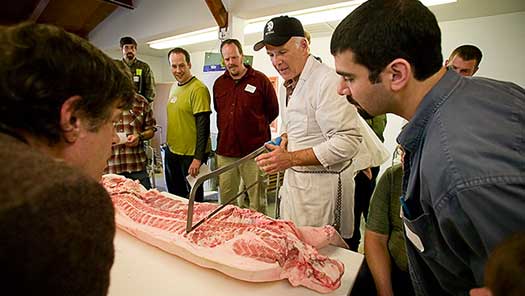
There was even a session on how to butcher a pig.
Participants praise fast-paced encounters
A gourmet lunch prepared by local chefs included ingredients
from local farms. But to talk to farmers and chefs in attendance,
the real star of the Portland event was the networking session
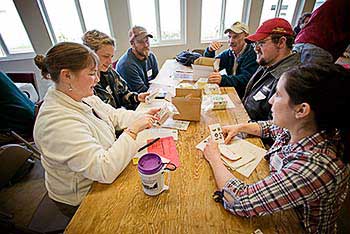
modeled after speed dating. During this 105-minute session,
buyers and sellers were paired up with likely business matches—ranchers
with chefs looking for grass-fed beef, for instance—to
allow them to get to know each other. After a period of time,
the chefs all moved to another group of farmers.
"I like that the Farmer-Chef Connection
put me easily in touch with potential customers. To hear
your competitors, customers and peers is very educational.
After all, you do not know what you do not know. I learned
a lot.”
--Andy Westlund,
Harmony J.A.C.K. Farms
“Farmer-Chef Connections are business-to-business programs,”
explained Sohm-Lawson. “They are about making direct
market connections.”
“I like that the Farmer-Chef Connection put me easily
in touch with potential customers,” said Andy Westlund
of Harmony J.A.C.K. Farms in Scio, Oregon. Westlund attended
the 2007 Portland event. “To hear your competitors,
customers and peers is very educational. After all, you do
not know what you do not know. I learned a lot.”
Westlund was fascinated, for example, to learn the views
chefs had about frozen versus fresh beef. “Some chefs
had real distain for frozen,” he said. “But others
could appreciate the difference between our beef, which might
be a ‘100’ on a scale of 1-100 when it is fresh,
but might drop to an ‘89’ when frozen, as compared
to fresh conventional beef, which might rate a ‘50.’”
“You may have a chef who says, ‘I want tenderloins,’
but they also want to know how the animal is raised, and if
it is nutritious and local,” Westlund pondered. “What
do they expect me to do with the rest of the animal?”
But through the networking session, Westlund was able to match
up with two chefs—one who needed mostly prime cuts of
beef like tenderloins, New York steaks and rib-eyes, and one
who needed mostly ground beef—to go in on a whole beef
together, splitting it between them.
Making good deals better
Westlund’s experience was by no means unique. In fact,
at the 2007 Seattle event a month earlier, Chef Wayne Johnson
from Seattle’s Andaluca restaurant and Chef Charlie
Durham from Seattle’s Sand Point Grill found themselves
talking with their beef supplier, DeAnne Clune, from Williamson
Farms in George, Washington. As it turns out, both chefs had
been purchasing whole beef from Clune, but Durham used mostly
ground beef, and Johnson used mostly prime cuts. Like in Portland,
these chefs worked out a deal with Clune to split the animal
between them, meaning everyone would get their needs met.
Seattle also featured the “speed-dating” styled
networking session.
“The speed dating was great,” said Will O’Donnell
of Mt. Townsend Creamery in Port Townsend, Washington. “The
first couple of matches didn’t work, but then I hooked
up with City Caterers and Bon Appetit, and things got going.
We had completely overlooked caterers as a market for our
cheese, and our distributor did not service them. The caterers
we met at Farmer-Chef gave us the names of their distributors,
and in the two months since the meeting, we have established
relationships with those distributors. Now sales to those
distributors account for 10-15 percent of our sales.”
Farmer-Chef Connections not only help farmers and chefs establish
relationships, they help them reinforce them. And Farmer-Chef
Connections help the culinary community reinforce and expand
its commitment to working with local farmers.

“Not only do I get to meet other
local chefs who are looking to buy direct, but I get to
meet the farmers I usually only talk to on the phone or
via email, and I get to make connections with new farmers.
With our purchasing volume, we have the power to make
for the success of a farmer.”
--Chef Mark Harris,
Bon Appetit
“It is an opportunity to get face to face with my existing
customers and get to know who’s new,” said David
Hoyle of Creative Grower, in Noti, Oregon. “I don’t
do the deliveries for our farm, so I don’t get to see
them that often.”
“It reaffirms what we do as a company,” said
Chef Mark Harris, who manages Bon Appetit food service’s
Reed College account in Portland. “Not only do I get
to meet other local chefs who are looking to buy direct, but
I get to meet the farmers I usually only talk to on the phone
or via email, and I get to make connections with new farmers.
With our purchasing volume, we have the power to make for
the success of a farmer.”
“I can establish and re-establish connections with
farmers after winter,” said Chef Troy MacLarty of Lovely
Hula Hands restaurant in Portland. “I can talk with
farmers about what they plan to grow this year, and I can
maybe even influence them.”
“I don’t live in Seattle,” cheese maker
O’Donnell said. “So I got to meet a lot of the
chefs who were already buying our cheese, but [whom] I had
only spoken to on the phone before.”
Ecotrust offers assistance
Portland-based Ecotrust has played a prominent role in the
developing of the Farmer-Chef Connection concept in the Pacific
Northwest, as well as in Wisconsin. It has just released a
toolkit for would-be Farmer-Chef Connection organizers called,
“Building Local Food Networks: The Farmer-Chef Connection
and the Guide to Local and Seasonal Products.”
“More contacts create more contacts.
Maybe a chef begins at the start of one year sourcing
10 percent of their ingredients direct from local farmers.
By the end of that year, it might be up to 50 percent,
then maybe 70 percent to 80 percent.”
--Chef
Wayne Johnson,
Andaluca restaurant
While the culinary community in Portland and Seattle initiated
the Farmer-Chef Connections in those cities, there is no reason
why farmers cannot initiate them as well, and the format is
simple and adaptable enough to suit any community. The toolkit
is a good starting point for anyone who wishes to create a
similar event in his or her region.
“Farmer-Chef Connections set up the connections for
down the road,” said Chef Wayne Johnson of Seattle’s
Andaluca restaurant. “More contacts create more contacts.
Maybe a chef begins at the start of one year sourcing 10 percent
of their ingredients direct from local farmers. By the end
of that year, it might be up to 50 percent, then maybe 70
percent to 80 percent. As more and more chefs start doing
this, eventually we will see a snowball effect.” 
|