|
June 8, 2006:
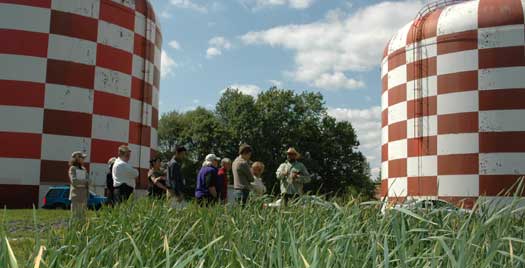
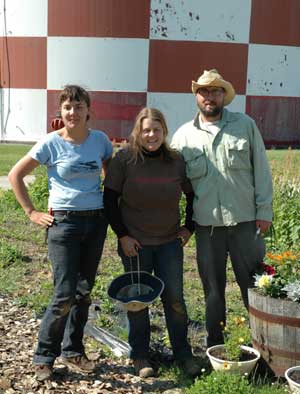
In the shadows of towering twin 5-million-gallon checkerboard-painted
water tanks supplying the modest northeast Philadelphia neighborhood
of Somerton, a miracle is taking place. Here lies Somerton
Tanks Farm, an experiment in bio-intensive urban agriculture
that seeks nothing less than to put a new face on farming.
The farm represents a partnership between the nonprofit Institute
for Innovations in Local Farming and the Philadelphia Water
Department, which was exploring innovative and environmentally
friendly ways to utilize the expansive grassy lawns that surround
its many facilities. "We’ve converted many to meadow
grass, but we were looking for something that was more productive
for the city and for the economy,” says Nancy Weissman,
economic development director for the water department. “We
also want to encourage sustainable business activity in and
around the city to protect our watershed.”
The goal was to see if the 1/2-acre farm could produce $25,000
in gross revenue, an initial benchmark met the first growing
season. Last year, in its third season of operation, the farm
surpassed $50,000 in sales ($52,200, to be exact).
“We consider it a huge success,” Weissman gushes
on a warm spring day as a group of Philadelphia foodies gathers
to tour the farm. “Our hope is that this development
will encourage more farmers to take up land in the city.”
Of course, “land in the city” can come with a
huge price tag, and while the Philadelphia Water Department
remains committed to the urban farming vision post-911, security
now overshadows any other plans for land surrounding the city’s
water supply. “We did our first site visit to this spot
on September 12, 2001,” Weissman says. “[911]
made an earthquake of a change for water utilities across
the country in terms of security issues.”
With that option a wash, land access continues to be one
of the biggest challenges for new farmers, both inside and
outside the city. One hope is that other entities with public
landholdings will step forward. Other options involve public/private
partnerships.
“My vision is to make Philadelphia a living lab,”
says Roxanne Christensen, president of the Institute for Innovations
in Local Farming. “We’ve got 30,000 vacant lots…there
are lots of different opportunities. There’s no one
model. A big issue right now is open space—they can’t
pave it all. The policymakers need to realize that agriculture
can be an asset all over the city.”
The “spin” on SPIN farming
When Christensen began developing the idea for farming public
lands in Philadelphia, she happened upon the work of Wally
Satzewich and Gail Vandersteen in Saskatoon, Saskatchewan.
Realizing there was good money to be made growing high-value,
multiple crops intensively, the couple had sold their 20 acres
of idyllic, irrigated farmland, leased 25 residential backyard
plots totaling half an acre, and become urban farmers (see
Wally’s Urban Market Garden
for more).
Satzewich helped Christensen and Somerton Tanks’ first
farmer draw up a plan of attack. A business partnership blossomed,
and the two have since co-authored a primer, a set of case
studies and other printed materials that break down their
trademarked SPIN (small-plot intensive) Farming for those
who wish to farm part-time for fun and a little extra cash
or as a fulltime occupation. Their case studies profile a
number of SPIN Farm scenarios, including:
- a 5,000-square-foot part-time hobby farm model that generates
$10,000 to 20,000 in gross annual sales;
- a 20,000-square-foot intermediate full-time farm model
that generates $54,000 annually;
- a 1-acre full-time model that brings in $50,000 to 65,000.
The case studies include marketing plans, start-up equipment
needs and costs, farm layouts and revenue targets, operating
expenses and pricing strategies (find out more at ).
A diverse portfolio
The basic premise of SPIN Farming is that you can grow a
lot of stuff in a small space. Current Somerton Tank farmers
Steve and Nicole Shelly have done a fine job putting that
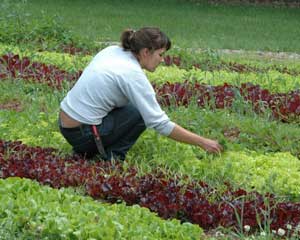
theory to practice. Their 280 beds turn an average of three
to four crops each season, and they grow 100 varieties of
50 different types of vegetables (it’s enough to make
your head spin). Breaking $50,000 was accomplished within
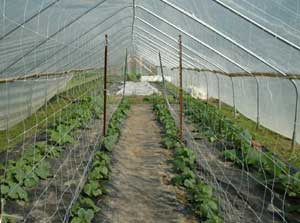
a 9-month growing season. This year, they’ve put up
a 90’ x 14’ hoop house—with recycled materials
at a cost of about $1,500—and aim to extend their growing
season.
 |
|
Not only is such intensive organic farming a lot of physical
work, it takes some serious brainpower, especially when you
consider factors such as fertility. On our tour, Steve Shelly
explains that this is accomplished through a complexity of
three-to-four-year rotations, by experimenting with cover
crops—such as buckwheat—that sometimes double
as food crops, and by trucking in (actually they use a van)
readily available compost from nearby mushroom farms.
Somerton Tanks Farm’s crop diversity is rivaled only
by its marketing channels, which include a 46-member (22-week)
CSA, three farmers’ markets, an on-site farm stand,
and a handful of restaurant and catering accounts.
Something the farm does not have a lot of is machinery—a
14-horsepower rear-tine tiller and a gas-powered weed trimmer
are about it. There’s also a modest walk-in cooler and
a tarped harvest station—complete with stainless steel
sink (adequate water supply is not an issue)—that allow
for the picking, washing and cooling of veggies in one-fell
swoop. This all adds up to superior quality and a longer shelf
life. “A lot of times people are kind of weirded out
by our salad mix,” Steve Shelly quips. “Someone
will come up to me at market and say “You know, I got
salad mix from you awhile back, and it’s still good.”
Low-tech innovation is everywhere—like the as-yet unpatented
homemade leaf miner traps Steve Shelly jokingly shields from
the camera, and the “overhead sprinker” (a rotary
sprinkler on a plastic sawhorse). Even the patched-up radio
in the processing station—which looks like something
the professor pieced together on Gilligan’s Island—speaks
to good old-fashioned ingenuity.
Part of the magic of SPIN Farming is low start-up costs.
Part of the reality for young farmers who hear a calling and
want to follow it is that passion and dedication can take
the place of acreage and fancy machinery, heavy inputs and
fossil fuel.
The new American farmer
Nicole Shelly studied architecture and was in the profession
“my second day” before realizing that it wasn’t
the right path for her. After plodding along for a few years,
she talked to Steve about putting their love for food and
for the environment together and trying their hands at organic
farming. So they signed up for a season at a certified-organic
farm in Hillsdale, New York. They learned out about the fledgling
Somerton Tank Farm project upon returning to Philadelphia.
“I call it farm karma,” Steve Shelly says.
The first year the farm was in operation, Nicole worked as
an intern and Steve volunteered. Within three years they were
running the place. “We like being outside and the independence
of being farmers…and both of our families have businesses,
so it was a good fit for us,” Steve Shelly explains.
Both farmers find farming and marketing equally challenging.
“You need to grow the right things for the right markets,”
Steve Shelly says.
“Every day is a challenge—If something can go
wrong it will go wrong,” adds Nicole Shelly. “You
just have to learn to roll with it.”
Christensen envisions a world where every new school, shopping
mall or housing development carries with it an agricultural
component.
“What we’re trying to do is recast farming as
a viable small business in the city,” she says. “SPIN
applies small business practices to farming, and its sub-acre
growing methods make it possible for many more people to follow
their desire to farm. SPIN farmers can have the best of both
worlds—they can couple their desire to own a small business
with their urge to farm, and they can do it right in their
own back yards or neighborhoods.”
Christensen, who has a marketing background, describes the
new urban farmer as “a Smith graduate with a biology
degree.” Coincidence or not, Somerton Tanks Farm assistant
farmer Mira Kilpatrick is just that. While at Smith, she took
a summer job at Brookfield Farms near Amherst, Mass., and
never got over the farming bug (to learn about Brookfield
Farm’s apprenticeship program, see The
Apprentice).
Kilpatrick grew up in the Philadelphia area and likes the
idea of becoming an urban farmer—her goal is to farm
on her own next year—but she wonders about the challenges
of land availability. “I’m looking in the city,
and I’m also considering moving beyond the city as well,”
she says. “It seems kind of difficult to get onto land
in the city.”
So what of this dream of a wave of urban farmers revitalizing
metropolitan areas and the face of agriculture?
“I think it could happen, but it’s going to take
a lot on the part of the people who decide what happens on
public land,” Kilpatrick says. “I don’t
think there’s a big enough push yet to make it take
off.” That push, she says, will come through public
education and people saying this is what they want. “I
think people get more excited about it when they come out
and see it.”
And why does someone with a science degree from a prestigious
Northeastern college want to become a farmer? That answer
comes easy to Kilpatrick.
“It’s one of the most important jobs you can
have.”
|
Fungus
amongus
USDA/Rodale Institute
collaboration finds on-farm application
Three years ago, USDA soil microbiologist David
Douds toured Somerton Tanks Farm. Afterward, he
offered his own services as well as enlisting
the help of several million little friends—mychorrizae.
In collaboration with The Rodale Institute, Douds
has been studying how these beneficial fungi interact
with crop roots and improve both soil and plant
health. Mycorrhizae invade plant root cells and
take their energy from plant carbohydrates; in
exchange, the fungi explore several inches into
the soil, greatly expanding the ability of plant
roots to absorb difficult-to-mobilize essential
nutrients such as phosphorus and zinc.
“This whole idea of on-farm production
of arbuscular mychorrizae fungi works well for
the labor-intensive small farm like Somerton Tanks
where a lot of things get planted by hand,”
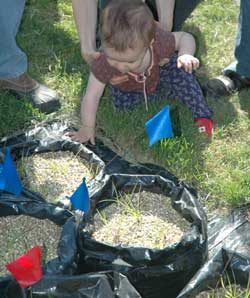
Dr. Douds says. The inoculum that’s been
produced so far can’t be applied to large
acreage with machines, Douds explains. Vegetable
farmers, however, can inoculate their crops by
incorporating the fungi into the potting mix used
to grow transplants. “It’s an efficient
way of using it labor-wise, and it fits right
into the production practices.”
-- DS
|
|

|