|
In the summer of 2002, a writing
assignment for Organic Gardening magazine brought
me to a grand celebration of heirloom vegetables at the nonprofit
in Decorah, Iowa. There I encountered
Chester Aaron, Darrell Merrell and John Swenson—the
“Dons of Garlic,” as I affectionately called them—a
brain trust of elder-statesmen growers who knew a thing or
two about Allium sativum. Their team-taught workshop
changed the face of my garden, and the bouquet of my breath,
forever.
Each fall around Columbus Day—the customary time for
planting garlic—I choose the fattest cloves from the
biggest bulbs of 15 to 20 varieties I’ve either grown
myself or otherwise purloined, I dutifully plant them 2 inches
deep in raised beds freshly dressed with finished compost,
I lightly mulch them with straw, and I wait for the first
garden surprise of early spring.
Garlic has grown in its appeal to market gardeners for a
whole host of reasons. Cooks (and their patrons) love it,
it is an extremely forgiving crop, it cures easily and stores
well, it’s a high-value crop for the space required,
and you can create a value-added product simply by braiding
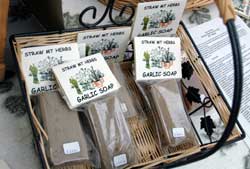
its leaves together (or by making garlic candles, soaps, chowder,
ice cream, pizza, funnel cakes, essential oils and even jewelry).
Add to all that the proven and purported medical benefits—from
treating high cholesterol and blood pressure, hypertension
and cancer to acting as a natural antibiotic—and the
folklore affording the pungent little orb talisman status
against vampires and other things that go bump in the night,
and you’ve got the makings of a lively festival.
Garlic festivals—which
usually take place in fall after bulbs have had time to cure
following a July harvest—run the gamut from a few farmers
selling a couple of common varieties on a quiet village street
to a full-fledged town party complete with musical entertainment,
food vendors, the crowning of a queen (or “Garlic Goddess”)
and more garlic varieties than you can shake a crusty loaf of
French bread at. Some festivals are more consumer-oriented (sell,
sell, sell), others favor garlic farmers and hobby growers like
myself (buy, buy, buy), while still others have a decidedly
educational focus. Most are a mixture of all of the above.
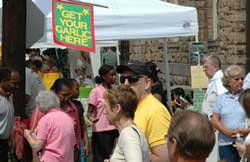
The in Stroudsburg, Pa., is one of those festivals
that take over the town—at least several blocks of it.
Carl Andrew, one of three founding members of the festival,
recalls how it all began 11 years ago. “We were all
part of the farmers’ market and we all grew garlic,”
says the affable farmer in the 10-gallon (at least) garlic-shaped
hat as he serves up garlic-laden pirogies to a young customer.
“I had a small patch of garlic and it was selling real
good. We said ‘We ought to have a festival at the market,’
and so we did it.” Six years ago, the festival moved
downtown and the merchants couldn’t be happier. Many
of them set up booths on the street—selling almost anything
you can imagine with garlic on or in it—and all reap
the benefits of tens of thousands of visitors to town on a
Saturday.
Garlic growers tend to share a special passion for their
crop of choice, and an inordinate number of them seem to have
a personal story to tell. Carl Andrew is no exception. “I
had a heart attack at 45, and that kind of got me interested
in garlic,” he says, alluding to the curative powers
of the humble bulb. “That was 1982 or 1983, and things
just sort of took off from there.” Andrews now has about
half an acre dedicated to garlic on his 3-acre farm.
East Coast garlic festivals—particulary in the Northeast
where winters can be harsh—tend to feature more hardneck
varieties (A. sativum var. ophioscorodon)
than softnecks (A. sativum var. sativum). The latter
is adapted to a wider range of climates—it does better
where winters are moderate—and cloves tend to be clustered
or layered and generally smaller than those of the hardneck
varieties. Hardneck cloves form in one layer around a rigid
stalk; they also tend to exhibit a wider range and intensity
of flavors, making them hugely popular with chefs. Hardnecks
can also be a little bit fussier to grow to maturity—particularly
if you are going for really big bulbs—and they
don’t keep as long as softnecks. (Most “grocery
store” garlic is softneck garlic that historically hailed
almost exclusively from the area of Gilroy, Calif.--where
a includes the crowning of a garlic queen. But
development pressures around Gilroy, and some say the ravages
of years of industrial farming, have allowed much-cheaper
imports from China—and less significantly Mexico, Argentina
and Brazil—to slowly take over that market.)
|
|
 |
Not every garlic connoisseur
prefers hardneck varieties. Chester Aaron, one of my original
garlic mentors, lists ‘Red Toch,’—a softneck
garlic that comes from Tochliavari in the Republic of Georgia—as
his favorite, both for the memory of his parents’ hometown
and for its exquisite flavor. Aaron, a “retired”
literature professor and consummate gourmet garlic grower
in Sonoma County, California, has elevated the “stinking
rose” to literary status, with published books including
Garlic is Life (Ten Speed Press, 1996), The Great
Garlic Book (Ten Speed Press, 1997) and Garlic Kisses:
Human struggles with garlic connections (Zumaya Publications,
latest printing 2004).
Garlic festivals tend to be a little too over-the-top commercial
for Aaron’s taste. “It’s just a bunch of
hoopla,” he says, “not ‘what are your problems
growers, and how do we solve them?’” Aaron lamented
the loss of one such gathering, the Garlic is Life Symposium
and Festival in Tulsa, Oklahoma, organized by one of the other
“Dons of Garlic,” Darrell Merrell. Speakers and
attendees have included David Mirelman, PhD, a biological
chemist from Weitzman Institute in Rehovot, Israel; Eric Block,
PhD, professor of chemistry and garlic researcher at the State
University of New York (SUNY); Fred Crowe, PhD of Oregon State
University and a leading authority on garlic diseases; Ron
Voss, PhD, of UC Davis, an expert on ; Bill Randle, an allium breeder from the
University of Georgia; Walt Lyons, PhD., of thegarlicstore.com
in Fort Collins, Colo.; Phil Simon, PhD, a plant geneticist
specializing in garlic at the University of Wisconsin; and
Joachim Keller, PhD, from the Institute for Plant Genetics
and Crop Research in Gaterslaben, Germany (an institution
that was instrumental in preserving many heirloom varieties
of garlic in former eastern-bloc nations before the Berlin
Wall felll).
Aaron says it would be nice to see some of the folks who
have reaped real success in the garlic business partner with
a University and festival-friendly town to create a garlic
gathering that offers something of substance to growers, researchers,
foodies and consumers alike. (Sadly, Aaron says, Merrell didn’t
find that level of support in Tulsa and ultimately tired of
footing much of the bill himself.)
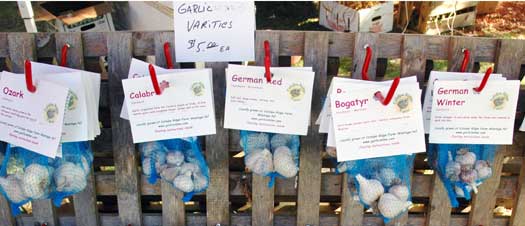
With more than 600 named varieties of garlic worldwide—there
remains some debate as to whether all of these are distinct
varieties or whether some varieties simply have more than
one name—choosing a favorite can be a lifelong process.
Mail order garlic seed businesses abound, but the advantage
of a garlic festival is that you get to meet the farmers and
touch, smell and sample their garlic (and if you’re
anywhere close to home, reap the added advantage of regional
adaptability). That’s why, a few weeks after the Pocono
Garlic Festival, a coworker and I climbed into his Jeep and
headed for the hills again, this time crossing the boarder
into New Jersey and Olde Lafayette Village for the Garden
State Garlic Festival, where more than 60 varieties were reportedly
on sale and at least 150 on display. We were going to buy
some seed garlic.
|
|
When we finally arrived (no thanks to Mapquest), we discovered
a smallish, relatively quiet venue. It didn’t take us
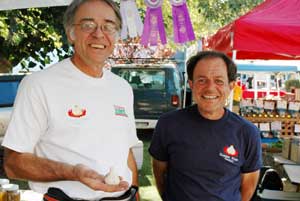
long to find festival organizers and garlic farmers Rich Sisti
and Roman Osadca hawking their wares only a few feet away from
each other.
“Gilroy and Saugerties [New York, home of the ] are the two big garlic capitals
on the East and West coasts,” says the lanky and affable
Osadca, a pharmaceutical engineer by day and a garlic farmer
about every other waking minute. “Nobody ever heard
about New Jersey.” Osadca and Sisti set out to change
all that. What the Garden State Garlic Festival lacks, for
the time being, in vendor numbers, it makes up for in quality
educational materials. And, thanks to Sisti, there are more
varieties for sale here then I have seen anywhere else. (While
Osadca grows 152 different varieties on his 150-acre farm
less than a half hour to the south, he’s only brought
three varieties into town to sell. Four German Whites, three
Legacies, and two Musiks—hardnecks all—go into
a “Cook’s Sampler Pack” for $10, and sales
have been brisk.)
“We’re only four years old,” Osadca says
of the fledgling festival, “but every year we’re
getting better.”
|
"There’s a fine line between
not enough and way too much. We started getting on this
scale where we had to sell it, because there was just
way too much of it." |
|
It's clear from talking to the other vendors that this is the
man to buy seed garlic from, and he offers us an attractive
price if we’ll just wait until he packs up so we can follow
him home (he hasn’t brought along quite the poundage we
require). Sisti chuckles in the background as official closing
time comes and goes and Osadca continues to talk garlic relentlessly
with any straggler who will lend him an ear (come to think of
it, everyone he ropes in ends up buying something).
Finally we arrive at Osadca’s solar home overlooking
the 150-acre Valley Fall Farms.
“We’re just like many small farms,” Osadca
says. “To be able to do it on a small scale, especially
organic, you end up having to have a regular job." When
Roman’s wife was laid off from a job as a food chemist,
he says, she fulfilled her life-long dream of becoming a full-time
farmer (dairy goats, laying hens and grass-fed beef are also
part of the operation.) “You know how to make a small
fortune in farming?” Osadca quips. “Start with
a big fortune.”
Despite the admonishment from one who clearly knows what
he is talking about, I am tickled when we leave two hours
later with our haul—70 pounds of seed garlic—and
wonder if this signals a leap from hobbyist to farmer (or
just a foolish lark). Then I recall the words of Paul Milenkowic,
another garlic farmer I’d talked with a few weeks before,
and I wonder if there’s really a difference. “When
I started out, the biggest thing was just the enjoyment of
the garlic and not having a patch to last you long enough,”
he had told me. “But there’s a fine line between
not enough and way too much. We started getting on this scale
where we had to sell it, because there was just way too much
of it.”
|