|
Posted January 7, 2005: Imagine assembling
a self-contained, regenerative farming system… and making
a living doing it. Impossible, you might say—but over
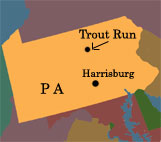
the last 20 years Anne and Eric Nordell of Beech Grove Farm
in Trout Run, Pennsylvania, have been doing just that. What’s
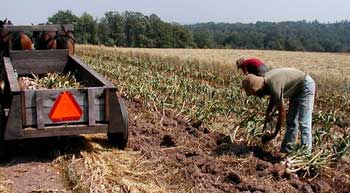
their secret? Draft horses, alternative tillage techniques,
and a time-tested rotation of cash and cover crops. They call
their system “bio-extensive market gardening."
Although
neither Anne nor Eric was raised on a farm, together they’ve
turned a 6-acre market garden into an ecologically sustainable
enterprise. Their fields are divided into 12, half-acre plots
roughly 120 yards long by 20 yards wide. Each plot follows
a single-run cropping system consisting of rows 34 inches
apart. “The shape of the fields reflects my experience
growing corn more than anything,” Eric explains. “It
lends itself to using horses.”
Because of the farm’s rural setting in north-central
Pennsylvania, the Nordells began by growing cool-season, non-perishable
crops such as roots, alliums, and medicinal herbs. Before
long, requests from local upscale restaurants for dependable
supplies of high-quality leafy greens led the Nordells to
add leaf and fruit vegetables to the mix. In the beginning,
Anne recalls, “the last thing we wanted to grow was
perishable crops."
Over the last three years, gross sales can be analyzed as
follows:
gross
sales by
market type |
leaf
& fruit veggies |
root
veggies |
farmers' markets
65% |
66%
|
34%
|
| stores
14%
|
75%
|
25%
|
restaurants
14% |
75%
|
25%
|
individuals
(bulk orders on-farm)
7% |
50%
|
50%
|
Although the type of produce they grow has changed over the
years, the Nordells' objectives are still the same: utilize
on-farm resources, remain a two person operation, and stay
debt-free by minimizing costs. Rather than chase gross income,
Anne and Eric have sought to do what is right for the land,
their customers, society, and themselves.
Beech Grove Farm has been certified organic since 1988. The
Nordells first sought certification because their wholesale
accounts—two growers’ coops, two distributors,
and Walnut Acres, a mail-order business—began demanding
it. As their sales shifted from predominately wholesaling
out of the area to direct marketing more locally, certification
became less important. But despite some reservations about
federal involvement, the Nordells have chosen to maintain
their certification because it distinguishes them at the farmers’
market, it allows them to sell to local stores, and it helps
to educate both growers and consumers about organic practices.
Contrary to some farmers’ experience, they say certification
takes less time and paperwork today than it did before creation
of the National Organic Program. Because of the cost-share
program, it’s more economical as well. And since the
Northeast Organic Farming Association of New York already
had a rigorous certification program, the federal standards
have not been difficult for the Nordells to meet.

“One of the nice
things about horse farming is that the horses are constantly
producing fertility.”
When Anne and Eric began farming, they used tractors for
some tasks and horses for others. But over time they found
that the tractor just didn’t pay. “I didn’t
think that horse farming alone would even be possible,”
admits Anne.
Today they keep four draft horses, an experienced pair and
a pair in training. Although the Nordells have to purchase
feed (oats, hay and minerals) and bedding (straw and other
materials) for the horses, these off-farm inputs result in
more than just feed and bedding. They equal fuel and fertility.
“One of the nice things about horse farming is that
the horses are constantly producing fertility,” Eric
says with a smile.
The Nordells have developed an innovative method for composting
the horse manure to control temperature and stabilize nitrogen.
Peat moss and straw are spread at the rear of the stalls to
absorb urine and manure. Since the horse stalls are located
near the pig pens, the soiled straw and peat moss can easily
be moved into one of three 'composting' pig pens. The rooting
instinct of pigs is harnessed by drilling some feed into a
hole in the used bedding. The pigs root in the pile, turning
the compost and helping to control temperature and odors.
Through intensive pig composting, manure can be applied to
the field in just six to eight weeks.

 |
|
The Nordells only compost and apply manure generated by their
own four horses. Compared to many market gardens, the rate
of application per acre is low. But unlike traditional market
gardeners, the Nordells apply compost to cover crops, not
their cash crops. The cover crops contribute to soil health
and in turn fertilize the cash crops. This also avoids flushes
of weeds during cash crop years due to nutrient excesses or
imbalances.
The compost that isn’t applied to the fields is further
turned and worked by laying hens. The action of the chickens
scratching creates a fine potting mix. The Nordells raise
their own seedlings in an innovative, energy-efficient hothouse
heated by a woodstove. The stove's flue pipe runs beneath
the propagation table, surmounted by a layer of rock that
acts as a thermal sink. The Nordells simply make a fire at
night and go to bed. Because the rocks absorb the heat and
hold it over night, there’s no need to stoke the fire
in the wee hours. The system combines convenience and economy.
"It only costs us $70 every two years to heat the hothouse
with slab wood,” says Anne.
The bio-extensive market garden
Each field rotates between a cash crop and cover crops every
other year. The cash crops alternate between early and late,
while the cover crops rotate between winter-kill and over-wintering.
Winter-kill cover crops, like oats and peas, precede early
cash crops, while over-wintering cover crops, such as rye
and vetch, precede late cash crops. The following sequence
is a template for a four-year rotation:
Year
1 |
spring |
rye |
| summer |
bare fallow |
| fall |
oats and peas (winter
kill) |
|
Year
2 |
spring |
early crops |
| summer |
clover
|
| fall |
clover |
|
Year
3 |
spring |
clover |
| summer |
bare fallow |
| fall |
rye and vetch
|
|
Year
4 |
spring |
rye and vetch |
| summer |
late crops |
| fall |
rye |
At first glance, you’ll see that the cover crop years
incorporate a six-week summer fallow. Deep plowing and successive
tillage create a series of stale seedbeds, which germinate
and terminate annual broadleaf weeds. These same weeds would
compete with cash crops the following year, but are now eliminated
from the soil’s weed seed bank. When preparing beds
for cash crops in spring, the Nordells use shallow tillage
to prevent new seeds from being brought to the surface.
What the above rotation plan doesn’t show are the various
alternative tillage techniques used at Beech Grove Farm. The
Nordells have made a firm decision not to use irrigation.
Instead, they seek to conserve existing soil moisture. This
is largely done by minimizing the depth of tillage.
|
|
| “a
weed management plan involves prioritizing what
weed is a problem, understanding its life cycle,
and then targeting that specific weed.”
|
|
Their alternative tillage techniques include mulch-tilling,
ridge-tilling, no-tilling, and skim plowing. Mulch-tilling
shallowly incorporates mature cover crops, leaving a mulch
of cover crop residues on the soil surface. Ridge-tilling
involves forming ridges and seeding them to cover crops the
preceding fall. In the spring, the winter-killed cover crop
is knocked off the top of the ridge, leaving a narrow strip
of clean soil for direct seeding. No-tilling
for the Nordells means slicing a narrow furrow into a cover-cropped
ridge and transplanting or hand planting into the furrow.
Skim plowing
is used to shallowly incorporate over-wintering cover crops.
Each of these alternative tillage techniques preserves the
soil structure created by the cover crops' root systems, controls
erosion, minimizes evaporation, and improves water infiltration,
creating a large reservoir of moisture for cash crops.
Each alternative tillage technique is used with specific
cover crops to coincide with target planting windows. Again,
the cover crops are divided into winter-killed and over-wintering
species; the planting windows can be generalized as early,
mid-season and late. The following chart lists the tillage/cover
crop regimes in chronological order:
| winter-killed
cover crops |
|
| Tillage
type
|
|
Cover
crop
|
|
Planting
window
|
|
ridge-till |
|
oats & peas |
|
early direct-seeded |
no-till |
|
oats & peas |
|
early transplant |
mulch-till |
|
oats & peas
OR
sorghum-Sudan & forage soybeans |
|
early transplant & mid-season
direct-seeded |
|
| over-wintering
cover crops |
|
Tillage
type |
|
Cover
crop |
|
Planting
window |
|
skim-plow |
|
rye & hairy vetch
OR
Italian ryegrass & clover |
|
mid-season transplant & direct-seeded. |
ridge-till |
|
rye |
|
mid-season transplant & late
direct-seeded |
mulch-till |
|
rye & vetch |
|
late transplant |
|
Each combination adds more options to the original four-year
rotation by fine-tuning planting conditions for a handful
of growing windows. The Nordells follow a simple principle:
Find the tillage/cover crop regime that allows the cover crop
to be killed and tilled six to eight weeks before planting.
This provides enough time for the breakdown of cover crop
residues before planting and allows the soil to gather moisture
for the cash crop.
Reduced tillage has presented a couple of problems at Beech
Grove Farm, namely weeds and slugs. We’ve already seen
how summer bare fallows and dominant cover crops address warm-season
weeds. The Nordells are now experimenting with a spring bare
fallow the year before early planted no-till crops to reduce
cool-season weeds, like chickweed. Eric explains that “a
weed management plan involves prioritizing what weed is a
problem, understanding its life cycle, and then targeting
that specific weed.”
|
|
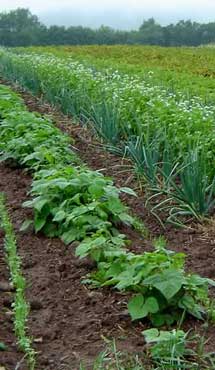
The Nordells use trap crops and chickens to deal with slugs.
Trap crops are plants used to attract pests away from valuable
cash crops. For example, since slugs seem to prefer legumes,
the Nordells have had some success planting beans in the pathways
between carrots. The slugs naturally gravitate towards the
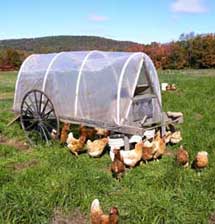
beans and leave the carrots alone. Even more effective are
the free-range chickens which the Nordells have worked into
their cover crop rotation. During a fallow year, laying hens
are grazed on cover crops and naturally feed on any slugs.
For example, the clover in an Italian ryegrass and clover
mix acts as a trap crop, attracting slugs from neighboring
cash crops. The chickens clear the fallowed field of slugs,
leaving a clean field for the following cash crop.
Who would have thought that a regenerative, in some ways
old-fashioned agricultural system could meet the needs of
a modern market? The Nordells’ Beech Grove Farm is proof
that it’s possible. Rather than reap short-term profits
through industrial efficiencies, they’ve sought to invest
in long-term sustainability through ecological efficiencies.
The farm's horses, complex rotations, and reduced tillage
methods are not industrial technologies, but rather ecological
technologies, truly sustainable and technologically appropriate.
It's hard not to come away with an impression of Beech Grove
Farm as a model of what sustainable farming could be. 
|