|
Diggers' Mirth Collective
takes its name from a radical agrarian movement that flourished
briefly in England in the late 1640s and early 1650s, when
a laborer named Gerrard Winstanley published a series of tracts
challenging private property rights and arguing that "the
earth. . . [was created] as a common storehouse for all."
The Diggers put their beliefs into practice by manuring fields
and sowing crops on wastelands in Surrey until they were driven
away by local landowners.
At the Intervale, Diggers' Mirth Collective was founded in
1992 by Dylan Zeitlyn and three other partners. A total of
11 young farmers have been part of the collective over the
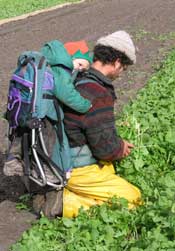
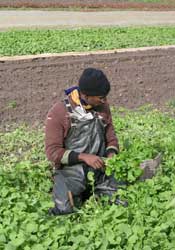
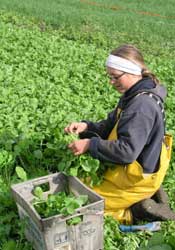
years. Today, Diggers' Mirth consists of Zeitlyn, S'ra De
Santis, Elango Dev, and Hillary Martin. The group has been
farming together for three seasons and say they're pleased
with their current balance of skills and personalities. The
four friends and partners all work the same number of hours,
earn the same amount of money, and arrive at all production
and marketing decisions jointly.
 |
 |
|
"We're really
lucky in Vermont that people understand the idea
of local versus California."
|
|
Collective management is facilitated by long hours of field
work, the Diggers say. "Planning for next year is pretty
much a constant topic of conversation," says Dev. "That,
and, 'When is it going to stop raining?'" interjects
De Santis. "We're always trying to figure out the best
balance of crops," she continues. Staying profitable
means seeking a balance, for instance, between reliable staples—the
farm's carrots and arugula are legendary—and new crops
that no one else is bringing to the farmers' market.
Diggers' Mirth manages a total of just under 10 acres of
Intervale land, putting half in cover crops each year to build
organic matter and restore fertility and dedicating the balance
to production. In addition to farmers' markets, they sell
to restaurants, through the Deep Root Organic Cooperative,
and to a handful of wholesale accounts, including Burlington's
City Market, Healthy Living, and the Shelburne Supermarket.
"We're really lucky in Vermont that the people understand
the idea of local versus California," says De Santis.
Ultimately, it's customer demand that keeps local grocery
stores committed to buying from local farmers.
Like the Intervale as a whole, Diggers' Mirth attracts visitors
from across the country who are interested in learning about
the collective ownership and management model for small-scale
farming. Zeitlyn's advice for would-be collective farmers?
First, as with any farm enterprise, "figure out what
your land is suited for growing, and then make sure you have
your markets lined up."
Second, know that the strength of a collective comes from
every member being willing and able to assume the responsibiliites
of ownership. On most farms, Zeitlyn observes, frustrations
and inefficiencies arise out of the gap between the owner
or manager, "who knows what to do, can work the fastest,
and cares the most," and the employees, who when push
comes to shove are getting paid by the hour. On a collective
farm like Diggers' Mirth, by contrast, "everyone working
there has the same level of commitment and care and ability
to work long and hard. Sure, there are debates and disputes,
but that's because we're all thinking and we all have ideas"
about how to keep improving the farm.
And that's what makes collective ownership not just philosophically
appealing, but economically competitive as well.
|