| Posted August 3,
2004: The organic agriculture movement, now morphed
due to its incredible growth into a multibillion-dollar industry,
is increasingly looking at ways to further the intention,
spirit, and goals of its original ideals. Technical sophistication,
diversification, and ecological practices for crop production
techniques are now well established and innovative marketing
and distribution methods incorporated into business practices.
Lagging behind are methods of improving the lot of the farm
worker, the frequently unnoticed element of the farm economy
equation where human justice is concerned. Gradually, though,
social accountability issues in agriculture are being advanced.
Julie Guthman, a U.C. Santa Cruz Community Studies professor
and author of the recently published University of California
Press book
cites two important trends. “People within the movement
realize that [social justice issues] were left out of the
construction of organic, not only in codification, but in
the movement itself, and that they need to be addressed explicitly
and deliberately. And there is the growth of movements around
fair trade and codes of conduct, though highly flawed, as
well as bestseller sales of books like Fast Food Nation
demonstrating increased public awareness of the social costs
of sustainable agriculture.”
Wouldn't it be nice, ponders Paul Muller, partner at Full
Belly Farm ()
in Guinda, Calif., “if in the future we judged organic
farmers by how well they are taking care of all parts of the
agriculture system, making sure farm labor is as healthy and
cared for as any other aspect of the farm?”
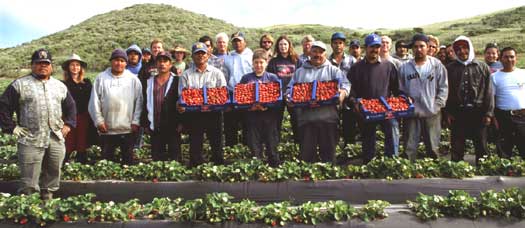
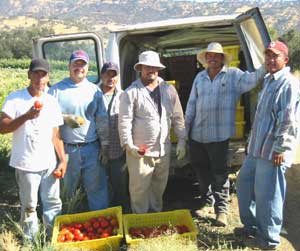
Full Belly Farm pays its 40 farm workers well above the minimum
wage and has made efforts to assist their workers' families
by having year-round employment, based on year ‘round
production and cash flow. Their longer-term workers receive
health care benefits, and Full Belly Farm partners have financially
assisted worker families to purchase homes in the community.
"I think a percentage of each crop harvested should
go back into improving farm working conditions,” says
Muller. But this concept is not easy to implement. In the
present agricultural economy, labor is an input where farmers
can cut corners when they are frequently caught in the cycle
of overproduction and lower prices for farm crops. “The
general public needs to realize and value the benefits that
farm workers provide our society and see that they are taken
care of.”
"Most farmers are wary of new, complex, or onerous standards,
but standards advocating for the health and well being for
farm workers would continue to differentiate organic agriculture
as a healthier system from top to bottom.”
Bettering the condition of our farm workers shouldn't fall
solely on the farmer, says Muller, a 25-year veteran of organic
farming. “Everyone in the food chain needs to adopt
a sense of fairness and responsibility for the well being
of farm laborers. It needs to be a partnership through the
whole agriculture system, with wholesalers and consumers paying
fair prices that then assure that farm workers are adequately
compensated in an equitable way. The equation of greater social
responsibility needs to be integrated though the whole food
system.”
Jim Cochran, farmer and owner of Swanton Berry Farms (),
believes that when you treat workers fairly and respectfully,
they will be happier and come back. “It costs a lot
of money, but it pays off in the way people look at things
in terms of the quality of the product and the services that
go into them. I hire professional agricultural workers. They
should have recognized rights. I think it is all about personalizing
the work force.” Swanton Berry Farm is a union, UFW
workplace.
 |
|
With the concept of sustainability, people mostly think about
the environment or economy or economic sustainability. More
attention is now being given to the idea of social sustainability,
which until recently has been sorely neglected. The International
Federation of the Organic Agriculture Movements ()
is a democratic federation with all fundamental decisions
taken at its general assemblies, where its World Board is
also elected. IFOAM is advancing a code of conduct for organic
trade, a learning tool for integrating social justice issues
into organic trading practices—in Europe in particular—and
intends to implement a new chapter in their standards.
It is truly an international effort, as the groups creating
the international set of social standards for all members
are the Fair Trade Labeling Organization International (FLO,
Germany), the International Federation For Alternative Trade
(IFAT, UK), U-Landsimporten (Denmark), TWIN trading (UK) Equal
Exchange (USA), Instituto Biodinamico (Brazil), Rapunzel and
Lebensbaum (both Germany), and Sekem (Egypt).
IFOAM recognizes that social justice and social rights are
integral parts of organic agriculture and processing. They
are researching aspects of labor welfare and rights, making
recommendations, and hoping soon to implement new standards
via developing guiding documents. IFOAM certifiers would then
start to enforce these new rules.
While such concerns are being heard internationally, some
resistance has come from the U.S. agriculture community to
integrate social justice and farm labor rights into the agriculture
industry, organic and otherwise. The need to bring social
justice issues into sustainable agriculture domestically is
greater than ever before. For example, in California, there
is state-mandated pesticide training for farm workers, but
there is little or no enforcement. Farm workers may be worried
about chemical impacts and hear about such things, but the
effect of poisons is frequently invisible and not immediately
felt.
American farm workers need a fair livable wage and health
benefits. Jim Cochran, owner of Swanton Berry Farm, says,
“It was three years after all my workers got health
care that I got it! I am the last person to get paid. That
is the way it works.”
Cochran continues: “It is important to institutionalize
good labor practices. When I first started, I didn’t
think about that, it was done informally. After I’d
been doing that for a while, I came to realize, it’s
good to have a [good social welfare] system and workers who
recognize their professionalism is appreciated, that they
are professional workers. Professionals have things that go
along with being professional and that includes certain protections
and forums for speaking and interactions with guarantees.
|
"The farmer is always painted
as the hero. I get so tired of that, the great suffering
farmer. Farming is tough, but in truth, the laborers have
a tougher time of it. There are a lot of other people
who have a tougher time of it than farmers." |
|
“One of the things that I have found, beyond the dollars,
is that what we do is an important part of society. We are not
people who do not count at all; in fact, we are professional
farm workers and the company has spent all this time and money
making these systems…”
“The farmer is always painted as the hero. I get so
tired of that, the great suffering farmer. Farming is tough,
but in truth, the laborers have a tougher time of it. There
are a lot of other people who have a tougher time of it than
farmers.”
Human rights and worker advocate activists feel that bringing
social justice issues to the center of the sustainable agriculture
agenda is way past due. California agriculture earns $30 billion
in annual sales, a figure three times larger than the combined
box office of the motion picture industry in the United States.
To develop more sustainability, there needs to be a better
understanding of the health and welfare status of farm workers.
Until the mid-1990s, no such research existed; there was no
baseline data on farm worker health.
Sandra Nichols is a research analyst with the California
Institute for Rural Studies ()
in Davis where, since 1999, she has studied farm worker health
and wellbeing.
“From one California study and several comparable national
studies, we’ve found health conditions among farm workers
pretty seriously troubling. Although a young population (the
median age is 34), one you’d expect to be in prime health
and strength, we’ve found a high risk for a lot of chronic
disease, heart attack, stroke, asthma, diabetes, high blood
pressure, [high] cholesterol. At the same time, farm workers
make infrequent medical visits; they are not generally covered
by health insurance. The health system is not functioning
effectively for this population to get adequate health care.
There are serious dental problems—50 percent have never
been to a dentist, only 15 percent visited one in past 12
months. There is long-term pain, eye problems, headaches related
to pesticide issues. Seventy percent have no health care.
Some services are available through employers, but many said
they could not pay for them.”
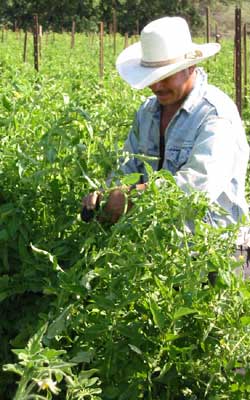
The 700,000 farm workers in California are a critical work
force that is politically vulnerable, and frequently victimized.
Many additional burdens are placed upon women back home where
families are frequently in disintegration due to transnational
labor movement. International labor policy has an impact on
many local communities.

|
|
Farm work can be very dangerous and demanding, creating work
injuries related to pesticide use and pressures to work faster,
leading to exhaustion and also a lot of mistreatment by foremen.
Housing conditions are frequently deplorable, overcrowded,
and substandard. Transportation is a serious issue as far
as accessing medical care. With no driver’s license,
it can be difficult for farm workers to get to health care.
There has been a rise in asthma and lung ailments. Mental
and emotional conditions, stress, loneliness and depression,
and financial pressures can lead to alcohol and drug abuse
as a way to deal with this depression and use of methamphetamines
to enhance performance during the peak of harvest in order
to keep up. Add to this risky sexual behavior, domestic violence,
lack of awareness of health services available, language,
and cultural barriers and, even if they get to a health clinic,
you have the equation for very serious social injustice.
Farm worker wages in the U.S. peaked in the late 1970s, and
like the state of farm worker housing, have been in decline
ever since. Current services are inadequate. This is truly
bi-national issue, since workers spend time in two countries.
There are major cultural, political, economic, structural
problems that need to be dealt with.
Dr. Aimee Shreck is doing research at the University of California
in Davis on social justice and sustainable agriculture, farm
labor, organics, and social certification. She points out
that there are many international agriculture social justice
initiatives compared to weak or nonexistent efforts in the
United States. There are exceptions, she says. “In the
U.S., there is the Food Alliance in Oregon ()
which has environmental and social standards components linked
into sustainable agriculture.” Another potent trend
in the buy local campaign is the Washington States Fair Trade
Apple campaign (),
a joint UFW/Food Alliance effort bringing together growers
and farm workers on the same side and using that as a marketing
tool to mobilize consumers to support Washington apples and
farm workers, who are all being hurt by imports.
|
"We’ve found health conditions
among farm workers pretty seriously troubling. Although
a young population, one you’d expect to be in prime
health and strength, we’ve found a high risk for
a lot of chronic disease, heart attack, stroke, asthma,
diabetes, high blood pressure, [high] cholesterol." |
|
More and more, social sustainability is happening through certification
programs, labeling, and the Social Accountability in Sustainable
Agriculture project, SASA ().
Launched in 2002, this is an international effort with four
partners developing a social and environmental verification
and labeling system (involving third party certification). It
brings together certification groups working to develop guidelines
and tools for social accountability, aiming to improve the social
auditing processes in sustainable agriculture and increase cooperation
between the various certification system initiatives.
Social Accountability International ()
has historically been involved with reforming manufacturing
and apparel sweatshops. They have recently started work on
agriculture, mostly on a large scale. Dole was the first to
be certified by SAI. SAI chose twelve pilot sites around the
world from southwest Africa to Central America and the United
States with the idea that by partnering together to conduct
joint audits, they would learn important methodologies from
each other. It’s in the grower’s self-interest
to have organic certification and fair trade certification
done at same time. Several of the initial concerns raised
by certification groups were related to discrimination, freedom
of association, working hours (international labor conventions
say that workers’ hours would be 48 hours a week maximum,
8 hours a day, 6 days a week), and existence of undocumented
workers. This last point is quite controversial, for much
of the agricultural labor in the United States is done by
undocumented workers. SASA will be finishing up it’s
research in about a year.
|
|
Stacie Clary, executive director of CALSAWG, the California
Sustainable Agriculture Working Group ()
observed that a trend is gradually forming. “We are recognizing
that small-scale family farmers are suffering economically,
and there is some common ground between family farms and workers—both
are being hurt. For example, local apple growers in Washington
are not able to compete with imported apples, so a project is
developing bringing together small farmers with retailers and
farm workers so that when consumers go into stores and see that
label, they’ll know it’s local, organic, and that
certain labor standards have been met. In CALSAWG, we are trying
to bring all the stakeholders together to produce a [social
standards] document with its principles in place and use that
to start a pilot project for farmers to see if using those principles—advertising
them at a farmer’s market or through a CSA—helps
them increase their sales and to see if consumers find that
useful.”
As for evolution in the area of the fair trade movement,
in a short period of time there has been incredible progress.
Today pineapples, mangos, bananas, and grapes along with coffee,
tea, and chocolate bearing Fair Trade Certified stickers are
available in scores of supermarkets nationwide, part of a
broader movement to make shoppers transfer their values into
the food they are buying.
The bananas are from Ecuador, Peru, and the Dominican Republic.
Certified Costa Rican pineapples, Peruvian mangoes, and South
African grapes are all grown and picked by farm workers now
earning a living wage. More than 15 percent of the bananas
in the international trade come from certified farms.
At TransFair USA (), the Oakland, Calif.-based nonprofit that certifies
Fair Trade products, marketing director Haven Bourque calls
it “a watershed moment for fair trade.”
The fair trade idea, paying farm workers in poor countries
who grow some of our favorite imported foods a fairer, higher-than-usual
wage and other benefits, started out in Europe with coffee
and chocolate. Workers also must earn at least minimum wage,
though that can be quite low, $2 a day or less, in some poor
countries. Fair Trade Certified also means workers have the
right to organize, that men and women received equal wages,
and that no child labor was used.
The fair trade concept is only five years old in the United
States. In Europe, where it took hold much earlier, shoppers
buy Fair Trade sugar, honey, tea, and orange juice. Along
with other new buzzwords such as ‘certified sustainable’
and ‘responsibly traded,’ Fair Trade Certified
food products have been brought to grocery aisles by some
of the nation’s biggest food marketers, and not just
in the enlightened, crunchy granola, hippie natural food stores,
though this is where the genesis of the movement took root.
Coffee farmers, for example, currently get $1.26 a pound
for Fair Trade Certified coffee ($1.41 for organic); the commodity
price for conventional bean is about 65 cents. ‘Fair
Trade Certified’ indicates that the producer has met
the requirements of the Fair Trade Labeling Organizations
International, which requires farm inspections to guarantee
that, among other things, farmers receive a higher-than-commodity
price for their products.
Since 1988, Global Exchange ()
has been at the forefront of the Fair Trade movement. Its
grassroots campaign to promote Fair Trade coffee and cocoa
products began in 1999 and has successfully mobilized community
activists, religious groups, students, labor unions, and politicians
to force corporations like Starbucks to be more socially responsible.
These trends reflect the strength and influence of the anti-globalization/workers
rights movements and also the growing concern over the WTO,
GATT, NAFTA, and the effects of globalization on third-world
workers. The growth of the grassroots movement, combined with
the success of the Fair Trade movement in Europe (where the
market for Fair Trade Certified products is three times larger
in dollar sales than it is in the United States) has persuaded
mainstream companies to sign on.
These trends seem to indicate that an increasing number of
consumers want to spend more money for socially responsible
products. The marketing and advertising wizards have come
up with a name for all of these people, ‘LOHAS’
consumers, which stands for ‘lifestyles of health and
sustainability,’ a term coined to describe the popularity
of products tied to interests such as yoga, organic food,
and products that embody social consciousness. Last year the
Natural Marketing Institute, a health-products consulting
firm based in Harleysville, Pa., found that a third of U.S.
consumers qualified as LOHAS, meaning they were significantly
motivated in their purchases by concern for their health and
the environment. That number was up from 30 percent the previous
year.
|
"Everyone in the food chain needs
to adopt a sense of fairness and responsibility for the
well being of farm laborers. It needs to be a partnership
through the whole agriculture system, with wholesalers
and consumers paying fair prices that then assure that
farm workers are adequately compensated in an equitable
way." |
|
In just the past year, sales of Fair Trade Certified products
are up nearly 50 percent, largely because these products are
moving into places like Dunkin’ Donuts. In just five years,
Fair Trade Certified coffee has captured mort than 5 percent
of specialty coffee sales.
The quick growth of socially and environmentally oriented
labels and certifiers has the consumer advocacy group Consumers
Union tracking 110+ designations, from bird-friendly to honoring
indigenous populations. (Check out .)
In California, voters have mandated living wages for workers
in the cities of Los Angeles and San Francisco. Many farm
workers earn less than the minimum wage. In this country,
there seems to be a prevailing attitude that it is our due
to have the cheapest food possible in the marketplace. The
people picking and planting crops are not looked on as citizens.
In fact, they frequently are not even citizens!
How can we exalt the role and position of farm workers in
our society? This is a fundamental challenge for the movement
for greater social justice at home. It seems the answer lies
in part in respecting and acknowledging the people who actually
do the work. Farm workers tend not to be particularly respected
by our society in general, yet many bring indigenous information
and most have a work ethic that supersedes that of the general
population.
The good news is that the Fair Trade movement on the international
production and domestic consumption levels has spread, and
succeeded, so quickly. Social codes of conduct for organic
farming are in development and use in Europe and elsewhere.
There is a growing movement for social justice for farm workers
around the world. The bad news is that, domestically, the
state of our farm workers is deplorable. Farm workers remain
some of the lowest paid laborers in the United States. However,
the trend for greater employer accountability for workers’
welfare and social justice is growing.
“I believe organic will have greater resonance among
the consumers if social responsibility standards are considered,
adopted, and communicated to the public,” offers Paul
Muller of Full Belly Farm. “That will in turn result
in a greater bottom line for farmers, who can see that return
go back to their workers.”
David Kupfer is a Northern California based writer and
environmental consultant, educator, and activist whose work
has appeared in Hope, Yes, Progressive, AdBusters, Whole Earth,
Earth Island Journal, and CCOF News. He has lived and worked
on four organic farms, and grows watercress for Chez Pannise
at Olala Farm on the San Juan Ridge near the Yuba river. A
graduate of UC Davis College of Agriculture, he has worked
on the annual Eco-Farm conference for many years.
|