|
Building a farm with a future in Japan will be something new
in time but not necessarily new in substance.

|
|
"Organic
food is not only for the wealthy. We want to make
a way for all people to enjoy the benefits of
good farming regardless of their means."
|
|
I would be a fool to think that I have something to teach an
agriculture with a 4,000 year history. Permanent agriculture
was born in this region of the world. But rapid development
of the industrial economy has ravaged farmers and rural areas
in Japan just as it has in other countries around the world.
In addition, in the past few years Japanese consumers have had
to contend with food poisoning outbreaks, the introduction of
genetically engineered foods, and food companies placing false
labels on their products. These events have shaken the confidence
of consumers in the food system.
It seems to me that if farmers are being hurt by the present
system, and if consumers are losing faith in the safety of
their food, then something must be wrong.
The scale of the food system may be what is at fault. I
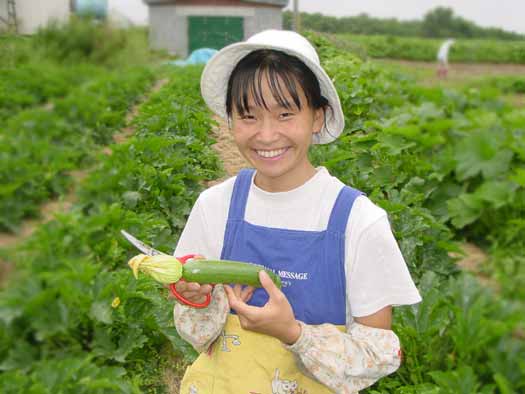
have been an organic farmer for 8 years in Japan. At present,
we grow food for 80 families. At Menno Village we are trying
to create a way of farming that just makes sense. The land
needs to be cared for and people need good, wholesome food.
That's why we are rediscovering the traditional agriculture
of Japan's past and linking together with city people who
support our farm in exchange for food.
I need to make a living but not all of our families are
of equal means. The solution? We use a sliding-fee scale depending
a household's ability to pay. Organic food is not only for
the wealthy. We want to make a way for all people to enjoy
the benefits of good farming regardless of their means.
To understand the farming practices and the social relations
that we have with our members, it would be helpful to briefly
look at the history of Japanese agriculture and what I feel
was its central guiding principle.
next
page...
|