Posted July 20, 2004: We've all seen them:
old farmhouses standing in the midst of suburban housing developments,
forlorn testimony to a former landscape. Occasionally they're
inhabited by some non-farming member of the original farm
family, or a later buyer; more often, they slowly deteriorate
and are eventually knocked down.
 |
|
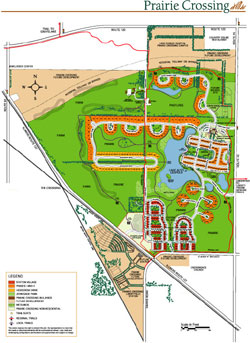
This 677-acre subdivision mid-way between Chicago and Milwaukee
is different, though, and one of the ways you can tell is that
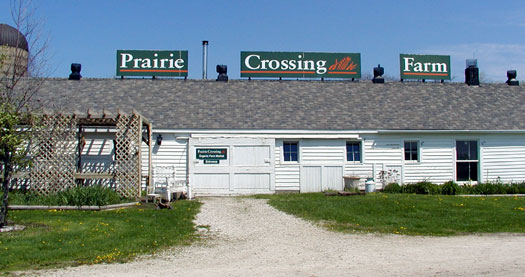
there's a group of old farm buildings still in use. Not all
are strictly dedicated to production agriculture: a large barn
built in 1885 has been converted to a community center, and
another farmhouse is now used as offices. But there are also
barns housing tractors and equipment, another farmhouse inhabited
by real farmers, and sheds and silos, greenhouses and compost
piles scattered in between.
This is Prairie Crossing Farm, and it lies at the heart of
a pioneering housing development that defies easy categorization.
Since the first lots were sold in 1996, Prairie Crossing has
attracted widespread media attention and has been featured
in academic debates about 'New Urbanism' and the meaning of
the American suburb. When it's complete (today just 15 lots
remain unsold) the community will comprise 362 single-family
housing units occupying just 20 percent, or 135 acres of the
total site. Nearly 70 percent, or 470 acres, are permanently
preserved open space, including farmland, restored prairie
and recreational areas. Two commuter train lines offer easy
access into Chicago, while a commercial center (still under
development) will provide basic shopping and other services.
From the beginning, Prairie Crossing has been governed by
10 guiding principles including environmental protection,
energy conservation, lifelong education, community diversity,
and economic viability. Its developers believe that having
a working organic farm on site is consistent with—even
essential to—all of those principles.
And while the farm was initially established by Prairie Crossing
staff members, environmental team leader Mike Sands explains
that the goal from the outset was to make this high-value
suburban land available to a local farmer or farmers. This
year, the project has reached that milestone with the arrival
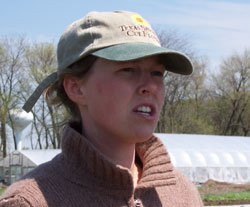
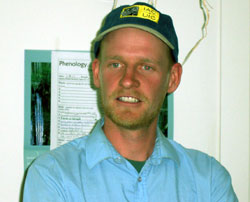
of Peg and Matt Sheaffer, their two year-old son Avery, and
their four year-old mixed vegetable and cut flower business,
Sandhill Organics. "The core idea is that the farm should
be part of the community," says Sands. "We're working
out from there."
An environmentalist's suburban village
The seeds of Prairie Crossing were sown in 1989, when a group
of ten local landowners got organized to fight a proposed
development of 2400 houses on small lots near the town of
Grayslake. They succeeded in blocking the development, but
only by brokering a deal to purchase 677 acres from the developer
for a cool $5 million.
The landowner group—incorporated as Prairie Holdings—had
little experience in development and was unprepared to sit
on an investment of that size for very long. Their initial
thought was "pretty conventional," as Sands puts
it—to carve the property up into a couple dozen 'ranchettes'
of 20 or so acres each. "But they were open to ideas;
and some land ecologists got involved and proposed something
more radical."
That radical something matured into today's Prairie Crossing.
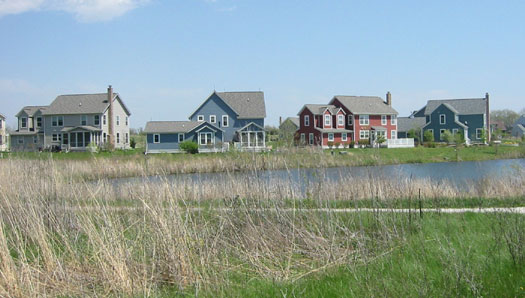
Lot sizes range from 5000 to 23,000 square feet. Houses are
designed for maximum energy efficiency and minimal construction
waste. Homeowners are encouraged to use native species for
landscaping, and several have seeded their front lawns to
prairie. Management of the common recreational areas avoids
the use of pesticides. The streets have no storm drains; instead,
constructed wetlands catch and filter run-off and then feed
into 22-acre Lake Aldo Leopold, also used for boating and
swimming. Ten miles of bike paths wind through the property
and link up with a more extensive regional trail network.
Prairie Crossing is so appealing, in fact, that from one
perspective it's succeeding almost too well. When the first
homes went on sale in January 1996, prices ranged from $180,000
to $480,000; values now run from $300,000 to $600,000. Numbers
like that may make it harder for the community to stick to
its goal of attracting an economically and racially diverse
group of people. At the moment, Sands says, most Prairie Crossing
homeowners fall into two broad groups: upwardly mobile thirty-somethings
with one or two kids; and empty-nesters in their late forties
or early fifties, some living with an aging parent. There
are also a few retirees, a few first-time home buyers, and
a few non-traditional couples.
Surprisingly, moreover, not everyone moving into the community
is already committed to the ethics of sustainability. Many
people who buy here, Sands explains, "are primarily motivated
by the fact it's a nice place to live, and it's a good investment."
"That used to bug the hell out of me," he admits,
but he's since made his peace with it, concluding that if
part of Prairie Crossing's mission can be to bring people
around to more ecological viewpoint, so much the better.
In a few gentle ways, Prairie Crossing residents are compelled
to participate in environmental stewardship. Buying a property
here entails mandatory membership in the homeowners' association,
which is responsible for collectively managing the recreational
open-space areas. In addition, a deed restriction on all lots
stipulates that one half of one percent of every sale goes
to the Liberty Prairie Foundation, a private operating foundation
which supports further ecological restoration, open-space
preservation, and community education in central Lake County.
Access to land, community, and markets
Prairie Crossing's farmland acreage includes a cooperatively-run
stable with 25 acres of pasture, 15 arable acres that have
been certified organic for a decade, and another 60 acres
that just received full certification a couple of weeks ago.
Two and a half acres have been carved off for a non-profit
'Learning Farm,' under separate management, which the two
schools on-site (a charter school with an environmental emphasis
serving grades K-8; and an 'adolescent' Montessori School
offering grades 5-9) can use for classes related to organic
farming and gardening. Peg and Matt Sheaffer have started
growing on 11 of the long-certified acres, and they're already
planning to extend their rotation with hay crops on the additional
ground.
|
|
|
The Sheaffers themselves could be poster-children for the
young organic farming movement. Now in their late twenties,
they've already gained experience working at some of the leading
organic and biodynamic farms in the upper Midwest: they met
at Harmony Valley, Linda Halley and Richard deWilde's operation
in Viroqua, Wis., and later worked at Red Cardinal Farm in
Stillwater, Minn.
For the past four seasons the Sheaffers rented land from
the Michael Fields Agricultural Institute in East Troy, Wis.,
where Matt was also on staff as primary equipment operator
for Michael Fields' 500-acre organic row-crop operation, growing
bread-quality winter wheat, food-grade soybeans, and seed
corn. At the same time, Peg and Matt together launched Sandhill
Organics, LLC, growing vegetables and cut flowers and selling
to restaurants and at farmers' markets in Milwaukee and Chicago.
Even before moving to Prairie Crossing, the Sheaffers thought
of Sandhill Organics as part of an emerging trend in which
farmers own and operate businesses that are not dependent
on single, specific farm sites. Peg argues that it can actually
be beneficial for beginning farmers to get started on land
they don't own. "There's such a difference between working
on an organic farm and owning a business," she emphasizes.
Starting a farm on rented ground requires less capital, of
course; but Peg feels it can also be easier to make good business
decisions when you have less invested in a place emotionally.
The Sheaffers had been looking for land for about a year before
settling on their new location. (Prairie Crossing, interestingly,
had been looking for farmers for about a year and a half.) In
addition to confronting the basic trade-off between land values
and market access—buildable farmland in the vicinity of
Prairie Crossing runs $40,000 an acre—the Sheaffer's search
for land forced them "to reconcile our desire for an idyllic,
isolated farm with our desire to be close to a community and
close to culture," Peg says. In their previous location,
Sandhill Organics was at least an hour's drive from most of
its markets, whereas here, as Peg puts it, "It just dawned
on us [one day this spring], we live with our customers! What
a great opportunity to get to know our customer base!"
Like those neighbor-customers, Peg and Matt enjoy being able
to hop on the train to Chicago to go to a lecture or eat at
a trendy restaurant. On the flip side, they anticipate that
one of the most challenging things about living and farming
here will be rebuilding their local agricultural community—finding
a network of farmer-neighbor-colleagues to share shop-talk
and other kinds of support.
Peg and Matt are acutely aware, too, of the potential contradictions
in their role as 'community farmers.' Occasionally, Peg says,
she's met people at farmers' markets or elsewhere who seem
surprised that she's intelligent, educated—and a farmer.
"They say something like, 'You're very well-spoken for
a farmer.'" She smiles wryly. While she emphasizes that
everyone at Prairie Crossing's been friendly and supportive,
that kind of lingering double standard suggests a real concern
that suburban farmers not become second-class citizens within
the communities they're growing food for. "I don't want
our son to be the poor kid in the neighborhood," Peg
points out. Unless Sandhill Organics can give them an income
in the same ballpark as those of the other Prairie Crossing
residents, the community vision may be difficult to maintain.
Clarifying production objectives
The Sheaffers are on their way to making that happen, however.
A prolonged wet period earlier this summer got them thinking
again about how to make "at least some of our income
not dependent on the weather," Matt says. "We need
to find ways to make farming just a little less risky,"
Peg adds. Sandhill already sells gift baskets of regional,
value-added products (including candles, soaps, wild rice,
and fruit butters) at seasonal markets and through their website,
www.sandhillorganics.com. They've also started talking to
chefs about doing frozen or processed food items.
 |
|
|
So far, too, Peg and Matt are very pleased with the shift
in markets that has come with their new location. Although
initially they had planned to sell both to Milwaukee and Chicago,
their Chicago markets are so good they've decided there's
no need to drive in both directions. The Saturday farmers'
market in the older Chicago suburb of Oak Park, they say,
has been outstanding. "We've already doubled our best
day [at the farmers' market] in Milwaukee last year,"
Matt reports.
Along with the farmers' markets, the Sheaffers have a 70-member
CSA at Prairie Crossing, which is requiring some readjustment
of the Sandhill Organics business strategy. Frustrated with
the stresses of growing 40 to 50 different vegetable crops,
over the past few seasons they had been narrowing down to
their most profitable 12 or 15 crops. They're now having to
reverse that trend to some extent in order to offer a full
range of veggies to their members. Still, Peg and Matt think
focusing on a smaller number of crops makes sense. For farmers'
markets, they find that having a lot of a few things "works
better than having a little bit of everything. We try to create
a feeling of abundance in everything we do," Matt explains—so
although they may only have flowers and five other crops at
any given point in the season, they feature 4 or 5 varieties
of each of those crops, make sure everything looks outstanding,
and pile the tables high.
At Michael Fields, their signature crops included heirloom
tomatoes, bunched spinach, arugula and other salad greens,
and fennel, but that too is open to revision. "One of
the things I've learned is that you don't necessarily get
to choose to specialize in the crops you like the best,"
says Matt. Instead, you have to go with what works best on
your land and in your markets. "It's the soil that dictates
what you can specialize in," and they're still getting
to know these soils.
A final market outlet—and an additional link to the
Prairie Crossing community—is a one-day-a-week farmstand,
newly re-located to the nascent commercial center by the train
stations.
Committing for the long term
Because this farmer-landowner relationship got started relatively
late for the 2004 growing season—the Sheaffers moved
on-site in early April, seedlings and all—they've started
with a one-year lease and a handshake agreement to work toward
something more long-term. The details won't be ironed out
until this winter, but will probably cover a term of between
40 and 99 years and include provisions to keep the land certified
organic; to maintain some kind of direct retail link to the
Prairie Crossing community; and to preserve what Mike Sands
calls "some scenic and access easements"—allowing
for walking trails around the perimeter of the farmed area,
for instance. The two parties have been looking to groups
like the New England Small Farm Institute, the Intervale,
and the Equity Trust for help in outlining the terms of the
lease.
|
| For
More Information... |
Prairie
Crossing
Sandhill Organics
|
|
Do they feel they'll be missing anything in not becoming
landowners? "We were never sold on the idea of owning
the land that we were farming," says Matt. "What
we are interested in is long-term responsibility for the land—such
as we would get with a 99-year lease. We do want to own the
home that we live in, and we want to own the equipment, because
we feel that those things have a lot to do with who we are
and how we farm."
Sandhill Organics at Prairie Crossing Farm may be just getting
started, but years of hard work and dedication on both sides
promise good things for the future. So far, Matt concludes,
"there has not been a single hiccup or a single issue
in the relationship. Our hope is that this will serve as a
model of access to land on the urban fringe for hardworking
farmers."
Laura Sayre is senior writer for The New Farm.
|