|
|
Surging conventional, organic
prices test CROPP’s “stability”
commitments
While Owen Nisley is relieved that someone else
is doing his marketing, that someone else is perplexed
in a time of unprecedented chaos in the national
organic milk market.
It’s a new market situation for George Siemon,
chief executive officer of CROPP/Organic Valley
Family of Farms, and it has him in a dilemma.
For the first time in history, the current surge
in both conventional and organic milk prices means
that CROPP is no longer paying the highest price
to its farmers, but a lower price than most conventional
and organic buyers.
Nisley sells to CROPP, the largest organic farmers’
cooperative in North America, based in LaFarge,
Wisconsin. Dairy producers from the Northwest,
upper Midwest and Northeast (including Pennsylvania
and Ohio) make up 450 of its 636 family farm members.
Their milk is marketed nationally under the Organic
Valley™ brand label For CROPP details:
“You can never pay farmers too much,”
said George Siemon, chief executive of Organic
Valley, to show where his farmer’s heart
lies. But his executive responsibilities force
him to ask CROPP dairy producers: How much can
we ask consumers to pay for organic milk? With
a half-gallon of Organic Valley milk costing at
least $3.29 a half-gallon at retail already, “you’ve
gotta start being concerned” about any further
price hike. This leads, he said, to the deeper
question begged by the current price situation:
How different can the price of organic milk be
from the price of conventional milk in the long-term?
Seeking predictability
CROPP/OV uses long-term contracts to build predictability
into the organic dairy sector, something missing
in the conventional milk market, Siemon explained.
In the conventional market, prices that were at
the disastrously low level of $10.50 per cwt.
last summer many places are now at $20. The conventional
fluid milk average for the last 10 years, broadly
speaking for the Midwest, has been around $12.50
– a price below the cost of production for
many farms.
Contributing the price hikes is growing demand
in the face of an actual production decrease this
spring. Replacement heifers are getting harder
to find as small dairy farms – the usual
source for the bigger dairies that dominate production
– have been forced out of business. The
mega-dairies – which often use BGH that
tends to shorten the productive life of its cows
-- also can’t get fresh young Canadian milkers
because of BSE-related import restrictions.
High prices for soybeans and hay are pushing
up dairy feed costs for all producers, most significantly
for those who rely the least on pasture-based
systems. These costs have a special impact, however,
for CROPP’s contracted producers with their
fixed price.
The organic co-op’s contracts to farmers
vary by region to reflect differing costs of production,
but fall in the range of $18.45 to $20.75 per
cwt., plus incentive pricing for seasonal production,
milk quality and hauling costs.
Dairy producer/members of CROPP’s dairy
executive council met this spring and did not
press for increased contract price, Siemon said
in an interview with NewFarm.org this week. They
saw the conventional milk price strength as being
some good news for their neighbors, he said.
It’s not so much the current higher conventional
prices that have him anxious. (Yet he admits that
the nine-month run for the conventional fluid
milk price spike, three months longer than the
average, might become more problematic for his
producers.)
Rather it’s recently announced price increases
of $1 to $2 per cwt. by other organic buyers that
have so changed the CROPP traditional position
of being the price leader. National organic competitor
Horizon Dairy announced a $1.50/cwt. hike this
spring, and Siemon has heard that new northeast
regional competitor Hood apparently topped Horizon’s
milk pay price to farmers.
CROPP’s only concession has been to skip
the lower “disincentive” prices usually
used during the spring flush of higher milk production.
These are off-set by higher prices offered during
lower-production times in the winter to work at
consistent volume throughout the year. Trying
to match the Horizon and Hood hikes would mean
shifting CROPP’s long-term contracts upward
a dollar or two per hundredweight and would take
million of dollars that CROPP doesn’t have
on hand, he explained.
Good signals from buyers
CROPP had to actively defend its higher-cost milk
to its commercial buyers a year ago when conventional
prices were “rock-bottom low,” explaining
its goal of slow, steady growth in the organic
milk supply. “We’re getting good signals
now from these buyers,” Siemon said. “We
see our role as to hold a steady rudder.”
“We’ve loved our stable world, and
we are not going to be easily jagged out of it.”
As competition for organic milk intensifies,
Siemon said the farmer-members of CROPP will continue
to position the co-op for long-term success. So
far, this has meant holding steady prices tied
to two-year contracts to its farmers and suppliers
in the face of the “roller-coaster”
variations. But being lower in its farmer price
for a longer time ahead while demand for organic
milk stays strong will put new kinds of pressure
on this arrangement.
It’s farmers like Nisley, Siemon said,
who help maintain the resolve to resist chasing
high prices – then risking getting caught
on the down side. “These are generational
thinkers who want to make sure CROPP is a community
vehicle,” said Siemon.
“We’re trying to deliver sustainability,
and that sticks out like a sore thumb in the world
of cheap food,” Siemon said. – Greg
Bowman
|
|
|
 |
June 11, 2004: Situated among the rolling pastures
near Baltic, Ohio, Owen Nisley’s organic “Evergreen
Acres” farm features an on-farm market, a variety of spelt
products, a flock of free-range chickens, and a certified-organic
herd of 42 Jersey dairy cows. His enterprise choices combine
a deep personal commitment to providing healthy food for his
customers, with some concessions to his own chronic health limitations
that would have sidelined people of lesser determination.
Nisley is a tall, thin, man wearing the dark blue, zipperless
clothing and a beard indicating, in the Amish tradition, that
he is married. Needing some mineral supplements for his cattle,
he politely asks for a ride in my car, as the trip would take
some time in his horse and buggy.
On the way to and from the local distributor, we pass horses
pulling black carriages, farmscapes devoid of telephone lines,
and earth-toned garments pinned to clotheslines. Nisley points
out an Amish neighbor who manages a herd of Jersey cows organically
just as he does, but who isn’t certified.
“Will he become certified?” Nisley wonders aloud.
“I don’t know.”
Nisley explained that he has always farmed organically. “For
me, growing up without using chemicals, it’s just so
hard to understand how people can still be using them,”
he said. “My dad farmed organically always. He never
believed in using the chemicals. Then when I started farming
I was committed to farming organically because I had health
problems and didn’t want to compound those problems
and challenges with chemicals.”
Energy from sun, wind and natural gas
Nisley has battled digestive problems and chronic fatigue.
Though he has been laid up for periods of time in bed, he
is fortunate enough to have a supportive community nearby,
including siblings and neighbors, who help with chores when
he is unable to complete them. With adequate rest, Nisley
is usually able to work. But he has invested in solar panels,
a windmill, and an engine that runs on natural gas that comes
from a well on his land. Even more, he has become passionate
about providing healthful organic products to his family and
to consumers.
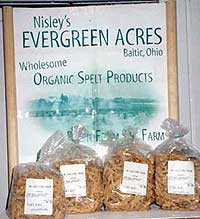
Several years ago, Nisley became interested in spelt because
it is easier to digest than grains such as wheat. Nisley began
raising spelt and used a popper to process the grain. He sold
the majority of the it wholesale and also offered spelt products
at his market. Combined with his other endeavors, however,
wholesale spelt production proved to be too much work. Nisley
sold his popper and now processes most of his grain elsewhere.
He continues to sell products at his market, and still makes
spelt flour and rolled spelt with a small roller and grinder.
He also uses spelt straw and husks as bedding for his livestock.
When we arrived back at his farm and unloaded the minerals,
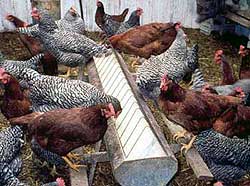
Nisley showed me the 250 chickens that produce eggs to sell
at his market. He has strikingly beautiful striped gray Barred
Rocks in with his Rhode Island Reds, two heirloom breeds.
Though they produce fewer eggs than newer varieties, he believes
the eggs are more nutritious.
Quality over quantity -- always
“I’m always looking for quality over quantity,”
Nisley said. “I’m always looking to improve the
nutrition of my products.” Nisley also raises Cornish
cross broilers for meat in the spring, takes orders for them,
and processes them on his farm.
|
"I’m always looking for
quality over quantity… .I’m always looking
to improve the nutrition of my products." |
|
Nisley is a firm believer in letting all of his chickens range
freely rather than being cooped up in buildings. In the winter
he lets them out in the afternoons. In the summer he keeps them
in pasture and houses them in a mobile, screen-bottomed trailer.
The trailer is powered by a Honda motor and Nisley moves it
often to ensure that his chickens have fresh clovers and grasses.
“Every day I move it a couple hundred yards,”
he said. “It’s more work but boy is it worth it.
Once daylight comes they’ll scatter out and have a fresh
patch to scratch. Its heaven for chickens compared to those
factory farms.”
A few of his 50-cow Jersey herd goes each year for meat,
which he sells at his store. “Jersey meat is the most
tender meat there is,” he said. “It takes the
least amount of pressure for a knife to go through a steak
of Jersey meat.”
Most of his cattle, however, he keeps for milk production.
“The Jersey cow is a gentler cow than most,” he
said. “That’s what we like about them. Plus they
have a higher butterfat and protein content. If you take a
gallon of milk and let it sit for a day you’ll see an
inch of cream on top. The higher butterfat gives it a better
flavor.”

Nisley milks his cows in a long parlor lined with tie stalls.
A natural gas engine runs a vacuum pump, a cooling compressor,
an alternator, and lights. He still dumps the milk in buckets
and carries the buckets to the milk tank. Before adding this
technology five years ago, he had milked by hand, using lanterns
for light.
To keep his milk house clean, he uses hydrogen peroxide and
an organic non-chemical cleaner. “It might take a little
more elbow grease, but we’re doing pretty good keeping
the bacteria down,” he said. “Hydrogen peroxide
works really well.”
Pampering cows with rest and comfort
One of Nisley’s most recent dairy health challenges
has been dealing with respiratory illness. A veterinarian
told Nisley to give them vaccines. The vaccines have kept
pneumonia away but, being live instead of dead, Nisley believes
it is the main cause of a persistent cough that many of his
cows have battled. Since administering the vaccine, Nisley
has learned of an organic vaccination that he vows to use
in the future.
| “I favor diversity all over
my farm. It is healthier for the land and the animals.” |
|
|
He is also working on tweaking his cows’ diet. Besides,
free-choice mineral supplements -- which allow the cattle
to choose how much of which mineral to eat -- he has tried
increasing the energy of their diet to include more foods
such as corn, grains, and even molasses. “It’s
a challenge to keep everything balanced,” he said. “It’s
a learning process.”
Nisley has also been trying to give his cows adequate rest
and comfort. In the past, he pastured his cattle all winter,
but he has recently built a new addition on his barn. This
keeps them warmer in the wintertime, and it also enables Nisley
to save manure for compost.
Nisley also gives his cattle a full year between calves,
including a two-month respite from being milked every year
to let them recuperate. This is usually during winter months
when they’re heavy with calf. Nisley does not artificially
inseminate his cows, choosing to run a bull from June to October
instead.
Grazing “fits” small-scale,
sloping pastureland
As with his chickens, Nisley believes in raising grass-fed
cattle and so keeps most of his land in pasture. “I
like to have most of my land in grass,” he said. “I
like it better than corn. My dad used always say the small
guys are less equipped to raise corn – let the big guys
do that.”
Nisley manages his pasture intensively, by rotating the space
where he allows his cattle to graze. His pasture is divided
into two main areas, separately fenced. He subdivides each pasture
into 36 squares by rotating fencing. This ensures that his cattle
always have fresh grass and gives his pasture a chance to rest
when he moves the cattle. It is also a much cleaner system because
it spreads manure to different areas and keeps his pasture evenly
cut, as a mower would.
The rapid, intensive movement increases plant diversity.
In many pastures, cattle will favor certain areas and let
others grow up. By allowing the sun to shine on the ground
in the well-grazed zones, heavy grazing pressure promotes
the growth of rye grass and native clovers, which he planted.
This is exactly what Nisley is striving for. “I favor
diversity all over my farm,” he said. “It is healthier
for the land and the animals.”
|
"Once daylight comes they’ll
scatter out and have a fresh patch to scratch. Its heaven
for chickens compared to those factory farms." |
|
While intensively managed pastures are becoming increasingly
popular in dairy circles, they aren’t novel in the grand
sweep of European Alpine dairy history. “Its not a new
thing,” Nisley said. “They used to do it in the
old country but now many have gotten away from it,” referring
to Swiss farmers.
Nisley sells his milk to CROPP/Organic Valley ()
based in Wisconsin. CROPP is the second-largest organic dairy
co-op in the country and the largest organic farmer-owned
cooperative in North America. Originally, Nisley was part
of a nine-member organic co-op in the area. There was benefit
to membership but marketing still took a lot of time and didn’t
always result in a premium for organic production.
Farm
at a Glance |
 |
|
Owen
Nisley
Evergreen Acres
Holmes County, OH
Size:
70 acres in pasture and fields out of 110
acres owned
Location:
East-central Ohio
Certified organic
Primary crops:
pasture, spelt for grain and straw
Primary
livestock: pastured dairy and
laying chicken
|
|
|
More than a year ago, they decided to join Organic Valley.
While they still do their own handling, they get higher prices
and don’t have to worry about marketing. “A few
years ago we didn’t get any premium for organic production.
It was just a personal commitment to stewardship,” he
said. “At that time it was hard work. Now we’re
reaping the benefits.”
Their success with Organic Valley prompted four others to
join their co-op, which continues to seek new producers as
it locks in larger contracts over time for its organic dairy
products. Nisley sees good opportunities ahead for other Amish
families that farm without using chemicals but aren’t
yet certified organic.
Bob Penelberry, a milk inspector who was checking Nisley’s
farm, has seen several farmers in the county become organically
certified and feels that it is a good way to go for many.
“Organic dairies are starting to catch on,” he
said. “I hope they do. They make sense for the small-time
farmers.”
It certainly seems to be working well for Nisley. He has
been able to combine making “a decent living”
with his passion for raising healthful products. “Our
hope is just to be good stewards of the land,” he said.
“And to produce quality, nutritious food for our own
family and consumers.”
As I was leaving, Nisley loaded me up with six dozen huge
brown eggs, a jar of homemade pear jam, and three packages
of steaks and roasts – all in exchange for driving him,
he said.
As I was eating a supper of grass-fed, organic Jersey steak
later that evening, I couldn’t help but think that I
got the better end of the deal.
Maybe he’ll need more minerals some time.
Jason Witmer is a freelance writer and photographer in
Pittsburgh, Pa., with his eye on the future of agriculture.
|