|
 |
|
Farm
at a Glance

Fred and
Judy Brossy
Ernie's Organics
Shoshone, Idaho
Size: 300 acres
Location: South-central Idaho,
near Shoshone
Certified organic since: 1996
Primary crops: winter wheat,
potatoes, dry beans, vegetable seed crops, hay
|
|
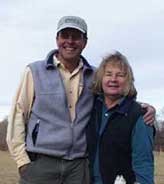
May 5, 2004: Fred and Judy Brossy have been
farm managers on the Bryant Ranch in south central Idaho,
just outside of Shoshone, for the past 20 years. Eleven years
ago they began transitioning to organic production, becoming
certified in 1996. They have been using the name "Ernie's
Organics" for their operation since 1997.
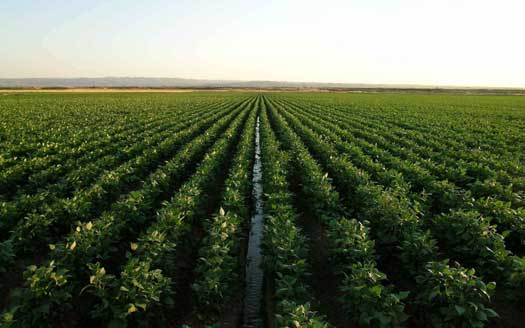
Of the Bryant Ranch's 1800 acres, about 300 are irrigated.
Last year Ernie's Organics raised 65 acres of wheat, 40 acres
of pinto and red beans, 15 acres of potatoes, and 120 acres
of hay and forage crops. Additionally, they had an acre of
asparagus, a quarter of an acre of carrots for seed, a half
an acre of sweet corn for seed, and 8 acres of green beans
for seed. Most years, Fred runs about 65 head of cattle from
April to October, fattening them up for another organic farmer.
Judy Brossy takes care of most of the office work for Ernie's
Organics, and has two greenhouses and a garden plot for raising
vegetables and cut flowers for sale at farmers' markets.
I worked for the Brossys as a farm hand for three weeks in
the summer of 2003, staying in their house and learning about
organic farming for a book I'm writing. Fred and I worked
side by side, and spent countless hours talking about the
best way to farm—not only to pay the bills, but to grow
healthy food, enrich the land, preserve the environment, and
do well by their employees.
Shoshone lies in an arid plain that depends on irrigation
for growing crops. The soil is good, and winter snows in the
surrounding Sawtooth Mountains refill the water table, lakes
and streams. Irrigation has been a way of life for farmers
here for over a century. Each farm has an allocated amount
of water, and the date that a farm first joined the water
distribution system determines who has priority. The land
Fred and Judy Brossy farm has been a part of the water system
since 1883. Even so, Fred worried last year that his water
would get shut off before the beans were finished growing.
He was lucky, and he brought in the crop.
Water costs are a considerable part of the year's expenses:
the Brossys spend about $15/acre to buy water and an average
of $30/acre for the electricity to run the pumps. They use
gravity irrigation as well as pivots, hand-lines, and wheel-line
irrigation, so the water costs vary considerably from field
to field.
Building soil
The Brossys build soil fertility in several ways, but use
no bagged fertilizers, not even ones approved for organic
use. Primarily they enrich the soil by rotating it into perennial
grass and alfalfa pasture, grazing cattle on the fields for
up to six or eight years before returning the land to arable
production.
It's Fred's belief that something should always be growing
on every inch of the farm. He plants winter wheat shortly
after potato harvest, and uses peas as a late-season cover
crop when not planting wheat. Even though they will winter-kill,
the peas can fix some nitrogen, keep weeds from getting established,
and add organic matter to the soil.
 |
"Smell that. Look
at the soil. See the earthworms. This is what
organic
farming is all about."
--
Fred Brossy
|
|
|
Fred uses portable electric fences to move the cattle to
fresh feed daily. For the 65 cattle he grazed last summer,
that meant expanding the pasture each evening by about an
acre, leaving the previously-grazed areas available also.
Too many cattle on a field, Fred says, will compact the soil
and damage the perennial grasses. He tries to keep 60,000
pounds of live weight per acre of irrigated pasture, and has
a handshake deal with another farmer who pays him 30¢
for each pound gained by the yearling cattle. In addition
to the cattle, Fred uses some of his 120 acres of pasture
to produce hay that he sells to horse owners.
After being in pasture, the land goes through a 4-year crop
rotation including one year in beans. A typical arable rotation
would be potatoes-winter wheat-beans-winter wheat, then back
to pasture. The rotation varies so that the potatoes can be
grown as far as possible from where they've been grown the
year before, and to take into consideration the best way of
irrigating a crop.
Another significant component in maintaining soil fertility
at Ernie's Organics is the use of compost. Dairies have become
big business in Idaho, and some of these have gone into compost
production, so Fred is able to buy as much as he needs. He
adds about 2 tons of compost per acre each year at a cost
of $15/ton. Fred figures it's money in the bank.
Labor and land
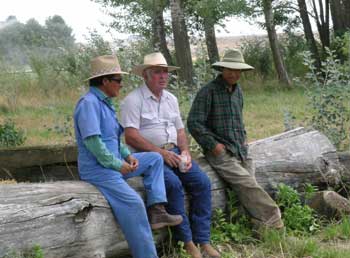
One of the aspects of Ernie's Organics that struck me as
remarkable was how well the hired hands are treated. Fred
employs three Spanish-speaking workers, all of whom are year-round,
salaried employees. They are given free housing on ranch land
and they get health insurance. In return, the farm hands are
highly loyal, hard working and good at what they do. Unlike
other farms I've visited, Fred doesn't have to tell each worker
what to do. Two of the three have been with him for 20 years.
They know what has to happen, and they do it.
|
|
In the winter, the farm hands work on the farm machinery,
much of which is old, or putter around the farm getting caught
up on chores like fixing fences. They don't necessarily put
in 40 hours a week during the winter months, but they know
that at harvest time--or when weeds are growing like mad--they'll
put in a lot more than 40 hours. There is no time clock, which
suits Fred and his workers just fine. Labor costs on the farm
are about 30 percent of the operating budget.
Fred and Judy have more flexibility in determining what benefits
and pay to offer their workers because the land they farm
belongs to an absentee owner who understands that with the
Brossys' stewardship the soil has gotten richer and the land
more valuable. The owner, who bought the property two decades
ago, lives in California and visits just once or twice a year.
He has not demanded that the Brossys pay him a specific annual
return on his investment, which gives them wiggle room in
bad years. "The land can only sustain so much return,"
Fred pointed out. "People working the land need fair
compensation. Some years it's tough to do that and still give
a fixed return to the owner. Corporate agriculture generally
wants a certain return on investment, which forces some farmers
to cut corners. Basically conventional agriculture depends
on fossil sunlight—petroleum—for fuel, fertilizer,
and transportation. The energy is all derived from the photosynthesis
of plants long ago. Ultimately a heavy reliance on petroleum
is not sustainable. We work hard to be as sustainable as possible."
Managing weeds and pests
The Brossys manage weeds on two scales: in the short term,
through persistent cultivation; and in the long term, through
crop rotations. Last summer we weeded the beans with Fred's
1947 Farmall tractor pulling a 4-row cultivator. Fred uses
a Lilliston rolling cultivator to get early weeds in his potato
fields. Wheat fields are harrowed before the crop emerges
to get the first flush of weeds. Failing to do that would
result in weeds that "would haunt you the rest of the
year," according to Fred. Once the wheat gets tall enough
it will out-compete most weeds. Canada thistle can be a problem
if it gets established, however.
| In Fred's view, pests of any kind
are less of a problem in a diverse ecosystem. Pests for
one crop are not pests for another. "The Colorado
potato beetle, for example, is an ally when growing beans.
They eat the nightshade weeds, leaving them skeletonized." |
|
|
Due to a labor shortage--I wasn't able to adequately replace
the experienced farm hand who was on sick leave--the weeds
got ahead of us in one field of beans. They got too tall to
clear out with the cultivator, so Fred and I and the two other
farm hands had to hoe a six-acre field by hand. It was a high
value crop as these were beans for sale as organic seed. We
used long-handled hoes with heavy heads that we kept razor
sharp, but it was still slow work. Canada thistle, pigweed,
and wild geraniums were the dominant species.
When a field gets too weedy, Fred will seed it in grasses
and turn it into pasture or hay. Perennial weeds lose their
vigor, he explained to me, if cut three times for hay each
summer. Some weeds the cattle won't eat, so he makes a pass
with a mower after the cattle are done with a field. This
also keeps the weeds from going to seed.
Although most insects are not a major problem for Fred, the
Colorado potato beetle is one he has worked hard to keep under
control. Each year he tries to plant the year's potatoes as
far from last year's field as possible. He has used Bt, and
recently has had excellent success with spinosad. "It's
so effective it's almost scary," Fred said. "But
you have to be very careful how you use it--the beetles develop
resistance so easily."
In Fred's view, pests of any kind are less of a problem in
a diverse ecosystem. Pests for one crop are not pests for
another. "The Colorado potato beetle, for example, is
an ally when growing beans. They eat the nightshade weeds,
leaving them skeletonized." Fred also noted that when
the federal government mandated aerial spraying for the whole
area for grasshoppers in 1985, everything got out of balance,
creating worse problems.
Recently, as part of a school project, two teenagers have
been coming out to the farm to raise beetles that selectively
attack spotted knapweed. They raise the beetles in net tents
and then release them, monitoring the effects on the weed
population. This is typical of Fred--he's open to new approaches,
and welcoming to people who want to use what the ranch has
to offer.
Although late blight in potatoes is a problem for some conventional
farmers in Idaho, Fred has never had a problem with it. "We
water at night to mimic dew. The hot winds dry out the leaves
during the day, which minimizes the chance of infection,"
he said.
Making connections, including sales
|
|
Experimenting
with Compost
Tea
Fred Brossy is always on the lookout for any
new technology that might increase his yields
or efficiency. Last summer he attended a day-long
seminar conducted by Dr. Elaine Ingham, the guru
of aerobic compost tea. Ingham promotes compost
tea to increase fertility and biological activity
in soils, and as a way for plants to fight off
attacks by fungi, such as those that cause blight
in potatoes.
Fred decided it was worth a try. Cautiously optimistic,
he decided to buy tea from Magic Valley Compost,
a local firm that has invested in the equipment
and training needed to prepare it properly. This
seemed better than investing in a brew tank and
learning the nuances of tea production.
After the wheat harvest last August, Fred disked
the stubble twice and then had Magic Valley apply
tea at the rate of 10 gallons/acre (at $2/gal)
through a center pivot irrigation system. After
that, he irrigated the field once a week for the
rest of the season so that the microorganisms
would stay active and help to break down the stubble.
Fred is not yet convinced that the tea made a
big difference, but it's too early to tell.
|
|
Part of the success of Ernie's Organics has been a good marketing
strategy. Fred usually pre-sells his crops, and does not store
them. When we harvested the wheat crop last summer, conventional
wheat was selling for $2.85 a bushel, but Fred had sold all
of his at $5.50. Although we loaded the wheat from the combine
into his storage bins, trucks from Washington state were there
to take the harvest away within two days of harvest.
All of Fred's organic potatoes, 200 tons, were sold to Kettle
Chips in Salem, Oregon. Again, Fred got a premium price, about
$10 a sack when conventional spuds were selling for $5. His
beans went to Amy's Kitchen and Eden Foods.
Oftentimes last summer (after a long hot day in the fields)
Fred would somehow find the energy to study after we were
done. He was working on a bachelor's degree in agroecology
from Prescott College, and recently was awarded his degree.
He was able to design his own course of study and to make
the coursework relevant to his own work as a farmer.
Like any farmer, however, Fred gets tired and worn down,
too. Being an organic farmer and having a network of friends
who are also organic farmers has been important to Fred and
Judy. They aren't working 6 or 7 days a week just to get a
pay check. They believe that organic farming is important
not only for the high quality food they produce, but also
for the greater environment. Their commitment to treating
everyone--and every part of the environment--with respect
and caring is central to who they are.
One of my favorite memories of my time on the farm was riding
in the wheat combine. The driver, a conventional farmer from
a neighboring farm, was amazed at what Fred had done without
herbicides or synthetic fertilizers. He looked at how clean
the fields were, and what great yields Fred was getting. He
looked at me and shook his head. "Fred should be proud,"
he said. "I don't know how he does it, but he should
be proud."
I had to agree.
|