|
May 11, 2004: Can Pennsylvania's apple sector
figure out new production methods and systems that will meet
even certified organic standards?
Some industry leaders are beginning to think the answer may
be yes. On November 12, 2003, the (SHAP) called
for the formation of a task force to encourage sustainable
and organic apple production in the Keystone state. The task
force has been taking its assignment seriously, and task force
chair Dr. Jim Travis says he is strongly optimistic about
the possibilities.
| "There are 25,000 acres of apples
in Pennsylvania, 70 percent of which are harvested for
processing apples each year. We think as much as 20 to
25 percent of those acres could be transitioned to organic." |
 |
|
"There are 25,000 acres of apples in Pennsylvania, 70
percent of which are harvested for processing apples each
year," says Travis, a plant pathologist with Pennsylvania
State University's Fruit Research and Extension Center in
Biglerville. "We think as much as 20 to 25 percent of
those acres could be transitioned to organic."
The barriers lie not so much in production methods, Travis
explains, or even in markets, but in the availability of certified
organic processing facilities and—more fundamentally—in
coordination among different segments of the fruit business.
"Some growers say the markets aren't there. But then
buyers tell me, give us more organic fruit—we can sell
whatever they can grow."
The idea behind the SHAP task force is to build that coordination
and thereby rachet up Pennsylvania's organic capability over
time. Converting conventional orchards takes three years under
certified organic growing practices before the fruit can be
sold as USDA organic. Bill Kleiner, Penn State Cooperative
Extension agent for Adams County, is the task force's vice-chair;
other members include growers, processors, and fresh-fruit
market representatives.
The full committee has met twice, in December and March,
to find out "what's possible, what's required, what needs
to be learned." In addition, Travis has been traveling
the state, gathering the pieces of the fruit-growing and -processing
puzzle that could be assembled into an organic whole.
The overriding goal is to keep Eastern
fruit growing viable
One of those pieces is keeping the flow of Pennsylvania apples
consistent into the “Eastern apple” stream—the
broad marketing label for apples from this side of the Rocky
Mountains. The use of controlled atmosphere (CA) storage by
more Eastern producers has increased retail buyers’
interest, but keeping a consistent supply of high-quality
apples is critical to competing with Washington and foreign
imports, says Diana Aguilar, executive director of the Pennsylvania
Apple Marketing Program.
Developing new organic market sectors at the commercial level
is always a matter of balancing dependable, certifiable supply
with the expanding—but not consistent—demands
of the organic marketplace.
“The task force research will show whether Pennsylvania
can actually produce enough low-spray or organic applies that
will work in the processing market, and that will be a good
thing,” she said. “As the task force and the industry
explore the specialty markets, find the techniques, work on
quality control and develop the necessary processing infrastructure,
I can work with buyers to promote our sales.”
Knouse Foods, for example—an apple growers' cooperative
and one of the largest Pennsylvania-based apple processors—is
interested in launching an organic line. (Knouse labels include
Musselman's and Lucky Leaf apple sauces and juices.) Another
major Pennsylvania processor, Mott's, already has an organic
line, and is reportedly interested in finding more local apples
to supply it.
Knouse Foods has also agreed to consider accepting a scab-resistant
apple variety for processing—a step which could have
a significant impact on growers' ability to manage their orchards
organically. "Scab control accounts for up to half of
fungicide applications in orchards," Travis says, "so
right there we could save 50 percent of fungicide use on apples
statewide."
Pennsylvania's apple growers seem to be equally interested
in organics. Travis said he was struck this year by the fact
that "the majority of the research projects selected
for funding by the growers this year were organic-oriented."
(The state's apple growers fund research through a voluntary,
self-imposed tax and mandatory assessments.)
"Processing is our first target, because it's most achievable,"
says Travis, "but the fresh-fruit people are interested
too."
Redefining the research agenda
A final and critical component of the SHAP organic apple
initiative is to redirect university research toward sustainable
and organic management objectives. Travis says he and his
colleagues at Penn State are already conducting some experiments
relevant to organic management in existing, non-organic research
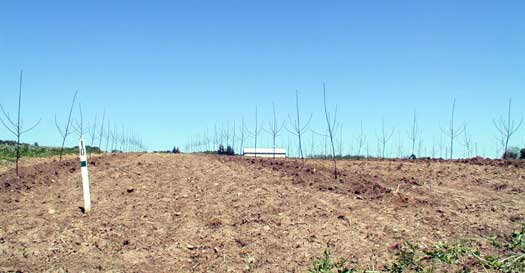
orchards, and a new, 2-acre block dedicated to organic apple
research is on its way toward organic certification.
In addition, the Penn State Fruit Center in Biglerville hopes
to work with a nearby grower to transition a 7 year-old orchard—one
that includes some promising varieties for organic production,
such as Gold Rush and Enterprise—and establish some
research plots there.
Finally, Travis and his colleagues are coordinating with
The Rodale Institute® researchers to develop a research
program in the Rodale farm orchards, where the trees are between
15 and 20 years old. (Click
here to read more about organic apple growing at The Rodale
Institute.) This will give the scientists three orchard life-stages
to look at—new, mature, and in between—as they
begin to examine such topics as tree spacings, training, fruit
rots, pests, and weeding in organic systems.
Travis believes that a focused research effort could yield
dramatic advances in sustainable and organic fruit production
for the Northeast. A veteran of progressive, conventional
fruit production and research—he grew up on an Adams
County fruit farm, and has been on the Penn State faculty
for over 20 years—Travis says he became convinced of
the viability of organic methods a few years back when he
conducted a trial comparing fungicide treatments to a foliar
fertilizer treatment in grapes. The foliar fertilizer had
no direct fungicidal effect, but nevertheless, it completely
arrested the spread of the fungus.
"Frankly, I expected low efficacy," he admits.
"But instead we found that these materials are just as
effective, are less expensive for the grower, and have reduced
environmental impacts. . . The only way that could be working
is by stimulating a disease resistance in the plant itself."
|
"We've spent 25 years making
synthetic methods work. What if we spent 25 years making
organic methods work? Just imagine what we could do." |
|
This phenomenon, known as systemic acquired resistance or
induced systemic resistance, involves using a benign material
to trigger an immune system-like reaction in the crop plant.
It is one of the many promising new areas of research in organic
agroecosystems.
"It made me realize, we've spent 25 years making synthetic
methods work. What if we spent 25 years making organic methods
work? Just imagine what we could do."
Pennsylvania's fruit sector, Travis says, has a lot going
for it: a favorable topography; highly skilled and dedicated
growers, some of them fourth- and fifth-generation fruit farmers;
and good soils that produce flavorful fruit, prized by processors
nationwide.
Exploring organic growing and marketing makes sense because
the system offers a way to preserve and build on that heritage
while at the same time improving profitability, satisfying
evolving consumer demands, and taking better care of environmental
resources. "The science is there," he concludes.
"All the pieces are there. We can do it." 
James Travis is a co-author of the "" and of Penn State's
"" guide for home orchardists,
and has a hand in the university's "" and newsletter. He has also co-written ","
describing the first three years of an on-farm research project
designed to reduce the use of synthetic inputs in Pennsylvania
grape production.
Laura Sayre is
senior writer for The New Farm.
|