|
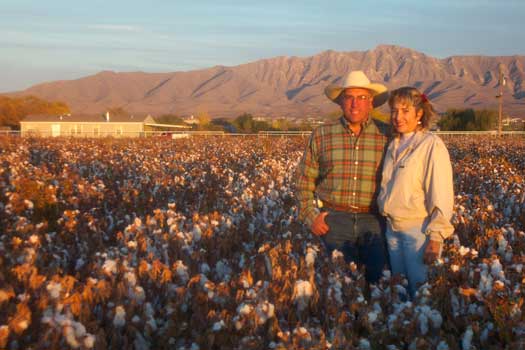
January 28, 2004: Dosi Alvarez is not your
stereotypical organic farmer. Stocky as the desert mountains
on the horizon of his Mesilla Valley farm, he calls himself
“conservative and traditional,” a point he makes
to explain why his farm sticks to a 900-acre cotton/chile/alfalfa
rotation, without growing market vegetables.
Yet tradition has not prevented
Dosi from learning the agronomic and human health lessons
that drive the organic food and farming movements today. In
fact, Alvarez Farm has been completely swept up in these movements,
perhaps even saved by them.
“This organic cotton has been our salvation,”
says Dosi, sitting at his kitchen table munching Japanese
sushi crackers from a recent visit by one of his international
buyers. Norma Alvarez, Dosi’s wife and fellow harvester,
nods strongly in agreement. “We have neighbors farming
conventionally and struggling to make ends meet,” Dosi
adds. “We get a premium for our cotton that more than
offsets our higher growing costs.”
According to a July 2003 ATTRA publication on “Organic
Cotton Production,” premiums range from $0.95 to $1.25
per pound, depending on quality and staple length. Yet it
was not money, but an expectant father’s concern for
his family’s health, that moved Alvarez Farm to go organic.
A family concern
Raised by a second-generation Spanish mother and a Spanish-speaking
father on a farm cleared by his granddad with horses, Dosi
took over the farm in 1974 after college and brief employment
with the Swift Packing Co., in Phoenix, Ariz. “Dad got
tired,” remembers Dosi. “Profits were not always
there, so he got a job inspecting fruits and vegetables for
USDA.”
Dosi spent the next two decades raising cotton, chile, and
alfalfa the conventional way, relying heavily on chemical
fertilizers and pesticides that he mixed himself out of concern
for his employees. Still, he recalls the day he found a farmhand
slumped over a tractor. “This guy was spraying Furadan
on the alfalfa weevil. We took him home and urged his family
to get him to a doctor. Fortunately he recovered.”
Fear from the close call, however, remained with Dosi after
he and Norma married in 1992 and found themselves expecting
their first child. “I was afraid my son might be born
deformed. I’d get the chemicals all over me. There’s
no time to shower during the day. Some of these chemicals
are systemic. Now that we have a family, I feel better knowing
the barn doesn’t have insecticides the kids can get
into.”
A red, white and green crop rotation
Dosi grew 25 acres of organic cotton in 1995 and 50 in 1996
before making the whole farm organic in 1997. Starting slowly
allowed him to test the truth of horror stories about organic
production. With two seasons of decent crops and not too many
problems, switching to full organic production eliminated
the expense of cleaning equipment between organic and conventional
usage.

Alvarez Farm grows 350-400 acres of American Pima, a premium,
extra-long-staple cotton that seems almost tailor-made for
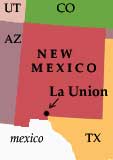
the climate in La Union, on the border between New Mexico
and Texas.
“We grow the S6, White, and Sea Island varieties,”
Dosi explains. “Organic Pima is a double-niche for us.
Pima cannot be grown [just] anywhere. We have hot days and
cool nights, which Pima likes. And it drops its leaves naturally
as it matures, so it sort of defoliates itself for harvest.
Then we just wait for the killing frosts to take care of the
rest.”
The ubiquitous Southwestern chile is the second crop in Dosi’s
rotation. He raised it organically but sold it to conventional
markets until the organic chile market opened up two years
ago. The chile’s fine, fibrous root system seems to
mellow out Dosi’s soils, leaving few clods to work through
the following year. Buyers of Dosi’s chiles include
Desert Herb in Chamberino, N.M., and Frontier Natural Products,
based in Iowa.

Alfalfa is the final member of the Alvarez Farm rotation.
Easily grown organically, it fixes nitrogen in the soil and
provides pasture for Norma’s horse breeding business,
which helps eliminate weevil eggs. With demand for organic
alfalfa rising among beef and dairy goat farmers, the crop
also provides Alvarez Farm with an additional revenue stream.
Crop rotation at Alvarez Farm means three to four years of
alfalfa in one spot, followed by alternating years of cotton
and chile for the next three to four years.

 |
|
Additional soil fertility is supplied by applications of
aged cow manure—20 tons/acre for cotton and 30 tons/acre
for chile—which in turn have helped bring Dosi's soil
organic matter (OM) content up to 2 percent, well above the
½–1 percent average for the Mesilla Valley. High
OM retains soil moisture, and allows Dosi to plant cotton
and chile in two rows per bed instead of the conventional
one row per hill, cutting in half the number of furrows in
each field and thus reducing the amount of water needed to
irrigate the furrows. In 2002—which Dosi recalls as
the season of a lifetime—Alvarez Farm beat its 2 cotton
bales/acre average with whopping yields of 2.7 bales/acre.
Bindweed, pinkies and bureaucracy
Naturally, two of the problems Dosi faces as an organic cotton
farmer are weed and pest control. The former is far greater
than the latter at Alvarez Farm. “We use furrow irrigation
out of canals, so there is constant weed seed infestation,"
Dosi says. “It’s a never ending battle.”
The farms’ biggest weed troubles are Johnson grass
and bindweed. The solution is a combination of new and old
technology—mechanical cultivation and hand hoeing. “This
is where I can fall back on dad and my employees, who farmed
before chemicals. Labor for hoe hands is one of our biggest
expenses.”
In fact, weeding labor can be $30 to $100 an acre, making
it the single largest component of Alvarez Farm’s average
cotton cost of $80/acre, up $30/acre from the farm’s
experience with conventional growing. Dosi admits that being
a short drive from Mexico gives him a good labor source; if
he were one hundred miles north, some of his employees might
not travel there for the work.
As for cultivation, it has been the farm’s only major
new equipment requirement since going organic. Dosi bought
an eight-row Sukup cultivator last year. When the cotton plants
are young, V-shaped blades keep weeds at bay. As the plants
mature, wire weeders can be run extremely close to the cotton’s
woody stalks without doing harm, allowing thorough cultivation.
“One day I saw one of my employees cleaning his nails
while running the cultivator,” remembers Dosi. “I
said, Guero, what are you doing? He said, 'Dosi, this thing
is great, it runs itself!'” Norma kids that Dosi and
the farmhands bow down to the Sukup each morning before work.

Asked about pests, Dosi responds with a calm enthusiasm one
might not expect from an organic cotton grower. “A lot
of insects don’t like Pima,” says Dosi. “It’s
not as lush as upland cotton. My beneficial insects take care
of the bollworm, and our killing frosts kill a lot of the
insects.”
The red tape of state government in Santa Fe seems to challenge
organic cotton farmers in New Mexico more than the pests.
“Five years ago there was a boll weevil eradication
referendum that required widespread spraying,” remembers
Dosi. “We went up to Santa Fe trip after trip asking,
what about the organic farmers? Everything is a battle there.”
Working with the New Mexico Organic Commodity Commission,
Dosi hammered out an agreement under which organic cotton
growers could avoid spraying by promising that if the boll
weevil appeared in a cotton field one year, they would cut
off its food supply by not planting cotton there the next
year. “We had weevils in some fields, but today there
aren’t any in the whole valley,” says Dosi with
a smile. “And the year off didn’t bother us anyway,
because that’s part of our rotation to break up pest
cycles.”
Today, it’s not the boll weevil but the pink bollworm
that threatens southwestern Pima, nesting inside the bolls,
where it is hard to get. A local referendum has Dosi and his
neighbors in eradication mode for the pest, using pheromone
disruptors to interfere with mating. According to a USDA study
cited in ATTRA’s “Organic Cotton Production,”
“pink bollworm mating disruption trials recorded higher
yields (1864 lbs/acre) than control fields with no mating
disruption (1450 lbs/acre).” After the pheromones reduce
the pest’s numbers, the farmers will introduce sterile
moths to try to eliminate it. Funding for the $10/bale eradication
assessment is a current challenge for Dosi, whose organic
commitment prevents him from qualifying for an exemption by
planting Bt cotton.
Dosi admits that the pink bollworm is one of his greatest
frustrations, reducing yields in infested fields to ¼
bale/acre. Yet on balance, Alvarez Farm averages 2 bales/acre,
well above its initial target of 1½ bales/acre and
at least equivalent to the yields on neighboring conventional
cotton farms.
Having a story to tell
So where does Alvarez Farm go to sell its harvested, ginned
cotton?
“The buyers have come to us,” admits Dosi. “It
started when Buhler Mills in Switzerland approached SWIG looking
for organic cotton.”
SWIG is Southwest Irrigated Growers, a marketing coop that
has been the funnel for almost all of Dosi’s buyers.
Buhler Spinning Mills buys 10,000 to 15,000 bales of extra
long staple Pima cotton from American growers each year to
spin into premium yarn in Winterthur, Switzerland. Just 300
of those bales are organic Pima, all from Dosi’s operation.
Athena Mills in Richmond, Calif., is another buyer at Alvarez
Farm.
Yet if the mills are the customers that would-be organic
growers need to land, one way to get to them is through the
product manufacturers. “Establish relationships with
the end buyers,” Norma recommends. “They are craving
that. It gives them a story to tell when they market their
products.”
Take organic outdoor clothing manufacturer Patagonia, for
example, which buys from Buhler and plans to start a line
of women’s clothes made of Pima cotton. Patagonia visited
Dosi and Norma recently for a photo shoot for its upcoming
spring catalog. So did a nine-person film crew from Taishobo
Industries of Osaka, Japan, which makes towels and fashion
apparel. The three-day shoot included fashion models, plus
footage of Dosi harvesting cotton by hand into an old-fashioned
burlap sack. According to Dosi, Taishobo plans to make a documentary
for environmental education back home.

Asked about other marketing opportunities, Dosi says ranchers
are buying his organic cottonseed for feed. He doesn’t
think anyone is doing fresh-frozen organic chile sales over
the Internet. For Alvarez Farm, marketing success has meant
watching the symbiotic development of different organic markets
and going with the flow.
Among friends
Reflecting on nine years of organic growing, Dosi recalls
that like soil fertility, which took five or six years to
build up, the acceptance of neighbors required time too.
“During the boll weevil eradication, I talked to a
friend about our no-spray plan. He just looked at me and said,
all I can say to you is you better do your homework. Well,
that was the best advice he could have given me. I did my
homework, we avoided losing our certification to spraying,
and in the process our fields became a refuge for a tremendous
assortment of beneficial insects.”
Acceptance followed success as Dosi was elected chairman
of the local gin, Mesa Farmers Coop, a few years ago. Area
farmers closed six gins to consolidate operations at Mesa
Farmers, which processes over 30,000 bales annually. To minimize
the cost of cleaning between conventional and organic runs,
it does all of the organic cotton at the end of the season.
And at the end of the day, Dosi and Norma rest knowing that
children Dosi, Seth, and Michele are growing up without the
toxic chemicals of conventional agriculture, snug in a home
supported exclusively by farming. 
|