|
Facts
About Agricultural Diversity
The Food and Agriculture Organization (FAO)
defines agricultural biodiversity as “the
variety and variability of animals, plants and
microorganisms that are important to food and
agriculture.”
Agricultural biodiversity is critical because
it:
• Provides the building blocks for breeding
new, useful crops and livestock
• Helps maintain agricultural productivity
through the preservation of soil biota, pollinators,
predators
• Contributes to greater landscape health
including soil protection, water quality and air
quality
• Improves the ability to recover from economic
or natural disasters like poor market prices,
pest infestations or bad weather.
Globalization and industrial agriculture are
two root causes in the rapid decline in crop and
livestock diversity over the last 50 years.
As a result:
• Over 90 percent of the world’s crop
varieties have disappeared from agricultural fields
• Half of the breeds of many domesticated
livestock have been lost
• Just three crops – maize, wheat
and rice – now provide more than 50 percent
of humankind’s requirements for protein
and calories.
Market pressures and the undervaluing of agricultural
biodiversity are considered to play significant
roles in its loss.
(Sources: FAO, UK Agricultural Biodiversity Coalition,
International Plant Genetic Resources Institute)
|
|
| More
Slow Food |
 |
|
Besides the “For the Defense of Biodiversity”
awards, Slow Food coordinates a number of projects
to increasing awareness and support for food products
and farmers threatened by agricultural industrialization.
In fact, in October Slow Food plans to host a
“Meeting of Farmers and Food Makers”
in Turin, Italy. They plan to bring together thousands
of farmers and others to share experiences, build
international connections, and develop strategies
for a new agriculture based on respect for “tradition,
humanity and the environment.”
Learn more about two of Slow Food’s other
initiatives, the Ark of Taste and Presidia:
NewFarm.org Nov. 21, 2003: Heritage turkeys: a
fast-growing and profitable niche for adventuresome
farmers http://www.newfarm.org/
features/
1103/heritageturkey.shtml
Link to Kristen’s Naples Presidium slide
show
|
|
|
Winner info
Africa
Name: Sibri Hamidou Ouedraogo
Association: UNGVT
Contact: BP 468, Ziniare, Burkino Faso
Name: Regassa Feyissa Chebeko
Association: EOSA
Contact: PO Box 5512, Addis Abeba, Ethiopia
Name: Sebastien Rafaralahy
Association: TEFY SAINA
Contact: B.P. 1221, Lot SIAE 33, Ambondrona, Antananarivo,
Madagascar
Americas
Name: Jose Iturriaga de la Fuente
Contact: Privada de los Cedros 230, Tetelpan San
Angel, Obregon, D.F., Mexico
Name: Winona LaDuke
Association: WELRP
Contact:32033 East Round Lake Road, Ponsford,
MN 56575, USA
Name: Getulio Orlando Pinto Kraho
Association: Assoc. of Kraho Villages
Contact: Aldeia Manoel Alves Pequeno terra Indigena
Kraho, Itacaja - Tocantins, Brazil
Asia
Name: Taiuli Berishvili
Association: DIKA
Contact: Nakveti 16, Delisi III, Tbilisi, Georgia
Name: Kuular Darjaa
Contact: Lenin Str., 62-7, 667000 Kyzyl, Tuva,
Russia
Europe
Name: Charles Martell
Contact: Laurel Farm, Dymok, GL18 2DP Gloucestershire,
Great Britain
Oceania
Name: Glenn Wightman
Contact: Box 496, Palmerston NT 0831, Australia
|
|
|
 |
A few weeks ago,
I had the good fortune to meet Charles Martell, a British farmer,
on a bus in southern Italy. As the bus wove its way up to a
mountain town on the outskirts of Naples, he told me about his
farm.
Since 1972 Charles has farmed near a town called Dymock in
southern England. He raises cattle and tends an orchard of
pears and apples.
On the surface Martell sounds like a typical farmer. But
dig a little deeper and you’ll find that he's a recognized
leader for his efforts to conserve agricultural biodiversity.
The cattle he raises is actually a rare breed, Old Gloucester.
Though they existed in Gloucestershire County for centuries,
they were only 33 left when Charles started to farm. Enamored
by the dual-purpose breed, he’s worked with his fellow
farmers to bring the registered Old Gloucester population
back up to over 700.
Rather than sell his milk to a dairy processor, he now turns
it into award-winning cheeses, including the double and single
raw-milk Gloucester varieties. These 200-year- old cheeses
disappeared from England’s markets in the 1950s, but
now enjoy a healthy comeback.
And his apples and pears? You won’t find Red Delicious
on his farm, but you will discover the official Gloucestershire
Apple Collection that holds 98 varieties of local apples.
To preserve and propagate his area’s diminishing pear
varieties, Charles also help set up England’s National
Collection of Perry Pears in 1989.
Martell’s penchant for reviving the agricultural and
biological heritage of his region is what brought us both
to Naples. He was one of 10 individuals honored with Slow
Food’s “For the Defense of Biodiversity”
award on November 9, 2003. I was a member of the award’s
international jury.
For the Defense of Biodiversity
Slow Food, an international consumers movement, has granted
this award since 2000. The event celebrates and promotes ordinary
individuals – farmers, researchers and organizations
– who have made outstanding efforts to conserve the
agricultural biodiversity and food traditions of their regions.
(See side bar, “Facts about Agricultural
Diversity.”)
|
| Farm
tour Slow Food style |
|
One of the ways Slow Food works to protect agricultural
diversity and the economic viability of small
farmers internationally is the designation of
“Presidia.” These are individual farmers
or processors who Slow Food has identified as
working to preserve unique and, often vanishing
pieces of their local food cultures.
Once established as a presidium, Slow Food helps
to promote the farm or processor and its products.
It promotes the location, and develops new and
fairly priced markets. It allows the farmers to
use the level of technology they feel is most
appropriate.
In developing nations, The Slow Food Foundation
for Biodiversity may provide additional financial
assistance to a presidium, if necessary. To date,
Slow Food has identified 167 Italian and over
20 international presidia.
(To learn more about Slow Food’s presidia
go to:
)
During the “For the Defense of Biodiversity”
awards in Italy, award winners and tour participants
had the opportunity to visit one of several Slow
Food presidia located southeast of Naples, on
central Italy’s western coast. I visited
the community of Agerola where Slow Food works
with local farmers to protect its local breed
of cattle, the Agerolese cows, from extinction.
In doing so they also help preserve its regional
cheeses, including Fior de Latte and the highly
prized Provolone del Monaco. MORE>
|
|
Slow Food started in1986 when a McDonald’s restaurant opened on one of
Italy’s most famous squares. Concerned that the industrialization
of food was causing the eradication of thousands of food varieties
and tastes, founder Carlos Petrini reached out to consumers.
He showed them that uniformity in the food system -- in chain
restaurants or supermarkets - was not inevitable. Consumers
could choose something different.
Soon after a movement was born.
Today the Slow Food is on five continents, has over 70,000
members and even boasts its own publishing company. The United
States has over 5,500 members.
Unlike the multinational agribusiness giants that promote
efficiency through monoculture and low commodity prices, Slow
Food recognizes that farmers are key to preserving flavorful,
high quality food. And profit is the key to maintaining farmers.
Using their influence with food lovers, chefs and media,
Slow Food rouses considerable interest in rare, often undervalued
foods and the people that produce them. This translates into
more demand in the marketplace.
Through their work to honor and promote farmers, Slow Food
hopes to buck the trends of efficiency, scale and homogeneity.
In its place they intend to create demand for a different
kind of agriculture -- one based on quality, diversity, and
small farm viability.
For farmers tired of the same old agriculture -- be it #
2 yellow corn, soybeans or Holstein cows --this movement is
leading one of the ways toward something different.
The Awardees
An impressive collection of people joined Charles Martell
on the stage in Naples’ San Carlo Theater. Although
they came from different climates, cultures and farming systems,
each works to protect and advance some part their culture’s
agricultural heritage – be it crop or animal species,
traditional farming techniques, or local agricultural knowledge.
Each award winner, either individual or organization, received
a cash award of 3,500 euros ($4,170 US) plus international publicity
to garner more support and interest in their various projects.
Slow Food awarded special jury prizes, 7,500 euros ($8,900 US)
each, to the winners from Burkina Faso, Brazil and Mexico.
The following is an overview of the other nine awardees,
organized by continent. To read great stories about the award
winners, visit the awards page of Slow Food’s website:
To contact one of the award winners go to:
Link to contact information (attached in excel spread sheet).
Americas
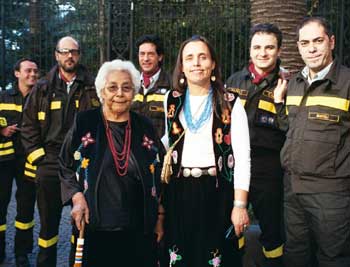
Winona LaDuke
and Margaret Smith,
both of White Earth Land Recovery Project in northern Minnesota,
received the award for their efforts to protect the integrity
of the wild rice markets essential to the White Earth Reservation’s
economic and social viability. The hand-harvested wild rice
market is currently under threat due to the influx of cheap,
paddy-grown wild rice on to the market.
A trained historian, José
N. Iturriaga de la Fuente has spent years
collecting information on food plants, recipes and products
rapidly disappearing from his native Mexican culture. He was
honored for his work to protect the country’s rich food
heritage being lost as Mexico’s population becomes increasingly
urbanized.
The Union of Krahô Villages,
located in Brazil, was acknowledged for their initiative to
recover the seeds and agricultural knowledge necessary to
grow local varieties of maize, sweet potato and cassava. Lost
with the introduction of hybrid replacements in the 1970s,
they have been able to reclaim the agricultural crops suited
to their soils and culture.
Africa
Agronomists Sebastien Rafaralahy
and Justin Leonard
Rabenandrasana, of the Association Tefy Saina in Madagascar,
were honored for their efforts to increase rice production
while protecting the environment. They worked with farmers
to implement an innovative rice-growing technique that utilizes
native rice varieties, rather than fertilizer-intensive “modern”
rice varieties, to increase rice yields.
Regassa Feyissa
formed the organization, Ethio-Organic Seed Action, to help
recover Ethiopian cereal varieties – such as durum wheat
- displaced by the Green Revolution. He was acknowledged for
his research and collaboration with farmers to protect Ethiopia’s
agricultural biodiversity and find markets for their agricultural
products.
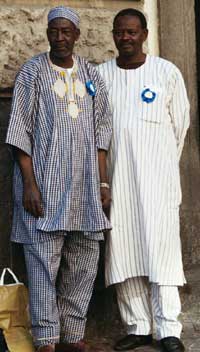
Union Namanegbzanga des Groupements
villageois de la zone de Tanlili (UNGVT) is
an organization that coordinates “village groups”
to improve the quality of life for small-farming families
in a region of Burkina Faso. UNGVT was honored for the successful
restoration of crops and tree varieties, which have improved
food security and helped control soil erosion over the last
ten years.
Asia
Taiul Berishvilli,
a plant breeder from Georgia, was recognized for his efforts
to improve Georgian varieties of cereals and legumes neglected
during the Soviet Union’s reign. Through his organization,
Dika, he is working with farmers to grow and find markets
for native varieties of chickpeas, beans, barley and wheat.
Kuular Darjaa
is a farmer and veterinarian from the Republic of Tuva, one
of the most remote of the former Soviet Republics. Kuular
was selected for his efforts to conserve rare Tuvan sheep
breeds as well as the cheese and dairy products made from
their milk.
Europe
For over 30 years Charles Martell
has worked to create a strong link between animals, trees,
the local area, and farmers and food producers. A farmer,
cheesemaker and expert in rare apple and pear varieties, he
has worked alone, managing to persuade other breeders, farmers
and producers of the importance of promoting local food resources,
and enabling people to rediscover this forgotten heritage.
Oceania
An ethno-botanist from the northern territory of Australia,
Glen Wightman
was honored for his work with Aboriginal communities to document
their traditional plant and animal knowledge. The Aborigines
have a rich oral tradition rapidly being lost with their declining
population.
The Special Jury Awards went to Iturriaga de la Fuente of
Mexico, the Union of Krahô Villages in Brazil and the
Union Namanegbzanga in Burkina Faso.
Kristen Corselius is a program associate with the Institute
for Agriculture and Trade Policy (Minneapolis, MN). For questions
or comments, please contact Kristen at .
|