|
September 15, 2006: As scientists we often lament on the mass
of good research with relevant information that never sees
the light of day. In organic agriculture this is an even greater
problem for two reasons: 1) there is a critical need for peer-reviewed
information on healthy certified organic systems to overcome
the organic research deficit; 2) much of the data recorded
is functionally lost due to more conventionally minded reviewers
who have no basis for appreciating the profound role of biologically
based organic practices on crop productivity.
In some ways The Rodale Institute Farming Systems Trial helps
to turn the tables a bit since there are few conventional
studies which have stayed the course for 26 years, as has
this trial, giving it a sort of “super validity.”
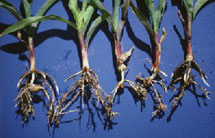
This spring I happened upon an exhaustive study of corn root
systems done at the Rodale Institute in collaboration with
researchers at Cornell University. The study was novel for
its use of video cameras to directly measure corn root proliferation
in the soil at different depths in experimental fields.
Working with Rodale Institute researchers, Dr. Victor N.
Bushamuka (a World Bank Graduate Research Fellow) implemented
the study using the video camera process developed by his
advisor, Cornell’s Dr. Richard W. Zobel. From 1989 to
1991, data points were taken from three sites at the Rodale
Institute and two sites in New York to see how alternative
agricultural practices affect the root system. To date this
work is only published as a Cornell University thesis despite
its novel method and dramatic results. ("Response of
maize root growth to tillage, fertilization, and weed control
systems under conventional and sustainable cropping systems.”
1993. Master’s Thesis. 181pp.)
Coming to grips with an inconvenient truth
You would think that a study like this would be enthusiastically
publicized, analyzed and debated, but this has not been the
case. The data irrefutably supports a startling conclusion:
alternative agricultural practices support dramatically increased
root growth. I believe this challenging conclusion is why
these findings haven’t yet made their way into scientific
literature.
This is science that deserves to make an impact, but first
it has to escape the thesis section of the Cornell Library.
So here goes:
The FST is our long-term trial comparing three cash-grain
systems: two organic rotations and one non-organic, corn-soybean
rotation, based on the current recommendations for soybean
and cash-grain corn production from The Pennsylvania State
University. Compared in randomized and replicated plots are
an organic system where manure supplies fertility, an organic
system where legume crops provide fertility and the “conventional”
cash-grain system.
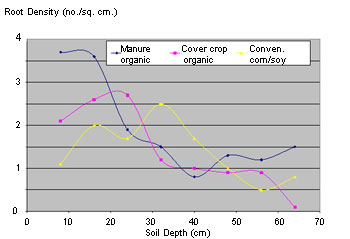
The FST results reported by Zobel and Bushamuka showed that
the livestock (manure) organic system and the legume organic
systems both significantly increased the presence of lateral
corn roots. The manure system doubled the lateral roots of
conventional corn and soybeans measured in the first 25 cm
(10 inches) of soil. In just 10 years of organic transition
management (), the amounts of roots were sharply
increased in both organic systems compared to the conventional
corn/soybean row-crop system.
Although it may seem obvious that roots are a good thing,
there is a group of scientists that argue, conversely, that
roots represent a waste of plant energy which could be better
portioned to plant grain yield. This seems to me like saying
legs are over-rated for running.
It’s true, I suppose, that you wouldn’t need
roots if you didn’t need to support the plant, feed
the plant, and get water into the plant. However, under natural
field conditions, those are real needs that crops have.
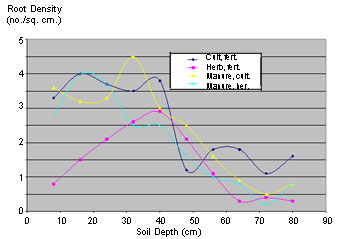
In data from the New York (Aurora) site, Zobel and Bushamuka
looked at the factors of cultivation versus herbicide and
manure versus fertilizer in all combinations. Like the Rodale
Institute site, at Aurora it was evident that manure was superior
to fertilizer for favoring lateral root density, and cultivation
was superior to herbicide.
Most dramatic was the data results showing that combining
the impacts of fertilizer and herbicide applications proved
synergistically negative for corn root proliferation at the
30-cm (12-inch) depth.
Looking at the devastating reduction of roots when fertilizer
is combined with herbicide in these samples, we can appreciate
the wisdom of the early organic pioneers who disliked reliance
on chemical inputs and advised against their use. Indeed,
long-term experimentation and experience would show a wide
range of subtle negative side-effects not originally envisioned
by the proponents of these “crop protection and enhancement
materials” at the beginning of their unplanned experiment
with the food system.
If I were a farmer entering a drought—or a corn plant,
for that matter—I would like the cushion of having more,
not fewer, roots. Considering there are thousands of synthetic
chemicals that interact with each other in unknown ways, the
best way to avoid unexpected negative consequences from these
is to avoid and reduce their use. Even their proponents look
at them more and more as necessary evils rather than as the
easy solutions they once thought.
As long as roots have the last say, using more natural biological
management techniques and fewer chemical inputs is the way
to improve plant responses to the growing environment as we
know it. 
|