|
June 8, 2006: You may have noticed your
gasoline is a bit more expensive these days. Farmers, likewise,
are watching their fertilizer costs skyrocket and trying to
figure out how they can keep up production levels as the price
of their mainstay nitrogen fertilizer jumps off the charts
(Douglas Beegle, Expensive Nitrogen, 2006). In standard conventional
corn farming, nitrogen fertilizer is a key input. For a long
time, nitrogen cost was considered cheap. But as natural gas
costs rise, synthetic N is no longer the bargain it was once
was (natural gas is a major input for making ammoniated nitrogen
fertilizer).
Not only was nitrogen historically cheap, but it packed a
wallop in terms of quick crop growth response. But that was
then and this is now. Now that nitrogen is not so cheap, how
are we going to deal with the changed cost structure? Now
that commodity grain prices are stagnant at best, how do we
reconcile the spiraling costs of these nitrogen inputs? Now
that we know that heavy use of nitrogen depletes the soil
and pollutes our waterways, what adjustments are we making?
Both the questions and the answers are timely, for the world
has changed and we must change with it.
Traditionally, corn fertilizer is either put on up front
or split between a starter fertilizer and a side-dress application
when corn is knee high. Following fertilizer and lime recommendations
given by Ohio State University Cooperative Extension Service
in 2003, a farmer would have spent $62 to produce 150 bushel
corn on 1 acre. We called TiMac, a large fertilizer dealer
in our area, and calculated the cost of that same recommendation
today at $132.70. The bottom line is that fertilizer is no
longer cheap. It is pretty hard to see the margin you will
have with $2-per-bushel corn on a $132.70 per-acre input cost
for fertilizer alone.
Experiments have shown that when you put down starter fertilizer—which
is typically about 20 percent of the total fertilizer recommendation
and investment—you get 80 percent of the crop response.
Conversely, putting down layby fertilizer costs you 80 percent
of your investment to get 20 percent of the return. Yet most
farmers do not use starter fertilizer, as it slows their planting
time. Even a starter fertilizer option would cost you about
$15 to $37 per acre today. This tweaking can help, but a whole
new approach is really what’s needed to lower costs
enough to realize any level of profit (profit that is not
dependant on price supports and commodity payments; both of
which might soon be the stuff of history).
Robert Rodale talked about the value of a farm’s natural
internal inputs and their ability to keep costs down as well
as regenerate, contributing to a thriving production system
that improves as they are used. Using your own resources is
the key to getting off the fertilizer treadmill—and
related upward cost spiral—and to reinvigorating your
prospects in farming.
Before synthetic fertilizer, farmers had traditionally used
legumes, composts and manures as their corn nitrogen sources.
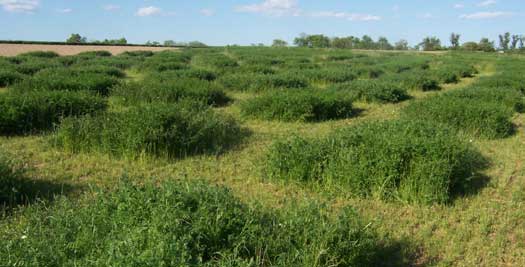
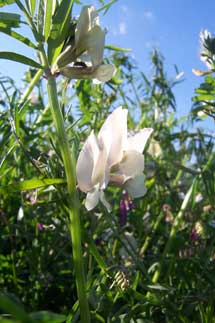
Here at The Rodale Institute, growing hairy vetch in late
summer after wheat allows us to capture our nitrogen for the
cost of cropping the winter annual. A sole crop of hairy vetch
costs about $30 for hairy vetch seed (30 pounds at a $1 per
pound) and about $12 to plant and turn it under. At 2003 levels,
growing a vetch crop was about a wash compared to fertilizer
nitrogen, but in the current economy it will be about half
that of the nitrogen cost alone compared to a conventional
approach. Hairy vetch produces up to and exceeding the 150
pounds of nitrogen needed for the nation’s average corn
crop of 150 bushels per acre. Additionally, hairy vetch and
winter cover crops actually build the soil organic nitrogen
supply (not to mention improving soil structure and soil biology).
Our research has shown that you can reduce the hairy vetch
seed rate by half by using oats as a nurse crop. By adding
a bushel of oats, which will winter kill, you get better fall
weed control, you trap damaging soil nitrates, and the spring
nitrogen production of hairy vetch ends up the same as with
the higher seeding rate. With the oat nurse crop, the total
cost of growing this mixture is about $30 per acre—a
good cost reduction from $42 per acre for straight hairy vetch.
We have shown in our long-term trials that corn and soybean
productivity can be maintained under cover-crop-fueled systems
at levels comparable to those fueled by synthetic chemistry
(namely, petroleum-derived agricultural products).
 |
|
Because the natural input of cover crops builds soil over
time, we need fewer and fewer inputs each year rather than
more because our organic matter in soil builds up using this
management approach. Our farm has increased 30 percent in
its soil-organic-matter base, stimulating three times the
microorganisms, which in turn recycle twice the nutrients
compared to a fertilizer- and pesticide-intensive input system.
Growing winter annual cover crops has been shown to not only
allow cheap nitrogen for corn production but to control soil
erosion and nutrient losses that otherwise would occur in
winter-fallow systems. As the price of petroleum has increased,
so have the costs of herbicides. In our weed-sensitive soybean
crop, rye can replace the use of escalating herbicide costs
(not only because the herbicides are increasingly expensive,
but also because growing resistance to products such as Montanto’s
Roundup means application rates are increasing).
With continuing problems with both input cost and water quality
issues related to both synthetic nutrient runoff and pesticides,
cover crops are the natural and friendly antidote for ailing
farm economies and for rising environmental and health problems
related to conventional farming systems.
Our farm manager, Jeff Moyer, received $18 per bushel on
our cooked organic soybeans for feed meal, $6.50 per bushel
on organic feed corn, and $6.25 per bushel on our organic
wheat for organic pretzels. In addition to great pricing,
we are exceeding our county’s yield averages on all
crops we grow, and our crop yields have improved over the
years.
Here at The Rodale Institute, our organic agriculture adventure
began with a rain of criticism for promoting a production
system pundits said could never compete with conventional
row-crop agriculture. Our own long-term research, and now
that of an increasing number of collaborators, has demonstrated
that the pundits were wrong! Last year, Ohio State University
researchers showed their organic management was significantly
more productive than conventional row-crop agriculture, further
confirming our own long-term results. At this point there
is no question about competing using organic practices; the
better question to ask is why government continues to support
dated and damaging agriculture systems that don’t make
economic or energetic sense (nevermind the toll they take
on environmental and human health).
It is time for farmers to take their futures into their own
hands and for our elected officials to support the fundamental
changes needed in our agriculture and food system (the latter
group can begin by fostering programs on cover crop education
and by making a support system available so this important
practice can flourish). We can see some progress under way
in this arena. Close to home, Penn State University provides
a range of information on how to measure the need for nitrogen.
This includes soil, tissue and stalk tests and worksheets
for crediting rotation histories and for manure application.
These tests are useful for conventional, sustainable and organic
farmers alike.
With synthetic nitrogen costs at historic levels, this point
in history offers the perfect opportunity for all farmers
to revise the economics of their production systems and to
change what is necessary to maintain viability as farmers.

|