|
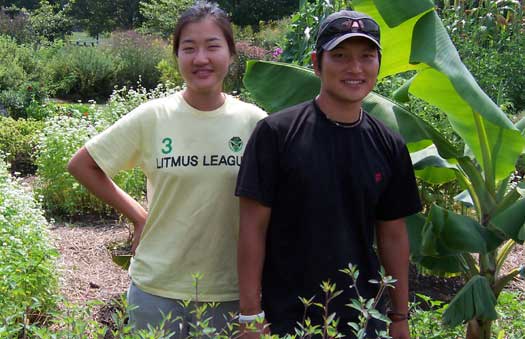
A-Reum Song I am a sustainable
agriculture student at Gyeong Sang National University in
South Korea. I spent my summer vacation with my professor
and seven team members volunteering with the research department
at The Rodale Institute.
In my country, there is not a very good impression of organic
agriculture. Farmers in South Korea follow similar standards
of modern industrial agriculture dominant in the West. Even
the small farmer typically relies heavily on chemicals. This,
I think, is connected with yields. Commercial farmers think
organic yields will be lower due to weed pressure and the
poor quality of soil on land that has historically been farmed
conventionally. A loss of yield can do serious damage to these
farmers.
Most farmers and consumers in South Korea know that organic
farming is being encouraged around the world. We just don’t
have access to the evidence and facts motivating this change.
Those who farm don’t know how to change from conventional
agriculture to organic farming, they don’t understand
why they must change, and they don’t know how such change
will affect their profits.
The Rodale Institute is doing a good job answering these
questions. Before coming here, I never saw a field farmed
using only organic practices. I have learned so much. My professor
always says “Never leave soil unclothed.” Bio-mulching
is important, he says, and “as we build up healthy soil,
we can produce a healthy crop.” Now I really know what
he is talking about, because I have seen it with my own eyes.
During my time here, I have seen and felt what organic farming
is.
I hope our seven team members will become pioneers of organic
agriculture in Korea. And I hope organic farming will become
“normal” farming and “conventional”
farming will someday be the anomaly, not only in my country
but around the world.
Mu Yeong Park In the summer
of 2006, a group of Korean students took on a new adventure.
We traveled to The Rodale Institute’s 333-acre research
farm for an internship program different from anything we
could ever experience in our country.
Seeing organic systems practiced and compared to conventional
farming gave us new facts and new knowledge about agriculture.
These include the knowledge that organic practices such as
cover cropping and limited and no tillage improve both the
fertility and the water-holding capacity of the soil. These
ideas have given us fresh insight.
Another new concept for us was Community Supported Agriculture
(CSA). I think this growing movement shows the concern many
Americans share about agriculture and that they are willing
to support organic farmers. And the fact that many young farmers
take so much pride in the growing organic agriculture movement
is a big difference compared to Korea.
I am sure that sustainable agriculture students from my university
will continue to visit The Rodale Institute. I want to say
to them:
- Don’t bring your anxiety. If you don’t have
a strong mind, the whole team will be weak together.
- Do prepare. There is no time for preparing in the U.S.
- Do what’s in front of you with full focus. If you
don’t lose an opportunity, there is more to gain.
I want to say thank you very much to all the kind people
who have helped us during our time in the United States.
|