|
|
Farm-at-a-glance

Mariquita
Farm
Location:
Land in Watsonville and Hollister
Years farming: Andy has farmed
for the last 20 years in various capacities from
farmworker to owner, from large farm to small.
Total acres farmed: 25
Key people: Andy, farmer and
rave king; Julia, farm wife, CEO, mom, email elf,
etc.; España, foreman, tractor driver,
all around repairman; Jose España, head
harvester; Lourdes Duarte, head vegetable packer
Range of crops: greens, root
crops, tubers and herbs, berries, peppers, tomatoes,
garlic, melons, artichokes, and more besides that.
Marketing methods: CSA and 1
farmers market, with a small number of carefully
selected restaurants that pick up at the farmers
market
Soil type: silty loam
Regenerative practices: cover
cropping, crop rotation, fallowing
Length of season: all year
|
|
|
 |
May 10,
2004: Sloth, carelessness, and poor planning can be
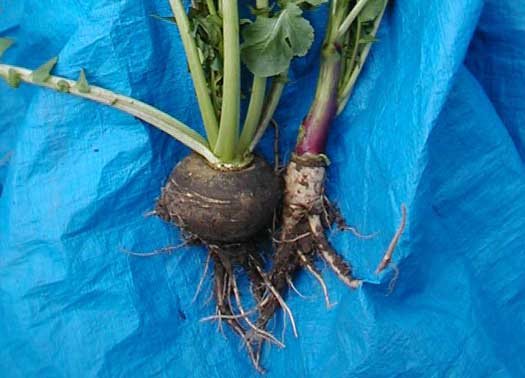
great teachers, as my most recent harvest of black Spanish radishes
illustrates. The black Spanish radish is an antique radish,
a throwback to a time when people counted on storing roots to
survive the winter. To modern consumers the black Spanish radish
is puzzling. Unlike the ubiquitous little red radishes that
adorn green salads the black Spanish radish is a huge root that
can weigh as much as a small cantaloupe. Black radish isn’t
mild either, but can be harsh, especially right after harvest.
Many recipes for black radish call for the root to be grated
and marinated in salt water to dispel the mustardy bitterness.
I’ve read that it is traditional to slice black radish
into pieces and eat it with a pinch of salt and a swig of
beer. This recipe is ok, though I’ve usually wondered
why I don’t just swig the beer solo. But I keep planting
black radish, even though most of my customers probably don’t
eat their black radishes anyway.
The root is so magnificently ugly with its rough textured
black hide that it makes a fabulous conversation piece. Food
stylists looking to take eye catching photos of table displays
love it. I’m charmed by the black root myself and I’ve
taken pleasure in growing an heirloom vegetable that seems
more suited to a museum than a restaurant.
Over the years I’ve learned to plant black radish after
midsummer so it will not bolt to flower before forming a root.
And I’ve learned to religiously cloak my planting of
black radish with a protective row cover from the day I sow
it. Even if most people don’t care to eat black radish,
cabbage maggots sure love it and without a row cover a marketable
crop can be almost impossible to achieve.
This is where sloth, carelessness, and poor planning can
make a big difference. Last year poor planning meant I didn’t
have row cover on hand to protect the black radish crop when
I planted it. The fabric came but then we didn’t do
a good job pinning it to the ground. The wind blew the row
cover off the seed bed leaving the tender young radishes exposed
to the flies. The result was a crop of black radish riddled
with pale white maggots. Out of two 40 inch beds planted in
double rows 600 feet long, I only salvaged a couple of bags
of radish worth saving. I threw the plastic sacks in the dark
corner of my cooler, disgusted. This was a bitter harvest
in more ways than one.
Recently I uncovered the bags where they had lain forgotten.
I figured the radishes would be rotten after four months in
a bag. But no. When I looked the roots seemed to look the
same as the day I harvested them. I sliced a root open to
see if it was rotten inside. The black radish in my hand had
snowy white flesh. Then, cautiously, without even a can of
beer on hand to wash away the taste, I tried a bite. The radish
was great. The harsh mustardy flavor was gone and the taste
was clean crisp, and mild!

I finally understood. Black Spanish radish needs to be stored
to reach its full potential. Back in the old days black radishes
would have been heaped in the cellar with carrots, turnips,
celeriac, etc. In the spring after sweeter roots had been
eaten up the black Spanish radish would be waiting, ready
and good. Beer brewed with the previous fall’s grain
harvest would be ready to drink, too.
My constant companions--sloth, carelessness, and poor planning--had
come to my rescue again. Now I have a good plan. This July
I will plant black radish right on schedule and I’ll
care for it assiduously. In November we will harvest and clean
the crop, then store it. Come next spring I’ll have
a crop to sell just when my fields are empty and I’ll
need money. Maybe I can even make back the dollars I lost
last year.
Ain’t I smart? 
|
April
20, 2004
Hats
off to the many sombreros of a farmer Quack
lawyer, truck driver, fake chef, and borderline
carnival barker: all in a day’s work for
a farmer like Andy Griffin … and once in
a while he gets to contemplate nature.
April 2, 2004
The
watermelon radish: Conspiracy from the left or
the right … or just a darned good heirloom
daikon? Those were among the suspicions raised
by this ancient veggie at a recent event in Santa
Cruz designed to introduce consumers to local
food producers.
March 4, 2004
Guerilla
garlic Battling
the influx of cheap Chinese garlic—even
in to Gilroy, the “Garlic Capital of the
World”—Mariquita Farm grows green
spring garlic, and banks its garlic dollars long
before the garlic festival in July.
February 13, 2004
New
riders of the purple goosefoot In Watsonville,
California, the founders of Mariquita CSA discover
the value of this antique cousin to spinach.
March 23, 2004
NOW
is the time for shameless self-promotion He
can't plant, cultivate or harvest--the fields
are a swamp--but Mariquita's Andy Griffin can
sell shares and hustle publicity.
|
|
|