|
January 17, 2008: Those of us who were there in the ‘90s when hog prices dropped to 8 cents a pound felt we were at the end of life as we had known it as independent swine producers. We had everything but a British military band playing “The World Turned Upside Down.”
They were indeed hard times, but the century has turned, and guess what—so has the set of opportunities facing enterprising, small-scale hog producers throughout the Heartland.
Small hog herds are coming back, or, more accurately, they are becoming profitable again after never really going away. They are just easing out of the brushy fencerows and the far corners. It is a very different situation now, and I’m seeing hogs being held by very purpose-driven, niche-market-oriented producers.
Certainly the big players are established and seemingly quite busy trying to devour each other. Some see them as looming over the landscape forever, or, more likely, until labor issues, environmental problems or public resistance—separately or collectively—cause them to seek greener (less-regulated) pastures in the Third World. Indeed, there is a belief that Big Pork is already primed to jump to Central or South America as soon as transport issues are resolved.
While here, they need a modest number of smaller producers in place to give their business that all-important family-farm veil of respectability. They have done this, in part, through contract production and leaving a few, very small market outlets untapped. All too often it seems that all they use contract production for is to shift numbers to circumvent CAFO environmental regulations based on animal numbers in one location.
Diversified independence
A body of truly independent livestock producers has remained and even grown recently. Common to nearly all of them is pork production that is not a singular focus of the farm, but rather one enterprise fitted into a diversified, integrated system.
These specialized hog raisers are:
- Producing precisely to the needs of their markets.
- Quite responsive to, and interactive with, these markets.
- Very often using purebred genetics exclusively.
- Investing as much time in marketing as in production.
When kept in modest numbers, hogs can fit in just about anywhere in the country. Many farmers are finding their markets simply by producing products to once again fill pork’s historical role in their region’s foodways.
There is a history of pork consumption and production of a very specific and distinct nature in New England, the Eastern Seaboard, the South, the Southeast, the Midwest and among numerous ethnic populations. This demand is built on pork of a savor and taste now sadly lacking in the factory-farm pork product.
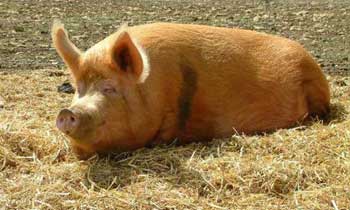
Research documents that pork from Duroc, Tamworth, Chester White and Berkshire breeds of swine tastes different, and has different eating qualities, compared to pork from the hothouse hybrids now widely used in confinement production. Likewise, pork produced out of doors has a different texture and finish, and projects something quite akin to the terroir now associated with certain American wines, i.e. special qualities of a food that derive from a specific location’s set of environmental characteristics, including soil qualities, solar incidence, day length, wind, rainfall and other traits of the place.
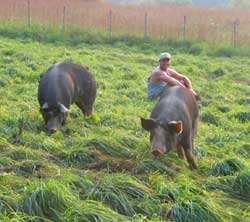
Outdoor pork also appeals to the informed consumer’s sense of humaneness, as well as social and ecological concerns. The pork from Grandpa’s hogs was the good stuff, and is what is wanted again by the majority of meat consumers who think about what they eat.
To this end, small producers are collectively and individually producing and marketing pork based on the taste it derives from its genetic background and the manner in which it is produced. Production-based marketing labels include additive- or antibiotic-free, crate-free, open-range, organic, high-percentage Tamworth and 100-percent Berkshire.
Berkshire pork—with its distinctive color and marbling (yes, marbling) quality—has great value in the Pacific Rim. One Midwestern group is doing extensive testing of the meat and animals it sells to this market to assure these customers are getting exactly what they are paying a premium to receive. Recently, a group of Missouri chefs were supplied with pork from a hog of one of the truly minor Red Wattle breed. They found it to impart a most unique set of qualities to their pork recipes.
This kind of full-flavored pork cannot be had in even the toniest commercially supplied stores. Traffic is limited to farmer-direct sales to adventurous consumers or specialty chefs or shop owners. By having their animals processed at small, local USDA-approved processing plants, farmers can afford to legally supply a range of finished pork cuts and products to eager families and chefs.
Whole-hog sausage works
A popular farmer-marketed product in my area of Missouri is whole-hog pork sausage, made from the entire carcass, less the ribs. Of modest cost, it’s conducive to uniform pricing and is a well-accepted, traditional pork product that can be used for every meal. It’s lean and desirable, as it contains hams, loins and shoulders. A local abattoir seasons it in several styles, processes it bulk (1- and 2-pound packs) or as links (like bratwurst), and flash freezes it for easy transport and sale to farmers’ markets, on-farm markets or stores.
Regulations pertaining to slaughterhouses, packaging and outdoor sale vary from state to state, but your county or regional Extension agents can help you locate the requirements and find state- and federally-approved processors.
It takes some time to develop these markets where people are buying a new product with new values. My first day at our local farmers’ market with a cooler full of such sausage made from a Mulefoot (heirloom, endangered) breed barrow resulted in sales of only a few pounds, mostly in 1-pound sticks. The good part was that I had the opportunity to talk about the great old breed and modern small farming. Consumers made a tentative trial investment, but larger sales soon followed.
Direct-marketing options for pork and live hogs include show pigs for 4-H and other youth livestock projects, heirloom breeding stock, cured-meat products, whole- and half-carcass sales and feeder stock. By keeping purebred herds, small-scale producers are better able to access all these markets and retain full control of that most important of all inputs—the seedstock, which embodies the genetic code on which everything rests.
Surge of the show hog
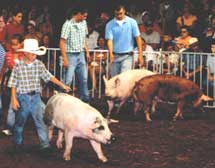
The show pig has become the big-ticket item in national sales for the traditional seedstock sector. It’s become one of the most popular of all youth livestock projects. These animals are purchased to be fitted for and exhibited at state, county and national events all across the United States.
Barrows and gilts are bought at about 40 to 50 pounds and 8- to 10 weeks of age for a particular show. At that event they enter the show ring as an animal ready for market as a finished meat animal. Many are indeed terminal shows, with the animals sold at the end of the event or transported to compete in an on-the-rail carcass competition.
There are swine shows throughout the year, but in the Midwest the primary market is for early spring-farrowed pigs to be exhibited at the summer and early fall fairs and shows. These are primarily pigs farrowed in January, February and March, the season when much of the breeding stock of years ago was farrowed.
You hear many stories of youngsters (really, their parents) paying $500 to $800 for 40-to 50-pound pigs, or paying several hundred dollars for the semen of a boar with a real show record, but the norm is generally $1.50 to $3 per pound for a pig with good show potential. Why so high? It’s because there are simply so few classic feeder pigs readily available in most areas. Even where larger operations abound, their production—all of it—is contractually bound.
It’s also because the competitive show pig is a finely bred young animal. Many are F1 crosses to gain the growth advantage of hybrid vigor, a fair number are purebred, and some will have a dash (or much more) of Pietrain breeding, an exotic spotted breed known for its heavy muscling.
Until quite recently, show pigs were being bred for extreme leanness and expression of muscling. It has been recognized and conceded that this trend is an extreme departure from real-world type characteristics. These extremes may lead to all sorts of problems from reproductive ills to basic soundness and animal durability. Fortunately, the trend now seems to be back to an animal of more middle-of-the-road type with greater internal dimension (a wider frame) and a bit of added cover (backfat).
Perpetuating genetic treasures
A small-but-growing number of swine raisers are actively involved in hog-breed preservation work, also. Some breeds actually went extinct in the 20th century, and a number more slipped to dangerously small populations. Among the rarest surviving are the Gloucester Old Spot, Wessex and Large English Black. (For details on these and other endangered breeds, check the website of the American Livestock Breed Conservancy.)
In a second tier of minor breeds, with perhaps better prospects for thriving, are the Tamworth and the Hereford. Minor breeds with old type—but being managed for improvement—include the Mulefoot and Red Wattle. What may surprise a great many, however, is just how badly numbers have slipped for such widely known breeds as the Spotted, Black Poland and Chester White.
A real success story is the Berkshire. Just a few years ago, national sow herd numbers had slipped to a few hundred pedigree-recorded individuals, and there was talk of the need for establishing a preservation herd. As word spread anew of the distinctive pork the breed produces—called “black pork” in Asian circles—new interest arose. Berkshire classes are now some of the most competitive at some state fairs. Actually, many of the minor breeds are presenting in greater numbers and stronger show classes than have been seen at Midwestern state fairs in decades.
The small swine herds I knew as a boy in the ‘50s are coming back. Some of them are the exact same herds. On these farms, the hog enterprise fits in and around a number of other ventures to diversify production efficiencies, broaden earning power, provide value-added potential and improve risk management. These producers are putting a very personal stamp on their product, one that has far greater meaning than simply “the other white meat.” (Actually, wasn’t that turkey?)
They are cultivating high-quality seedstock that yields premium pork, using high-touch marketing in direct sale to consumers, to achieve the highest possible returns for a uniquely excellent product. They are ironing out the ups and downs once associated with selling commercial hogs by developing loyal customers in niches of their own making. They output only as many hogs as their markets will profitably support and are careful to use practices distinct from the negative images of confinement-produced pork.
These are farmers now netting $100 or more per market hog. They know what their markets will bear and push no harder. They are taking a lesson from the wisdom of their critters. The undoing of pork production has not been the greedy nature of the pig, but rather the greedy nature of the producer.
By living within their limits, everybody will get along. 
|