|
Posted April 20, 2004: It was a pilgrimage of sorts, a quest for truth and knowledge—what the dictionary calls “facts or ideas acquired by study, investigation, observation, or experience”—rather than a scholarly recitation of mere book learning.
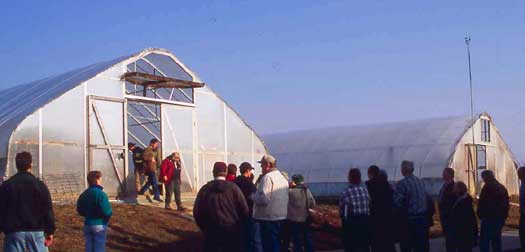
Some 35 eager students, each paying up to $175, traveled in March to rural Pennsylvania—from as far away as California, Colorado and Quebec—to learn the finer points of passive solar greenhouse design, construction and operation from Steve Moore. They affectionately refer to the 53-year-old Moore as the “Gandhi of Greenhouses” because he has successfully demystified the often bewildering high-tech world of greenhouses, reducing growing under cover to its biological basics while completely eliminating both chemical inputs and fossil fuels.
Moore’s two-day workshop did not disappoint them.
Question: “Can I make a living at this? How much money can I make?”
Answer: “It is more than possible to earn a livelihood,” says Moore, who has been farming on his own for 30 years, the last 15 with unheated, passive solar greenhouses.
“It’s amazing what you can accomplish. It is a good income,” says Moore, citing the $50,000 a year being grossed by Pete Johnson, a young farmer in northern Vermont. (That was a few years ago. Johnson continues to do better each year. After farming part of his parents’ place, he is now buying a farm of his own and putting several acres under cover. Look for details on Johnson’s farm on NewFarm.org later this year.) ”But if you’re interested in making a lot of money—quick,” Moore cautions, “go into insurance or something.”
Question: “How many customers does it take to be economically viable?”
Answer: “Start with five, 10 or 15 customers,” Moore advises those interested in selling shares of their harvest through a Community Supported Agriculture program. “Go slow.”
First, he advises, collect all of the tools you will need, perfect your growing systems and structures, build your soil, and hone your marketing skills.
“Plan ahead. Set goals. Try to be practical and realistic. Grow what you grow best for your markets. Marketing is everything. When you hit 50 customers, quit your job. And set 100 customers as your goal for next year. One greenhouse, well managed, can feed 100 shares from early March through Christmas.”
Question: “Why do you only grow head lettuce and not salad mix?
Answer: “Because it’s good money with less labor,” Moore replies.
“They’re begging for organic lettuces locally.”
And so it goes, hour after hour--including during breaks and over lunch—for two full days as Moore tries to quench his students’ thirst for knowledge.
Moore’s next greenhouse workshop is scheduled for September 24-25 and it’s almost full. Early registration is $175 per person, single, or $160 per person for two or more people from the same family or farm. Free on-site dormitory space is limited. Another round of workshops will be held next winter. Moore is also working on a website and a manual on how to design, build and operate a passive-solar greenhouse year-round. (Keep checking NewFarm.org for details.)
And so it goes, hour after hour--including during breaks and over lunch—for two full days as Moore tries to quench his students’ thirst for knowledge.

Question: “What crops don’t pay in a greenhouse?”
Answer: “Cabbage, broccoli, Brussels sprouts and potatoes.”
Question: “What about movable greenhouses?”
Answer: “Mobile greenhouses never really worked for us.”
What has worked better than anything for Moore is a serious commitment to soil improvement. He tells the story of how the contractor who built the 30- by 96-foot gothic arch greenhouse for Moore at Wilson College a few years ago thought he was doing the farmer a big favor. After perfectly leveling the greenhouse site, the contractor brought in a rolling vibrator, a mechanical compactor, and tamped the disturbed soil solid.
“It was a road, as flat and almost as hard as asphalt,” Moore recalls. “But it was perfect, as far as the contractor figured. He didn’t know I was planning to grow in the ground and not on benches.”
The soil was so hard it took Moore three whacks with a pick just to break loose a clod of clay. Starting that November, Moore added compost, tilled the clods and kept adding more compost. He laid out permanent beds and pathways and began planting. By March, he was harvesting his first vegetables. After four years, organic matter in his soil measured 14.69 percent.
At his new location near York, PA, Moore used a tractor-drawn chisel plow to eliminate compaction from construction. He double digs greenhouse beds, using a 30-inch wide U-bar or “broadfork” with nine 20-inch tines, until reaching optimal soil structure to a depth of two feet. “The U-bar cuts the time in half,” Moore says. “It takes me 30 minutes to do a 5- by 20-foot bed.” To keep from compacting the beds with his feet he stands on a 2- by 5-foot digging board. His soil is now so friable that Moore works it up before each planting with only a scuffle hoe, a thatch rake…or his bare hands. (He never uses a tiller inside his greenhouses.)
“There is no substitute for your own compost,” Moore says. “If you can’t make your own, mushroom compost is a pretty good way to jump start your farm.” Contrary to popular opinion, Moore believes you can have too much compost. That’s especially true if it contains animal manure, which can cause salt buildup in the soil. Moore has eliminated animal manure from compost used in the greenhouses (though he still uses some manure in the fields. He checks his soil regularly with an EC (electrical conductivity) meter to guard against salt buildup.
Question: “How do you cover a greenhouse with plastic?”
Answer: “Work quickly. And use your friends, at least a couple of them. Six people are even better,” Moore advises. You want one person on each corner, while two others unroll the plastic along the top, center ridge of the greenhouse frame.
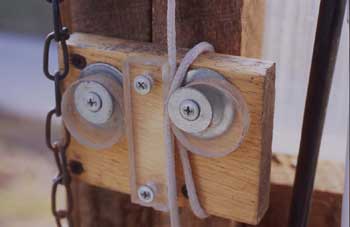
Before getting out the plastic, he advises, make sure all of your fasteners are in place so that the plastic can be secured as it is spread. A variety of fasteners—everything from used drip tape and staples to fancy, interlocking metal extrusions—can be used. Moore favors “wiggle wire” (brand names Wire-Lock and ZigZag wire). It is soft, pre-bent spring wire that locks up to three layers of plastic into aluminum channels bolted to wooden framing or metal greenhouse bows. (Moore buys his wiggle wire and many other items from Nolt’s Produce Supplies, 152 N. Hershey Ave., Leola, PA 17540; 717-656-9764.)
|
|
 |
Peak height of a 30- by 96-foot gothic-arch greenhouse is about 12 feet, so you’ll need at least one stepladder that tall, Moore says, offering that two ladders is preferable, since a 50- by 100-foot roll of 6-mil greenhouse plastic weighs about 150 pounds. (Using a pair of ladders, two people can easily carry the roll to the peak.) For easier handling, Moore suggests inserting a pipe through the middle of the heavy cardboard tube holding the plastic.
Next, Moore says, place the middle of the roll on the ridge pole, the purlin or brace that runs down the peak. Be sure, he adds, to leave a 2-foot overhang on the outside edge; that will give your plastic-handlers something easy to hang onto and plenty of plastic for battening down the edges.
When Moore’s son, Ben, is helping him, they simply walk down the lower purlins, unrolling and unfolding the plastic as they go. The plastic is specially folded or “gusseted” in a C-fold to cascade down each side from the middle. Father and son work two to three bows ahead of the plastic-handlers on the ground, who stretch and smooth the plastic as it unfurls.
“If your roll is dead center, no adjustment is needed,” Moore says. Once the sheet of plastic is unrolled and spread, it is “tacked” at the corners and in the middle with short sections of wiggle wire.
|
Steve Moore’s
Greenhouse Favorites
Cilantro—“It’s more popular than ever. I raise it year round, and a lot of it. It provides three to four cuttings.”
Pak choi— “It’s the hero of our winter greenhouse.”
Eggplant—Neon, Black bell, Imperial, Orient Express.
Turnip—Hakurei. “This is the only one to grow. It’s in a class by itself.”
Carrots—Minicor, Mokum
Perpetual spinach—From Fedco, a chard that’s a sleeper.
Cucumber—Diva, Telegraph
Cherry tomato—Sun Gold. Two rows per bed on north side, caged and covered on cool nights. Sun Gold doesn’t crack as much in greenhouse. Plants March-April, harvests through Thanksgiving.
Heirloom tomato—Arkansas traveler
Colored peppers—Smorgasbord, Gourmet (orange) Labrador (yellow). “The earliest we ever lost our peppers was Thanksgiving. The latest was the first full week of January.”
Celery—Venture. Premium price for Thanksgiving.
|
|
“If you’re putting on a double layer, you do it the same way, only it gives you more of a thrill, because you have a layer of plastic under your feet as you walk down the purlins,” says Moore. “In two or three hours, you’re through and your friends can go home. How long it takes depends on who I have for help.”
That technique definitely is not for the faint of heart or anyone with a fear of heights. So, if walking 96 feet—about nine feet above the ground—on a thin, plastic-covered pipe is not your idea of a good time, relax. There is another way, one that is definitely safer and, some might say, a little saner.
Count Moore’s wife, Carol, among those who refuses to venture onto the tall monkey bars of the greenhouse frame. When Carol helps her husband cover a frame, they do it by tying a long rope to each end of the pipe through the roll of plastic. Then, from the safety of the ground, they pull the roll the length of the frame, unrolling the plastic as they go.
“It’s best to install plastic in summer,” adds Moore. “First, warm your plastic in the sun. After the frame is covered and the plastic begins to cool, it contracts and gets tighter.”
Moore irrigates everything in his greenhouses with drip tape, using four or five tapes per bed. “That means a lot of fittings, but it delivers a lot of water. Adding a cheap ($10) mechanical timer makes it reasonably automated, which leaves time for a full-time job,” he adds for a laugh.
“There is no substitute for looking at the ground,” Moore says. But he doesn’t just look at the soil surface. A couple of times each week, Moore uses a metal soil probe to pull soil cores from as deep as 24 inches below the surface. “It looks wet on the surface, but when I probe down below it is sometimes dry as can be.”
It’s all part of Moore’s commitment to producing food for maximum flavor, freshness and nutrition. He farms a total of 30 acres owned by Sonnewald Natural Foods, which is something of an intentional community dedicated to personal and planetary health. Sonnewald, which has been organic since 1946, bills itself as perhaps the oldest existing organic farm and natural food store in Pennsylvania. Its motto is: “Good health comes from the farm ... not the pharmacy.” Moore’s greenhouses are only about 100 yards from the store, a far cry from the 1,500 miles that most Americans’ food travels from farm to table.
“We, as farmers, are the primary health care practitioners to the nation,” Moore opines. “The store is a Mecca for health information. It lets us reach more people quicker than we could do on our own farm.” 
|