|
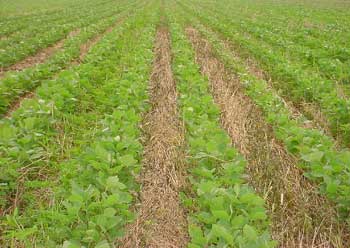
November 20, 2003: "'I thought you guys were organic!'" So said one of The Rodale Institute's (TRI) conventionally farming neighbors earlier this year, after seeing TRI's freshly planted soybean field. Rodale Farm Manager Jeff Moyer had knocked down the cover crop of rye and planted the beans directly into the residue. "It looked so good and the kill was so complete, he thought it must have been sprayed," recalls Moyer.
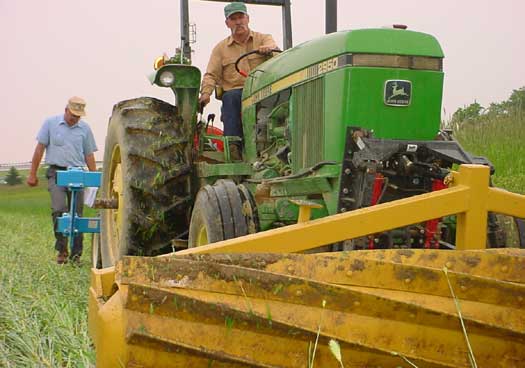
Rest assured, however--there were no chemicals involved. Instead, Moyer used a new, front-mounted cover-crop roller designed and built at The Rodale Institute® as part of a continuing effort to develop practical methods for reduced tillage organic production. The Rodale Institute Farm team has experimented with no-till corn into mixed legume covers as well as no-till soybeans into small grain covers, and is greatly excited about the results. "We're moving toward a situation in which we do our primary tillage to get our cover crop established, so that [the cover crop] almost becomes your primary crop, even though it's not for sale," Moyer explains. "It changes the way you think about the whole system."
Moyer has been using cover crops to supply nutrients, build organic matter, and prevent soil erosion in TRI fields for more than three decades, so for him the challenge of organic no-till has lain not so much in managing the cover as in finding the right equipment to knock it down and plant. In past years, Moyer and his crew went after the job with a modified, ground-driven Buffalo stalk-chopper and a 4-row, shoe-style Buffalo no-till planter. Although that combination worked reasonably well, it still left room for improvement. For 2003, TRI farmers paired their innovative, home-made roller with a Monosem double-disc no-till planter and achieved much better results.
"Last year, no-till for us meant the difference between eight field operations for corn--plow, disk, pack, plant, rotary hoe, rotary hoe, cultivate, cultivate--and two--roll and plant," says Moyer. "This year, we cut that to one," rolling and planting simultaneously. "That really starts to get the attention of the conventional farmers, because it addresses one of their major objections to organic, that it requires more field passes. You can't get it much lower than one pass."
TRI's cover-crop roller was constructed in collaboration with another neighbor, John Brubaker. Brubaker's land lies adjacent to The Rodale Institute property, and the two farms frequently exchange labor, tools, and ideas; he has also worked with TRI on equipment-development projects in the past. To support his work on the roller he received a 2002 farmer's grant from the USDA's Sustainable Agriculture Research and Education (SARE) program. Brubaker is a skilled welder and practical engineer--"I've been a shop-monger all my life, that's what I've always loved to do," he confesses--but he also brought a specific area of expertise to this project. As a member of the Groffdale Mennonite Church (aka the 'Horse and Buggy' Mennonites), which prohibits the use of rubber-tired tractors and motorized road vehicles, he has always worked with steel-wheeled tractors. And the cover-crop roller acts a lot like a big steel wheel.
Building the right tool for the job
 |
|
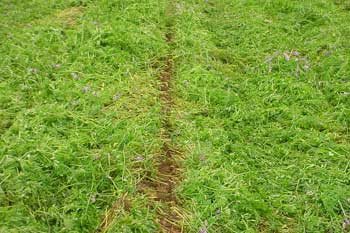
Once you've seen how one pass with a roller can turn a lush stand of rye and hairy vetch into a 5-inch thick, weed-suppressing mulch, you'll wonder why anyone thought of introducing herbicides into the concept of no-till. (A recent study conducted by Sean Clark at Berea College, Kentucky, and reported elsewhere in these pages www.ca.uky.edu/agc
/pubs/pr/pr470/PR470C.
HTM #vegetables, found similar results between knockdown alone and knockdown with glyphosate, or Roundup, when planting corn into a rye cover.) The goal is not to cut the stems but just to crimp them and lay them flat, and the key is to wait until the cover crop reaches full flowering. If you do it before, the plant is still in a vegetative growth stage and will bounce back green and vigorous, but if you get it after that point, it will dry and die. "At least a 20% bloom is suggested," explains Matt Ryan, a TRI research technician who has worked on the no-till effort, "but we've found it's better to wait for 50 to 75% bloom." As long as any early-developing seeds are still green, they won't be viable to create a problem in the next crop.
Modified stalk-choppers like the one Moyer was using before have gained some popularity as cover-crop rollers, but they do have a couple of significant shortcomings. First, any rear-mounted roller is liable to perform unevenly because the plant material won't receive the full impact of the roller where it falls into the depressions created by the tractor tires. Second, steering the planter accurately across the knocked-down residue can be a challenge because the planter's row-markers can't make a good line in the thick residue. To get around that problem, the team even tried planting first and then rolling, but before long they realized that a front-mounted roller would resolve both issues--and have the additional advantage of saving another trip across the field.
To design the new roller, Brubaker explains, they began "by looking at what worked and what didn't work with the stalk chopper." The stalk chopper's eight rolling drums arranged in two parallel rows, for instance, meant sixteen sets of bearings to maintain and as many snag spots for the cover-crop material to get bound up on. The new implement's single cylinder has just two bearings, and these are inset three inches on either side and fronted with a smooth shield to reduce catching. The stalk chopper has blades running parallel along the drums, but Brubaker's familiarity with steel wheels led him to suggest curving the roller's blades around the cylinder in a chevron pattern, which prevents bouncing and helps guide the tractor in a straight line (whereas curving the blades in a screw pattern would tend to auger the tractor to one side). Brubaker also knew that the blades should be angled back from the direction of motion, because if they were mounted at a 90º angle to the drum they would kick up soil as they left the ground.
|
|
|
Other aspects of the design proceeded by the 'goldilocks' method. The team chose a pipe 16 inches in diameter for the drum, for instance, "because we thought anything bigger than that was just going to look ridiculous on the front of a tractor," as Moyer puts it, and anything smaller didn't seem like it would do the job. Similarly, they settled on 4-inch blades "because six inches looked too big and two inches looked too small." The roller's overall width--10 feet six inches--was determined by the width of planting four rows on 30-inch spacings, with a three-inch overlap on each end "just to be safe."
With these features in place, the team strove to make the roller as adjustable as possible. Since they were starting with a hollow pipe, they sealed it tight and inserted a removable plug so that the drum could be filled with water to vary its weight for different field conditions. All of the blunt, square-ended blades are bolted in place instead of being welded so that they can be removed or replaced as needed. And when choosing the degree of twisting of the blades around the drum, Moyer and Brubaker made it so that if every other blade were removed there would still be continuous ground contact from one blade to the next.
Field testing, and looking to the future
But the proof, of course, is in the field performance. Although the 2003 crop yield and weed biomass data have yet to be analyzed (at this writing the soybeans are still in the field), Matt Ryan reports that "everyone was really, really impressed with how well this [system] worked." Part of this year's improvement was due to the new Monosem planter, which makes a narrower planting strip in the cover-crop residue and thus minimizes the potential weed zone. But the roller was the star of the show. Moyer estimates that they got "at least a 90% knockdown" with the new setup; and the roller easily handled tough cover crop combinations, like hairy vetch and rye, which caused lots of problems with the stalk chopper. "The only change we might make is to add some tractor weights to the frame" of the roller, says Brubaker, since they found that in the toughest field conditions for knockdown--a very dense stand of cover, on a dry soil--the implement wasn't quite heavy enough even when filled with water.
Different types of cover crop also handle somewhat differently beneath the planter, and another refinement the team plans to make next year for vetch covers is to put small tires angled around the planting row after the seed drop, to nudge the plant material back over the exposed area. For the small grain covers, they used toothed cultivator-type wheels for this purpose, but the easily-snagged vetch needs something soft and blunt. Ryan also suggests that if possible, small grain covers should be planted perpendicular to the direction of the main crop, so that the 6-inch drill spacings will be less likely to get exposed in the knockdown process.
|
|
After planting, a few weeds did eventually get through the mulch, but for the most part these were delayed enough in their growth that they posed no competitive threat to the crop. "It's important to remember that beyond a certain point, weed control becomes strictly a beautification process," Moyer emphasizes. "Small weeds are not going to affect your crop yields." To handle the occasional aggressive interloper in the no-till field, Moyer and his crew did a quick and dirty trial of vinegar as an herbicide, tacking some shields onto a two-row sprayer and running through a few rows of the soybeans. "It would have worked better if we'd sprayed the vinegar earlier," says Moyer, "but you can see it did have an effect." (USDA researchers John Teasdale and others have published initial experimental results of using vinegar as an organic herbicide www.barc.usda.gov/anri/sasl/vinegar.html.)
For next year, The Rodale Institute researchers are planning a more rigorous experimental trial to test the performance of the no-till system versus plow-till. There's been some talk of submitting a patent application for the new roller design, but Brubaker waves off such commercialism and Moyer stresses that despite its initial success, the tool is still in the prototype stage. "There's a lot of tinkering that could be done," he notes. "Maybe the blades should be serrated, or sharpened, or every other one should be twice as high. Or we might be able to plant on 15-inch rows instead of 30, since a lot of the reason to have wider rows is so you can cultivate." Seeding rates on the cover crops could also be adjusted for different results. Interest in the implement is mounting, however. "Jeff told me he's already gotten a request for one," says Brubaker. "I don't have that much time with my own farming, but I haven't said no."
The organic no-till system has at least two potential groups of farmers it might interest: conventional farmers who are already doing no-till, and organic or sustainable farmers who are already working with cover crops. Ryan notes that for those already using covers, the barrier to trying no-till is finding the right equipment--and the new roller design could help with that. But for Moyer, the most exciting thing about developing this new method is that it "really opens the door to conventional farmers. When I talk to conventional farmers, they say, 'I'd be ready to think about organic if it could be no-till.' They all got rid of their moldboard plows years ago." He even points out that conventional farmers could incorporate cover crops into their no-till systems while continuing to spot spray with herbicides or plant Roundup Ready soybeans. After all, the new roller is just a tool; and for conventional farmers to convert to organic is a big step.
"Farmers are business men--they need to have a business plan in place to make a change like this, they need to talk to their banker, to their families, really think it over." For that group, Moyer recommends trying out the system on a small field at first--perhaps a rented field belonging to a landlord wanting to see a reduction in chemical use. "A lot of the farmers around here farm rented ground," Moyer notes, "and that land base is dwindling" as the owners give in and sell off to developers. "So the farmers are saying to themselves, I need to figure out how to make the same amount of money on half as much land. Going organic could help them do that." 
|